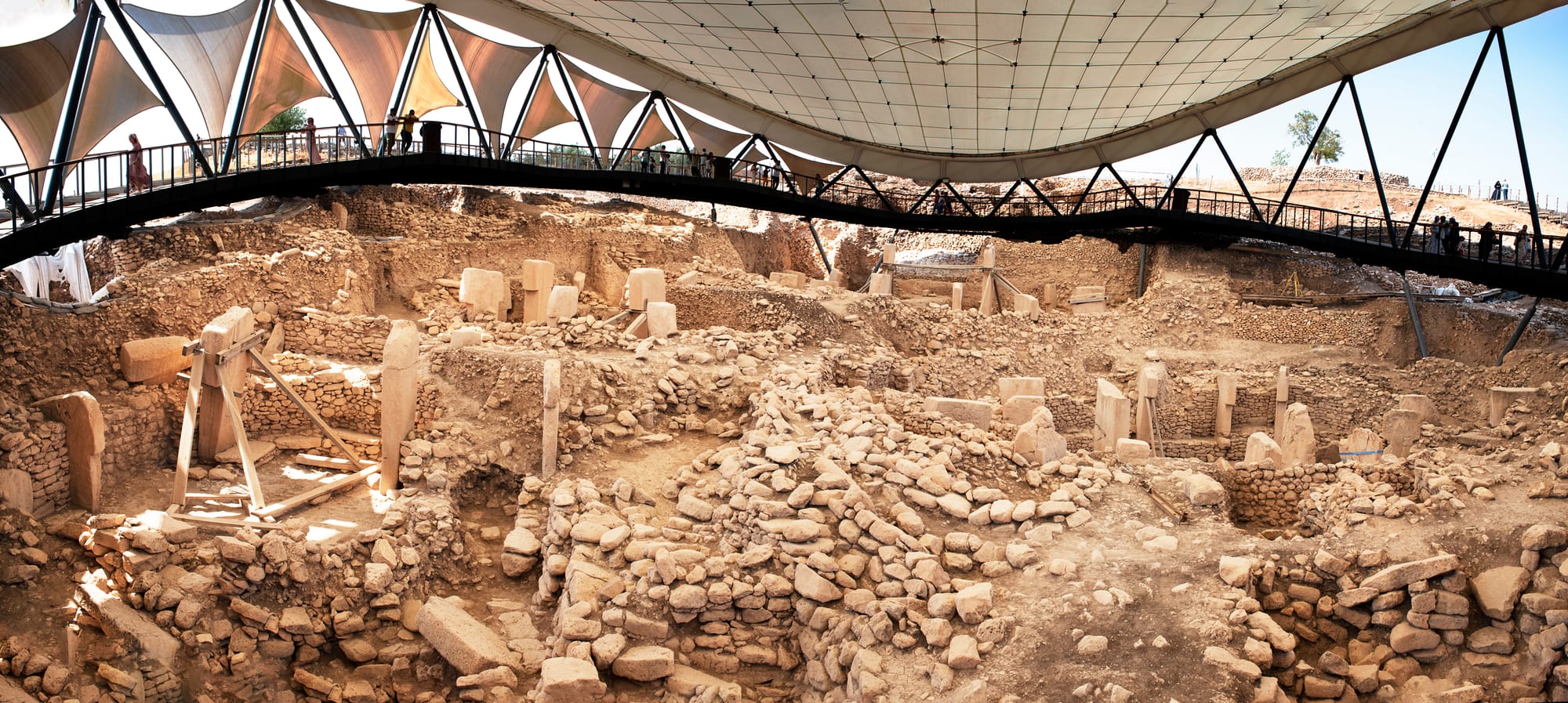
On a limestone ridge near Şanlıurfa, in south-eastern Turkey, sits a mound that
unsettled a long-held assumption about how civilisation began. Göbekli Tepe is a
complex of monumental stone enclosures built around 9500 BCE [1]. That places its
construction roughly 6,000 years before Stonehenge and about 7,000 years before
the Egyptian pyramids. The people who raised it were hunter-gatherers. They had
no pottery, no metal, no wheel and no farming. The standard account once held
that monuments came after agriculture and settled villages. Göbekli Tepe shows
large, organised building work happening first.
Sequence of events
The mound was first recorded in 1963, during a joint survey by Istanbul
University and the University of Chicago [2]. The surveyors noted broken stone on
the slopes but read some of it as later graves, and the site was set aside.
In October 1994, the German archaeologist Klaus Schmidt revisited the hill while
searching for sites resembling nearby Nevalı Çori [2]. He recognised that the
“tombstones” earlier teams had dismissed were in fact carved Neolithic pillars.
Systematic excavation began in 1995, as a joint project of the Şanlıurfa Museum
and the German Archaeological Institute (DAI) [2]. In 1996 the team began
clearing the first of the great enclosures after a landowner threatened to break
up the pillar heads.
Schmidt directed the dig until his death in 2014 [1]. Work has continued under the
DAI and Turkish colleagues, and since 2021 it has formed part of the wider Taş
Tepeler (“Stone Hills”) project, which is excavating related sites across the
region [3].
Documentary record
Four large circular enclosures, labelled A to D, have been excavated [1]. Each is a
ring of T-shaped limestone pillars, with two taller pillars standing at the
centre. The largest reach about 5.5 metres and weigh several tonnes [1]. They were
quarried, dressed and moved without metal tools or draught animals.
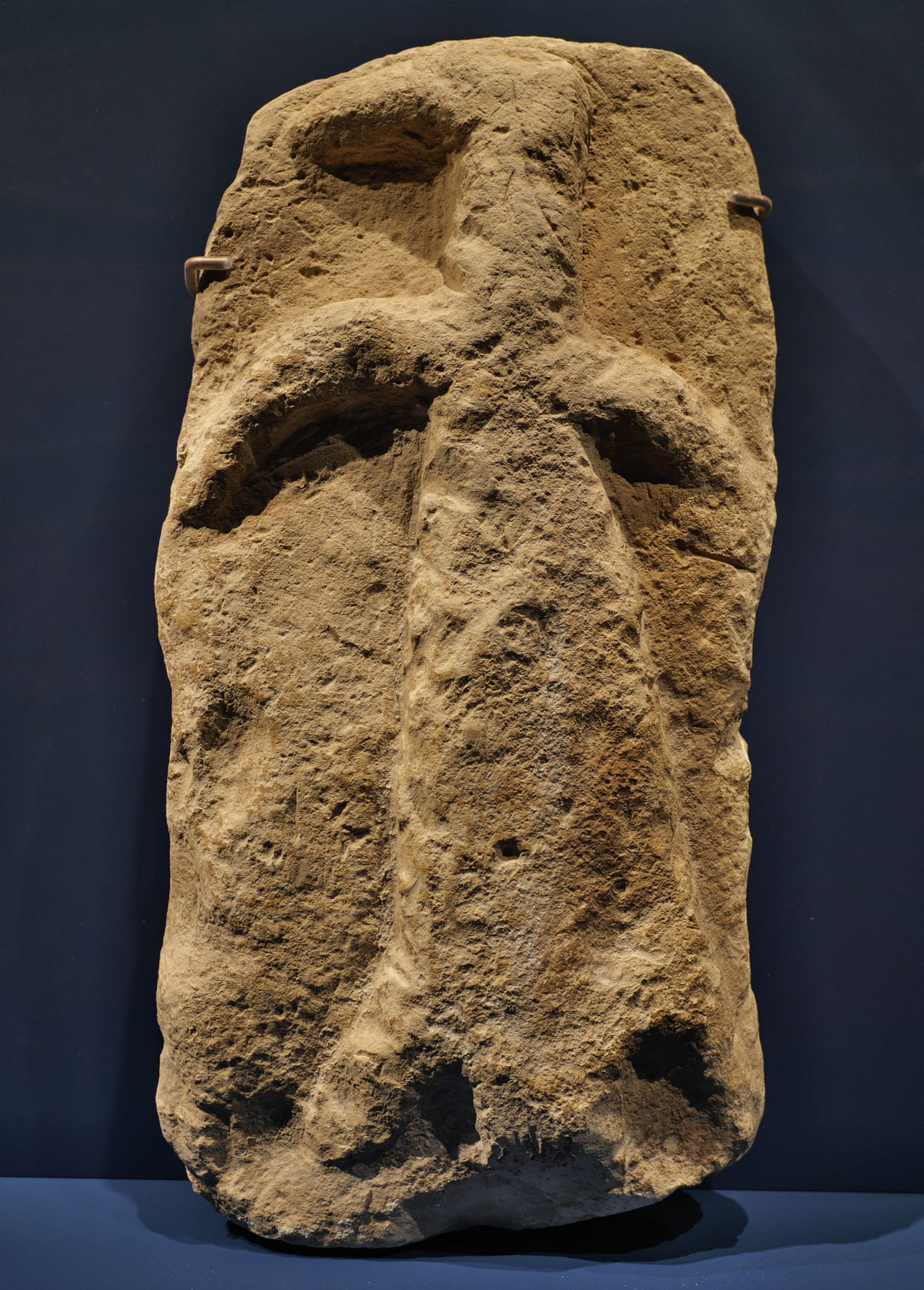
Many pillars carry carved reliefs of wild animals: snakes, boars, foxes, vultures
and gazelles [1]. Some show human arms, hands and belts, which suggests the
T-shape was meant as a stylised human or ancestor figure [1]. Radiocarbon dating
places construction in the Pre-Pottery Neolithic A, between roughly 9500 and 9000
BCE, with activity continuing for centuries afterwards [1].
Geophysical survey of the mound indicates at least twenty enclosures in total, so
the excavated portion is a small fraction of the whole [1]. The site was inscribed
on the UNESCO World Heritage List in 2018 as testimony to the shift from
hunter-gatherer life towards the first farming communities [4].
Open questions
What the enclosures were for is not settled. Schmidt read the site as a ritual
centre — a gathering place and, in his phrase, a kind of sanctuary that came
before the village [1]. Later work complicates that picture. Grinding
stones, evidence of cereal processing and water-collection channels point to
ordinary daily activity alongside any ceremonial use [5]. Several researchers now
argue ritual and domestic functions coexisted, rather than the site being a pure
“temple” [5].
The burial of the enclosures is also debated. Excavators first proposed the
structures were deliberately backfilled, which would explain their fine
preservation. That reading has lost ground; study of Enclosure D points
instead to damage by landslide and rubble, followed by repair [1]. How
hunter-gatherers organised the labour, and how many people gathered here, remain
open.
Status
This file sits in the UNCLASSIFIED tier because Göbekli Tepe is a mainstream,
peer-reviewed archaeological site, not a contested claim. It is a UNESCO World
Heritage property, excavated for three decades by the German Archaeological
Institute and Turkish institutions, and reported in journals such as PLOS ONE
[4][5]. The dating, the pillars and the carvings are documented and accepted. What
remains genuinely debated is interpretation — purpose, the meaning of the
burial, and the social world of the builders. Claims linking the site to lost
civilisations or extraterrestrial builders sit outside the evidence and are not
supported by any of the excavating teams.
References
[1] K. Schmidt, “Göbekli Tepe, Southeastern Turkey: A Preliminary Report on the
1995–1999 Excavations”, Paléorient 26.1 (2000), pp. 45–54; with the German
Archaeological Institute Göbekli Tepe Research Project excavation reports
(1995–2014).
[2] German Archaeological Institute, “Göbekli Tepe – The First 20 Years of
Research”, Tepe Telegrams blog, 2016.
[3] Taş Tepeler project / Karahan Tepe excavations, directed by Necmi Karul;
reporting via Arkeonews and Türkiye Today, 2023–2025.
[4] UNESCO World Heritage Centre, “Göbekli Tepe”, inscription 1572, 2018.
[5] L. Dietrich et al., “Cereal processing at Early Neolithic Göbekli Tepe,
southeastern Turkey”, PLOS ONE, 2019.