The phrase “Operation Mockingbird” travels widely. It names a belief that the Central Intelligence Agency once ran a single, organised scheme to control the American press. The documented history is narrower than the legend, and in some ways stranger. What the record shows is a long pattern of covert ties between the CIA and US journalists, confirmed under oath in the mid-1970s. What it does not show is a programme by that name.
Sequence of events
The story begins with the Cold War intelligence apparatus. In 1948 the CIA created the Office of Policy Coordination, its covert-action arm, led by Frank Wisner [1]. Through the 1950s and 1960s the Agency built working relationships with reporters and editors at major outlets, sometimes for intelligence, sometimes to place stories.
These arrangements stayed hidden until the wider intelligence scandals of the 1970s. In December 1974 the journalist Seymour Hersh exposed illegal CIA domestic activity. The Senate responded by forming the Select Committee to Study Governmental Operations, chaired by Senator Frank Church of Idaho. The Church Committee took testimony through 1975 and published its final report on the 29th of April 1976 [2].
On the 11th of February 1976, before the report appeared, CIA Director George H. W. Bush announced a new rule. The Agency would no longer hold “any paid or contractual relationship” with any full-time or part-time correspondent accredited to a US news organisation [3]. The timing tells its own story.
In October 1977 the reporter Carl Bernstein, of Watergate fame, published a long investigation in Rolling Stone. He went further than the Committee had [4].
Documentary record
The Church Committee’s final report stated that the CIA maintained covert relationships with about fifty US journalists, most of them freelance contributors or representatives abroad [2]. The report described a far larger overseas network of “several hundred foreign individuals” who supplied intelligence and at times placed covert propaganda, giving the Agency reach into newspapers, press services, radio, television and book publishers [2].
Bernstein’s Rolling Stone article reported that more than 400 American journalists had carried out tasks for the CIA over twenty-five years, according to documents he said were held at CIA headquarters [4]. He named senior news executives who, he wrote, had co-operated, including William Paley of CBS, Henry Luce of Time Inc. and Arthur Hays Sulzberger of the New York Times [4]. These are reported figures, drawn from his sources rather than from the public record, and the higher 400 count has never been independently confirmed against released files.
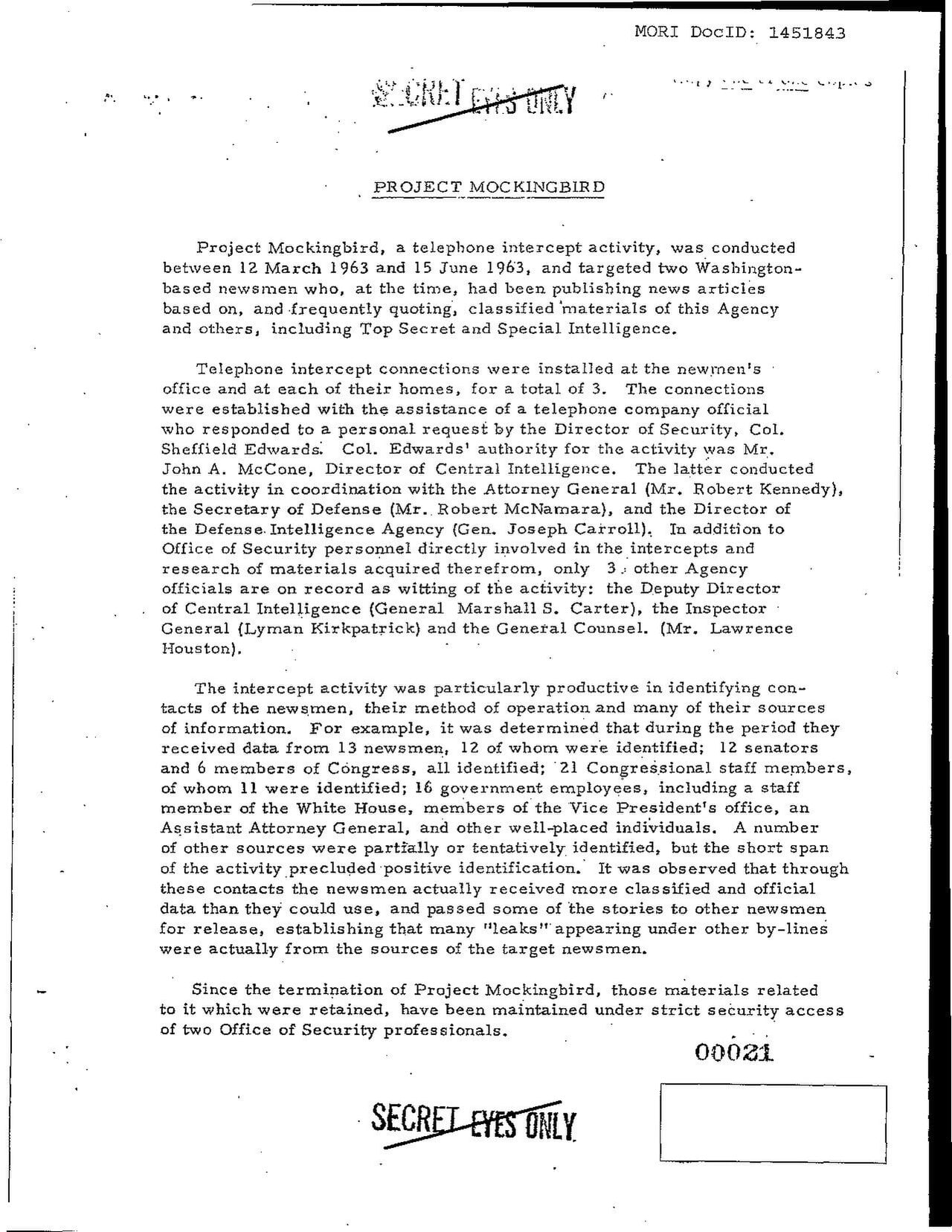
The codename is where care is needed. The term “Operation Mockingbird” does not appear in the Church Committee report. It was popularised by the author Deborah Davis in her 1979 biography of Katharine Graham, “Katharine the Great” [5]. Davis attributed the programme to Frank Wisner but gave no sources for the claim [5]. The CIA’s own 1973 “Family Jewels” memorandum, released in 2007, does mention a “Project Mockingbird” — but that was a 1963 wiretap of two Washington columnists, not a press-control scheme [6].
Open questions
How many journalists were involved, and at what depth? The Committee counted about fifty; Bernstein reported more than 400. The gap has never been closed from primary documents.
Did a single named programme exist? The historian David P. Hadley, after reviewing the files, concluded that the organised “Mockingbird” of legend “does not appear to be grounded in reality”, while affirming that genuine CIA press influence did occur [7]. The two findings sit together uncomfortably, and that tension remains unresolved.
What was destroyed? Many CIA records from this era were thinned or lost before disclosure, which limits any final count.
Status
This file sits at SECRET because its core is documented and its edges are not. The covert relationships are confirmed by the Church Committee under Senator Frank Church and by Director Bush’s 1976 corrective rule [2][3]. The scale claimed by Carl Bernstein is named and on the record, but rests on his sources rather than released files [4]. The popular codename, traced to Deborah Davis [5], is contested, and the genuine “Project Mockingbird” of 1963 is a different and smaller thing [6]. The programme is real. Its most famous name is not.
References
- Church Committee (1976). Final Report, Book I: Foreign and Military Intelligence. US Senate.
- Church Committee (1976). Final Report, published 29th April 1976, on CIA relationships with US journalists and foreign media assets. US Senate.
- Central Intelligence Agency (1976). Regulation on relations with US news media, announced by Director George H. W. Bush, 11th February 1976.
- Bernstein, Carl (1977). “The CIA and the Media.” Rolling Stone, 20th October 1977.
- Davis, Deborah (1979). Katharine the Great: Katharine Graham and the Washington Post.
- Central Intelligence Agency (1973). “Family Jewels” memorandum, declassified 2007 — reference to “Project Mockingbird” (1963 columnist wiretap).
- Hadley, David P. (2019). The Rising Clamor: The American Press, the Central Intelligence Agency, and the Cold War. University Press of Kentucky.