CONFIDENTIAL
HH-26003
Erdställe — Europe's Enigmatic Medieval Tunnels
- Incident
- 2026-01-29
- Location
- Reinstedt, Falkenstein/Harz, Saxony-Anhalt, Germany
- Coords
- 51.7203, 11.3517
Brief
Erdställe are narrow, hand-dug underground passages found across Central Europe and most commonly attributed to the medieval period; their original purpose remains genuinely unresolved by scholarship. The most recent primary-documented example was excavated in late 2025 at Reinstedt in Saxony-Anhalt, where a late-medieval Erdstall was found cut into a Neolithic burial enclosure. The state archaeology office announced the find on the twenty-ninth of January 2026 and set out three competing interpretations without choosing between them.
Filed 2026-07-13 · Last updated 13 July 2026
Briefing
Erdställe are narrow, hand-dug underground passage systems found across
Central Europe, concentrated in Bavaria, Austria and the neighbouring Czech and
Slovak lands, and most commonly attributed to the medieval period [1][6]. Unlike
most subjects in this archive, the open question here is not whether the
structures exist — hundreds are documented, mapped and preserved — but what they
were dug for. That question remains genuinely unresolved by scholarship, and the
most recent primary-documented example makes the point plainly: excavated in late
2025 at Reinstedt in Saxony-Anhalt, a late-medieval Erdstall was found cut
into a Neolithic burial enclosure, and the excavating authority published three
competing interpretations without selecting one [1].
Sequence of events
1878 onward — early documentation
- The Benedictine priest Lambert Karner is reported to have documented more
than four hundred tunnels in Lower Austria from 1878 [5]. This archive records
the figure as reported rather than independently verified.
1973 — the field organises
- The Arbeitskreis für Erdstallforschung e.V. is founded, largely on the
initiative of its long-time chairman Karl Schwarzfischer [3].
- From 1975 the association publishes the annual specialist journal Der
Erdstall, the discipline’s established primary-record repository [4].
- In 2018 the association receives the German Denkmalpflegepreis for decades
of documentation and preservation work [3].
Late 2025 — the Reinstedt excavation
- The Landesamt für Denkmalpflege und Archäologie Sachsen-Anhalt (LDA)
carries out a rescue excavation near Reinstedt, part of the Falkenstein
municipality in the Harz district, ahead of planned wind-turbine construction
[1].
- The excavation documents a late-medieval Erdstall dug into the trapezoidal
ditch of a Middle-Neolithic burial monument of the Baalberger Kultur, dated
to the fourth millennium BCE [1].
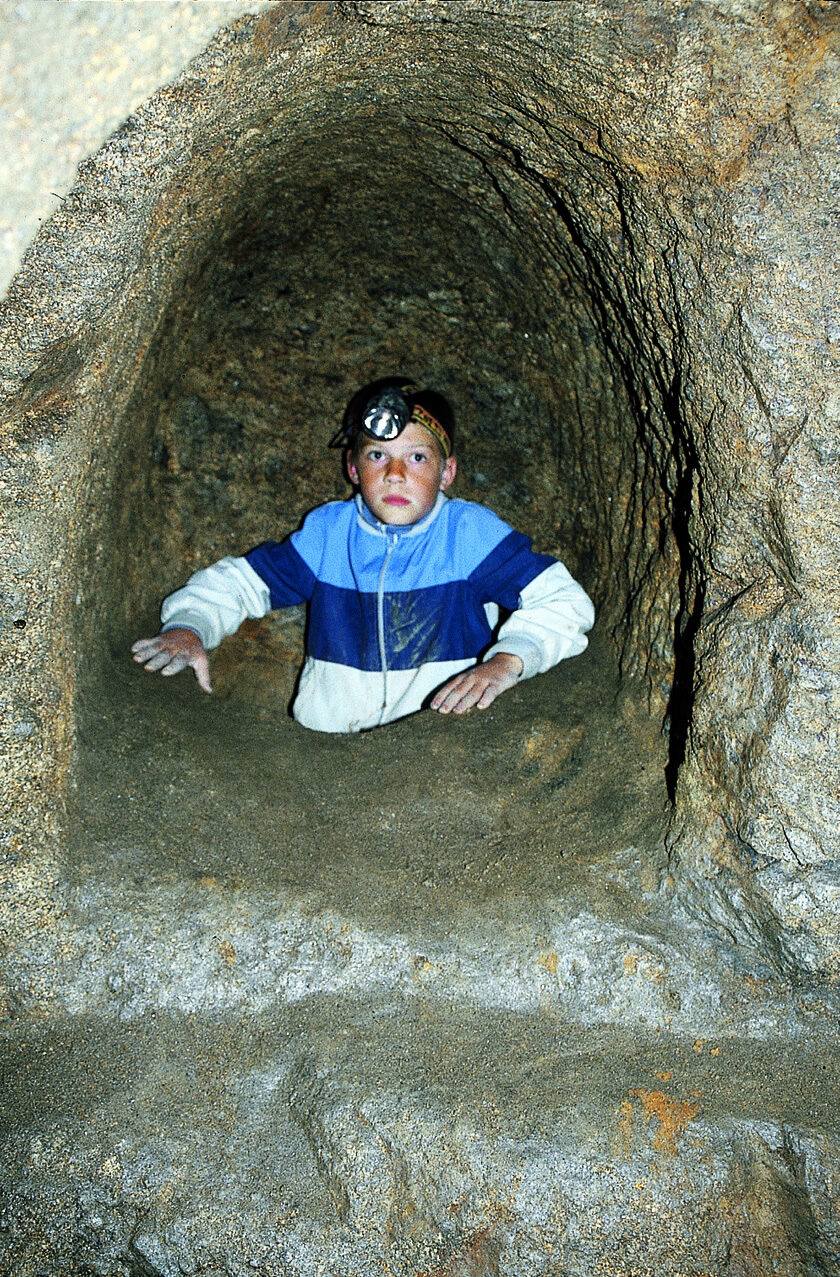
- The passage measures roughly 1 to 1.25 m high and 50 to 70 cm wide, with a
roughly oval entrance about 2 m long and up to 75 cm wide. Sections carry a
pointed, “gothic” roof profile; a niche is cut into the wall and a step carved
into the loess [1].
- Finds recovered from the passage fill: an iron horseshoe, a fox skeleton,
numerous small-mammal bones, a charcoal layer at the deepest point, and
late-medieval pottery sherds [1].
The twenty-ninth of January 2026 — announcement
- The LDA publishes its press information on the find, with Dr Tomoko Emmerling
and Dr Oliver Dietrich named as press contacts [1][2].
Documentary record
The LDA press information of the twenty-ninth of January 2026 is the primary
government record of the Reinstedt excavation, covering the dimensions, the
finds, and the office’s interpretations; a PDF version is published on the LDA
server [1][2]. Dating of the structure rests on the associated late-medieval
pottery and other material within the fill — the official release does not report
radiocarbon dating of this structure, and this archive does not represent one as
having been performed [1][6].
The LDA set out three non-exclusive interpretations: that the still-visible
Neolithic earthwork may have helped medieval diggers relocate the spot; that a
“pagan” grave site avoided by the local population would have made a good hiding
place; or that the space served a ritual function. The office did not adjudicate
between them [1]. That restraint is the defensible position, and this file
follows it.
Beyond Reinstedt, the discipline’s own record runs through the Arbeitskreis für
Erdstallforschung and its journal Der Erdstall, published annually since 1975
[3][4]. Current officers are listed as Otto Cichocki (first chair) and Ralf
Keller (second chair) [3].
Secondary reporting, which this archive holds to a lower bar, describes roughly
two thousand Erdställe known across Central Europe — about seven hundred in
Bavaria and five hundred in Austria — clustering in rural areas near historic
settlements, churches, cemeteries and gently wooded slopes [5]. The same
reporting describes narrow Schlupf slip-passages of roughly 30 to 40 cm wide
and 40 to 50 cm tall connecting levels, passages extending up to about fifty
metres, and a classification into types A to D by complexity [5]. None of these
figures is confirmed in the primary sources consulted.
Open questions
- Purpose is unresolved. The primary sources do not establish a single
agreed original purpose for Erdställe generally, and the LDA explicitly
presents multiple hypotheses without choosing [1].
- Reinstedt’s date rests on associated finds, not on an independent
radiocarbon result [1][6]. Reported radiocarbon work on tunnel wood elsewhere
— a range of approximately 950 to 1100 CE, attributed via secondary reporting
to a working group led by Dieter Ahlborn — could not be traced to an
underlying study and is recorded here as reported only [5].
- No authoritative total count exists in any primary source consulted;
figures circulate only in secondary reporting [5][6].
- The refuge hypothesis is contested. Josef Weichenberger is reported to
have proposed the tunnels served as refuges during raids, such as Hungarian
incursions, and to have tested habitability by remaining underground for
forty-eight hours [5]. The spelunker Edith Bednarik is reported to challenge
this, arguing that inadequate ventilation and a single exit would make the
tunnels a death-trap in fire or flood [5]. Why the passages are typically
found swept clean of occupation debris is not resolved by the documents [5].
- Dr Heinrich Kusch is reported to argue for a much earlier, Neolithic
origin and a “massive underground network” — a position outside the medieval
mainstream [5]. The popular claim of a single continuous Stone Age tunnel
running from Scotland to Turkey has no traceable primary source and appears to
be a distortion of a separate-sites argument; this archive treats it as
unsupported.
- Widely repeated “soul-passage” and purgatory readings appear in popular media
as interpretations, but could not be traced to a specific dated primary study.
They are not admitted here as evidence.
Status
This file is CONFIDENTIAL — admitted on the strength of a contemporaneous
state-archaeology record, the LDA’s Reinstedt press information and its published
PDF, supported by the standing documentary work of the Arbeitskreis für
Erdstallforschung and its journal [1][2][3][4]. The structures themselves are not
in doubt; the mystery is functional, not evidentiary, which places this file
closer to the archive’s record of megalithic sites
than to its reported-encounter material. Where the record thins — counts,
typologies, radiocarbon ranges, purpose theories — this file marks the claims as
reported and leaves them there, as the excavating authority itself did. Readers
tracing how societies are read backwards from their earthworks may find the
archive’s file on forgotten empires a useful
companion. Updates pending any peer-reviewed publication of the Reinstedt
excavation or an independent radiocarbon result.
References
- Landesamt für Denkmalpflege und Archäologie Sachsen-Anhalt (2026). “Spätmittelalterliches Versteck im jungsteinzeitlichen Grabengeviert: Erdstall bei Reinstedt entdeckt”, press information, 29th January 2026. Government record of the excavation, dimensions, finds and interpretations.
- Landesamt für Denkmalpflege und Archäologie Sachsen-Anhalt (2026). Presseinformation: Erdstall bei Reinstedt (PDF).
- Arbeitskreis für Erdstallforschung e.V. Der Arbeitskreis — association pages documenting its founding in 1973, leadership, purpose, and the 2018 Denkmalpflegepreis.
- Arbeitskreis für Erdstallforschung e.V. Die Zeitschrift DER ERDSTALL — the field’s specialist journal, published annually since 1975.
- ExplorersWeb. “Erdstall Tunnels: Rural Europe’s Unexplained Giant Wormholes”. Secondary reporting; source of the counts, typologies, and the Weichenberger, Bednarik, Kusch, Karner and Ahlborn claims recorded above as reported.
- Spektrum der Wissenschaft. “Sachsen-Anhalt: Mysteriöser Erdstall aus dem Mittelalter entdeckt”. Secondary reporting on the Reinstedt find and the broad twelfth-to-fifteenth-century dating.