CONFIDENTIAL
CR-26007
Mokele-mbembe
- Incident
- 1913-01-01
- Location
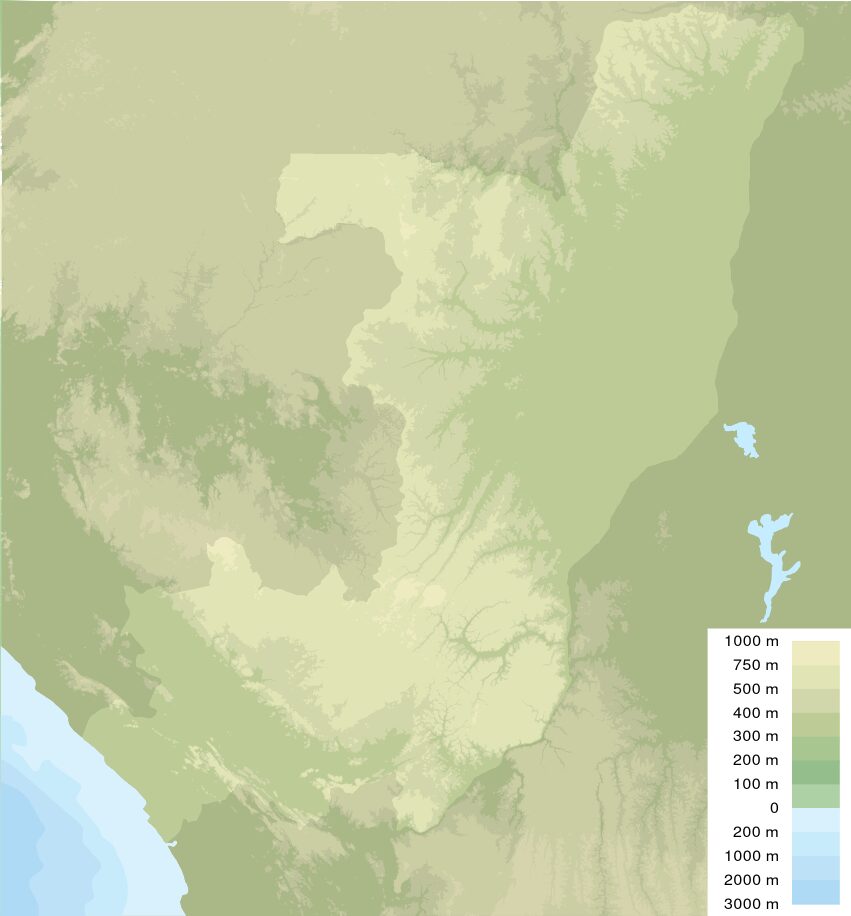
- Likouala region and Lake Télé, Republic of the Congo
- Coords
- 1.35, 17.15
Brief
Mokele-mbembe is a large, long-necked, reptilian animal reported from the swamps and rivers of the northern Republic of the Congo, which some cryptozoologists have interpreted as a surviving sauropod dinosaur. The written record runs from an 18th-century missionary account in 1776 through a much-quoted 1913 German colonial expedition report to a wave of dedicated expeditions in the 1980s. No physical specimen, verified photograph, or government or scientific confirmation has ever been produced.
Filed 2026-07-18 · Last updated 18 July 2026
Briefing
Mokele-mbembe is a large, long-necked, reptilian animal reported from the
swamps and rivers of the northern Republic of the Congo — notably the Likouala
region and Lake Télé — which some cryptozoologists have interpreted as a
surviving sauropod dinosaur [4]. Unlike most military-linked files in this
archive, the record here rests on travel literature, one unpublished colonial
report, oral testimony from local communities, and cryptozoology-society
publications. There are no FOIA, military, or intelligence records on the
subject, and no physical specimen has ever been produced. This file sits
alongside the Loch Ness Monster case in the
archive’s record of long-necked-water-animal reports, though the two share no
evidential connection.
Sequence of events
1776 — the earliest written reference
- The earliest commonly-cited Western written reference appears in Abbé Lievain
Bonaventure Proyart’s Histoire de Loango, Kakongo, et autres royaumes
d’Afrique, which relays missionaries’ reports of finding the clawed
footprints of an unseen animal “of monstrous size,” the prints said to be
spaced several feet apart [3][4].
1909 — Hagenbeck’s memoir
- The animal-dealer and zoo pioneer Carl Hagenbeck’s memoir Beasts and Men
is published and survives in full [1]. It is widely quoted as describing
second-hand reports of a “half elephant, half dragon” animal in African
swamps that Hagenbeck speculated might be a surviving sauropod; this passage
could not be verified verbatim from the scanned text [1][4].
1913 — the von Stein expedition
- German Captain Ludwig Freiherr von Stein zu Lausnitz leads an official
survey expedition in what was then the German colony of Kamerun [4].
- The expedition is cut short by the outbreak of the First World War in 1914
and his zoological report is never formally published [4].
- The surviving, much-repeated excerpt describes the animal as “of a
brownish-gray color with a smooth skin, its size approximately that of an
elephant; at least that of a hippopotamus,” with a long muscular neck — a
quotation preserved only through later authors, not from an accessible
original [4][2].
1919–1920 — the Smithsonian account
- A 32-man Smithsonian Institution expedition to Africa is frequently linked to
the legend; secondary accounts say guides found large unexplained tracks and
heard unidentified roars, but the expedition was curtailed after a train
wreck killed several members, and nothing was confirmed. No primary
Smithsonian document verifying this was located [4].
1980–1983 — the modern expeditions
- Microbiologist Roy P. Mackal and engineer/explorer James Powell mount
two expeditions to the Likouala region in 1980 and 1981, the second partly
funded by the National Geographic Society [2][4].
- On a 1981 Lake Télé expedition, the explorer Herman Regusters and his
wife Kia state that they saw the animal and obtained photographs and
sound recordings; the imagery is judged inconclusive by other researchers
[4].
- In April/May 1983, the Congolese zoologist Marcellin Agnagna leads a
Congolese expedition to Lake Télé and states that he observed the animal at
close range for roughly twenty minutes; his attempt to film it fails, and his
account is disputed [4].
Documentary record
The single most-quoted “primary” source, the von Stein 1913 report, was
never published and survives only as excerpts in later books — chiefly Willy
Ley (1959) and Mackal (1987) — with no accessible original located [4][2].
Mackal’s own monograph, A Living Dinosaur? In Search of Mokele-Mbembe
(E.J. Brill, 1987), is the fullest compiled record: it reproduces the von Stein
report and eyewitness interviews and is archived in full [2]. Mackal’s teams
recovered no physical specimen and no clear photograph, but he argued that
consistent eyewitness descriptions supported a real, unknown animal [2][4]. The
oldest documents in the chain — Proyart’s Histoire de Loango… (1776) and
Hagenbeck’s Beasts and Men (1909) — are public-domain by age and digitised in
full [3][1].
Open questions
- No primary Smithsonian, colonial, or government archive was located to
confirm the 1913 von Stein wording independently of later authors, or the
1919–1920 Smithsonian “tracks and roars” story [4].
- No verified photograph, film, physical remains, or DNA has ever been
produced; the alleged Agnagna film and Regusters photographs are not
available as verifiable primary media [4].
- Whether “Mokele-mbembe” denotes a single putative animal or a composite of
local descriptions of rhinoceros, elephant, and folkloric water-beings is
not resolved by any primary source [4].
- The name is commonly glossed from Congo-Basin Bantu languages as roughly
“one who stops the flow of rivers,” but no primary linguistic authority for
the translation was found [4].
- A peer-reviewed geology study of the Lac Télé structure reportedly argues
against a meteorite-impact origin for the lake and calls it a
cryptozoological and biodiversity hotspot; the article itself was
access-blocked, so only the listing, not the paper’s text, could be verified
[5].
Status
This file is CONFIDENTIAL — admitted to the archive as a documented body of
reports and expedition literature, not as a confirmed animal. The documented
elements are the existence and content of the source books and the fact and
dates of the expeditions [1][2][3]; the descriptions of the animal itself
remain reported or witness testimony only. Local reports collected by
20th-century expeditions describe the animal as aggressive, herbivorous
(favouring the Landolphia liana-fruit), and state that a specimen was
allegedly speared by Bagombe communities at Lake Télé around 1960 — all
uncorroborated by physical evidence, and the ~1960 episode has no traceable
primary document [2][4]. Critics further note that a significant share of
late-20th-century expeditions were organised or funded by young-earth
creationist groups seeking a “living dinosaur,” a characterisation reported in
secondary sources rather than a documented admission [4]. Witness testimony
alone does not clear our editorial bar; this file is retained for its
documentary trail, pending any verifiable primary media.
References
- Hagenbeck, Carl (1909). Beasts and Men: Carl Hagenbeck’s Experiences for Half a Century Among Wild Animals. Internet Archive (orig. Longmans, Green & Co., 1909).
- Mackal, Roy P. (1987). A Living Dinosaur? In Search of Mokele-Mbembe. Internet Archive (orig. E.J. Brill, 1987).
- Proyart, Abbé L. B. (1776). Histoire de Loango, Kakongo, et autres royaumes d’Afrique. Bibliothèque nationale de France (Gallica).
- Mokele-mbembe. Wikipedia (tertiary source, used to cross-reference names and dates).
- “Lac Télé structure, Republic of Congo: Geological setting… and evidence against an impact origin”. Journal of African Earth Sciences (Elsevier). Listing only; full text access-blocked.
Frequently asked
- What is Mokele-mbembe?
- Mokele-mbembe is a large, long-necked, reptilian animal reported from the swamps and rivers of the northern Republic of the Congo, notably the Likouala region and Lake Télé. Some cryptozoologists have interpreted the reports as evidence of a surviving sauropod dinosaur, but no physical specimen, verified photograph, or scientific confirmation has ever been produced.
- What is the 1913 von Stein report?
- In 1913 the German officer Captain Ludwig Freiherr von Stein zu Lausnitz led an official survey expedition in the colony of Kamerun and prepared a zoological report that was never formally published after the expedition was cut short by the outbreak of the First World War. Its much-repeated excerpt describing an animal "of a brownish-gray color with a smooth skin" and roughly the size of an elephant survives only through later authors, not from an accessible original.
- Is there any physical evidence for Mokele-mbembe?
- No. No verified photograph, film, physical remains, or DNA has ever been produced. The alleged 1983 film by Marcellin Agnagna and the 1981 photographs by Herman and Kia Regusters are not available as verifiable primary media, and were judged inconclusive by other researchers.
- Who searched for Mokele-mbembe in the 1980s?
- The University of Chicago microbiologist Roy P. Mackal and the explorer James Powell mounted two expeditions to the Likouala region in 1980 and 1981, the second partly funded by the National Geographic Society. Mackal published the results in his 1987 monograph A Living Dinosaur? In Search of Mokele-Mbembe.