CONFIDENTIAL
CS-26010
Project Blue Book and the 1968 Condon Report
- Incident
- 1968-10-31
- Location
- Wright-Patterson Air Force Base, Ohio, United States
- Coords
- 39.8261, -84.0483
Brief
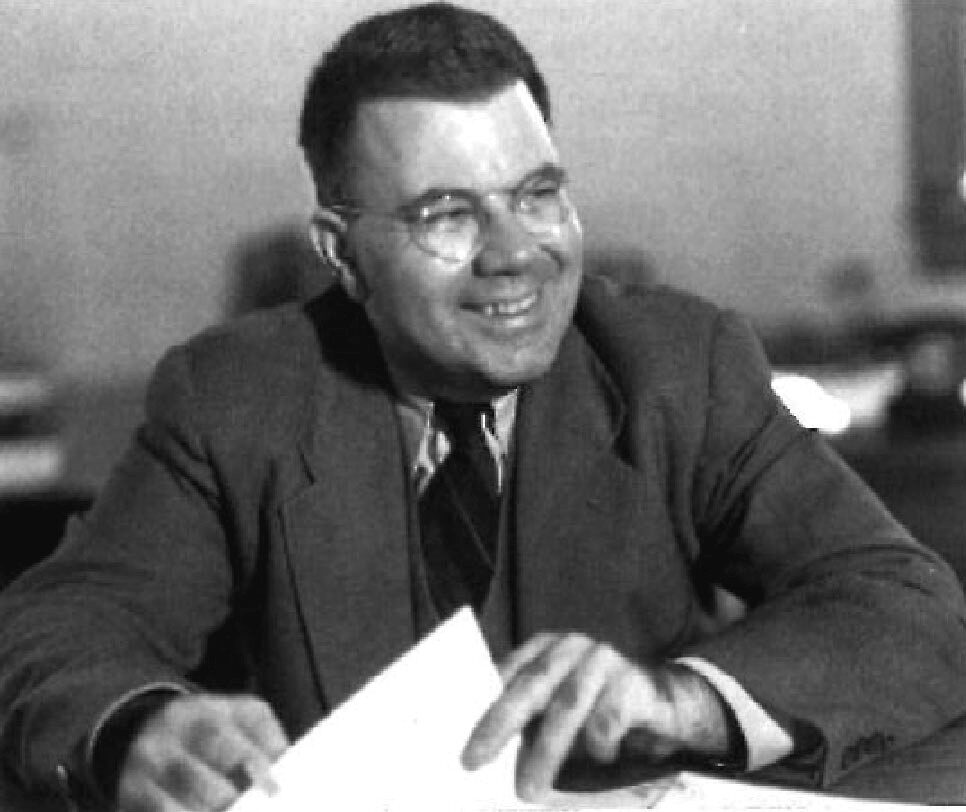
Project Blue Book was the US Air Force's UFO investigation office at Wright-Patterson AFB, running from March 1952 until December 1969 and logging 12,618 sightings, of which 701 were never identified. It was closed after a US$313,000 Air Force-funded study at the University of Colorado, directed by the physicist Edward U. Condon, concluded in 1968 that further UFO study was unlikely to advance science — a conclusion endorsed by a National Academy of Sciences panel on the eighth of January 1969. The case files were transferred to the US National Archives in 1975 and are public today.
Filed 2026-09-06 · Last updated 6 September 2026
Briefing
On the thirtieth of December 1947 the Air Force Chief of Staff directed
that a project be established “to collect, collate, evaluate, and distribute
within the government all information concerning sightings which could be
construed as of concern to the national security” [3]. Code-named Sign and
assigned to the Air Technical Intelligence Center, it became, through two
renamings, the longest-running official investigation of unidentified aerial
phenomena in the United States. It ended twenty-two years later on the strength
of a single contracted study.
Sequence of events
1947–1952 — Sign, Grudge, Blue Book
- the thirtieth of December 1947. Project Sign established by direction of the
Air Force Chief of Staff [3]. Maj. Gen. Charles P. Cabell, Air Force Director
of Intelligence, is credited by the National Archives with ordering the
project [2].
- February 1949. Sign issues its report after evaluating 243 cases: “No
definite and conclusive evidence is yet available that would prove or
disprove the existence of these unidentified objects as real aircraft of
unknown and unconventional configuration” [3][2].
- August 1949. Continuing at reduced scale as Grudge, the project completes
evaluation of 244 reports and concludes the sightings were attributable to
“misinterpretations of conventional objects, a mild form of mass hysteria or
war nerves, and fabrications for the sake of hoax or publicity” [3][2].
- March 1952. The project is renamed Blue Book [3][2].
1952–1966 — the working office
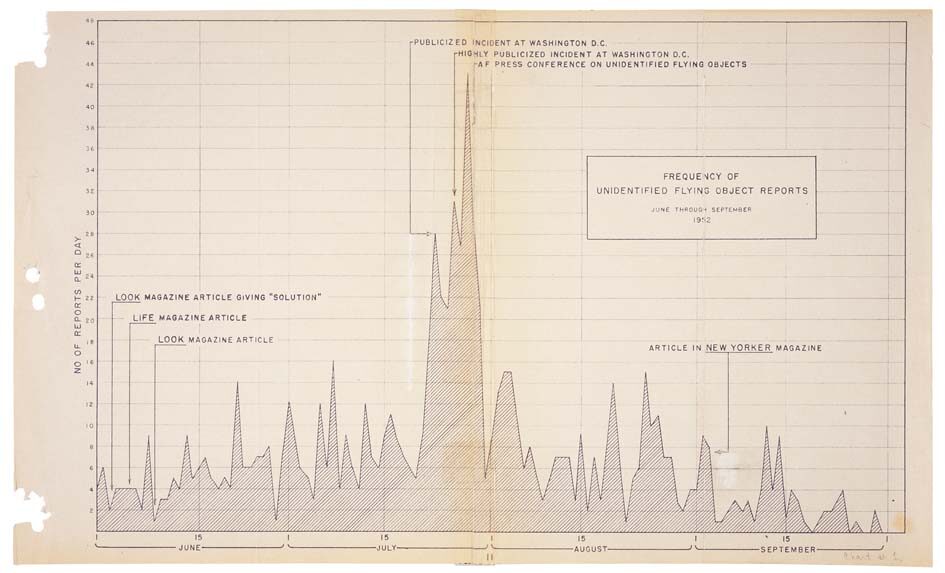
- the nineteenth of July 1952. Multiple sightings are reported over Washington,
DC [2].
- January 1953. A CIA-convened Scientific Advisory Panel of outside civilian
scientists — H. P. Robertson, Luis W. Alvarez, Lloyd V. Berkner, S. A.
Goudsmit and Thornton Page — reviews “a selection of the best documented
incidents” and reports that “there is no residuum of cases which indicates
phenomena which are attributable to foreign artifacts capable of hostile
acts”. It recommends “that the national security agencies take immediate
steps to strip the unidentified flying objects of the special status they
have been given and the aura of mystery they have unfortunately acquired” [3].
-
- Air Force Regulation 200-2 sets three standing objectives: determine
whether UFOs threaten US security; determine whether they show technological
advances useful to US research and development; and explain the stimuli that
caused the observer to report a UFO [3].
- End of 1954. A three-year unclassified contract study is released as
Special Report No. 14, concluding that “the probability that any of the
unknowns considered in this study are ‘Flying Saucers’ is concluded to be
extremely small” — the report that set the tone for official treatment of
disc and saucer reports for the remainder of the
programme [3].
- Throughout. The Blue Book office at Wright-Patterson carries a complement of
“only one officer, two sergeants, and one civilian stenographer”; initial
investigation of each sighting falls to the commander of the nearest Air
Force base [3].
- Through 1965. 10,147 UFO reports have been disposed of across seven
categories. In 1964, of 562 reports, 19 were classed Unidentified [3].
-
- An Air Force Scientific Advisory Board ad hoc committee chaired by
Brian O’Brien reviews Blue Book and finds “there appears to be no verified and
fully satisfactory evidence of any case that is clearly outside the framework
of presently known science”, recommending strengthened investigation [5].
1966–1969 — the Colorado study and the closure
- the seventh of October 1966. The University of Colorado project is publicly
announced; an initial contract of US$313,000 covers 15 months from November
1966 under Air Force contract F44620-67-C-0035. Field work uses “two-man
teams, composed whenever possible of one person with training in physical
science and one with psychology”, rising to three teams by 1967 [5][6].
- the thirty-first of October 1968. The final report is transmitted by
University of Colorado president J. R. Smiley to Secretary of the Air Force
Harold Brown [6].
- the eighth of January 1969. An ad hoc panel of the National Academy of
Sciences publishes its review, endorsing the Colorado findings and stating:
“On the basis of present knowledge the least likely explanation of UFOs is
the hypothesis of extraterrestrial visitations by intelligent beings” [7].
- the seventeenth of December 1969. Secretary of the Air Force Robert C.
Seamans Jr. announces the termination of Project Blue Book. The National
Archives states the decision was based on the University of Colorado report
and the Academy’s review of it [1][2].
1975–1976 — transfer to the National Archives
- the thirty-first of March 1975. USAF Headquarters formally offers
“approximately thirty-seven (37) cubic feet” of UFO case files covering June
1947 to December 1969 to the Archivist of the United States, noting the
function “has been known as Project Sign, Project Grudge, and Project Blue
Book” and that the records were created by the Aerial Phenomena Branch,
Foreign Technology Division, AFSC [8].
- the twenty-eighth of May 1975. A NARA appraisal memorandum (accession
NN-375-209) records the files as then held at the Albert F. Simpson
Historical Research Center, Maxwell AFB, Alabama, and flags the requested
access restrictions as the reviewer’s “main concern” [8].
- Spring 1976. The redaction process is completed. The Air Force had asked that
witness names be deleted before public access, because “in order to obtain
candor and cooperation from witnesses, the Air Force assured them that their
names would not be publicly disclosed” [8][2].
Documentary record
Section I of the Condon Report carries the finding that closed the
programme: that “further extensive study of UFOs probably cannot be justified
in the expectation that science will be advanced thereby”; that “none of the
things seen, or thought to have been seen, which pass by the name of UFO
reports, constituted any hazard or threat to national security”; and that “the
defense function could be performed within the framework established for
intelligence and surveillance operations without the continuance of a special
unit such as Project Blue Book”. Condon further recommended “that teachers
refrain from giving students credit for school work based on their reading of
the presently available UFO books and magazine articles” [4]. The full report
runs to roughly 1,465–1,496 pages across three volumes [6][10].
The letter of transmittal states that the Air Force pursued “a policy of
complete noninterference with the work of Dr. Condon and his staff” and that
“There has never been the slightest suggestion of any effort on the part of the
Air Force to influence either the conduct of the investigation or the content of
this report” [6]. This archive notes that the assertion is the university
president’s own, made in the report’s front matter; it is not an independent
finding.
The fullest insider account of Blue Book’s own methods is “The Investigation
of UFO’s” by the Blue Book officer Hector Quintanilla, Jr., published in the
CIA’s Studies in Intelligence and released under the CIA Historical Review
Program on the twenty-second of September 1993 [3]. The astrophysicist
J. Allen Hynek, Chairman of the Dearborn Observatory at Northwestern
University, served as Blue Book’s Project Consultant for eighteen years [3].
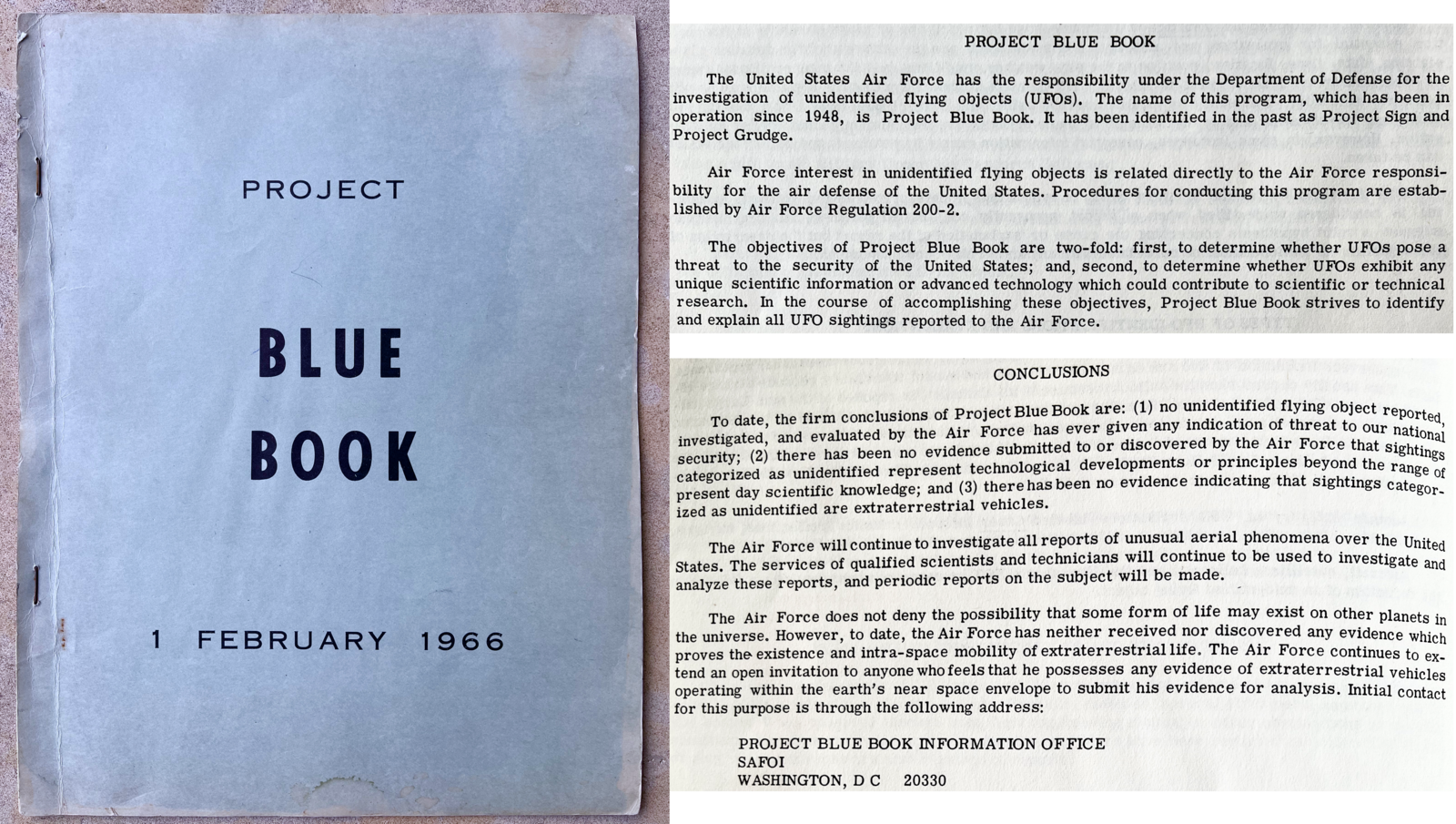
The final tally stands at 12,618 sightings reported between 1947 and 1969,
of which 701 remain “Unidentified”. The Air Force’s three stated conclusions
were that no UFO investigated “has ever given any indication of threat to our
national security”; that there was no evidence of “technological developments
or principles beyond the range of present-day scientific knowledge”; and “there
has been no evidence indicating that sightings categorized as ‘unidentified’
are extraterrestrial vehicles” [1].
Open questions
- What the 701 unidentified cases were. The primary sources reviewed here
do not explain them, nor give a case-by-case account of why they resisted
identification.
- Socorro, the twenty-fourth of April 1964. Quintanilla’s CIA article calls
the case of police officer Lonnie Zamora “the best-documented case on record”
and records the diagnosis as “Unsolved” — the Air Force never identified a
stimulus despite checking radiation, balloon control, helicopter and aircraft
activity, radar, and soil and burned-brush analysis. No source reviewed here
resolves it [3].
- The Colorado project’s own arithmetic. Section II of the Condon Report
does not state a total number of cases the project examined, nor how many of
its own field cases remained unexplained [5].
- The missing year. No source reviewed here records the internal Air Force
deliberations between the Academy review of January 1969 and the termination
announcement of December 1969.
- Blue Book’s precise closing date. Sources give the announcement as the
seventeenth of December 1969 [1]; NARA states termination was “ordered” that
date, and the USAF transfer memorandum says the function “was cancelled Dec
1969” [8]. The widely repeated “operations ceased January 1970” date does not
appear in any document retrieved for this file.
- A verbatim Seamans quotation. The commonly quoted line that Blue Book
could not “be justified on the ground of national security or in the interest
of science” is attributed to Seamans’s December 1969 memorandum. The
Department of Defense reading-room copy of the press release could not be
retrieved, and the quotation is therefore not cited in this file.
- The Academy panel’s membership. The retrieved record of AD0688541 does
not list the panel members; Gerald M. Clemence is associated with the
document [7].
- Provenance of the project’s internal correspondence. The University of
Colorado’s Condon collection finding aid could not be retrieved (HTTP 403),
so the archival provenance is unverified here [11].
Status
This file is CONFIDENTIAL — admitted to the archive on the strength of
US government records: the National Archives holdings and public description of
the case files [1][2], the CIA’s released Studies in Intelligence account [3],
the Condon Report itself [4][5][6], the National Academy of Sciences review [7],
and the 1975 transfer and appraisal documents [8].
Contested material is held below that line and recorded here as reported, not
established. Critics argued that Condon’s dismissive public statements during
the investigation indicated a predetermined conclusion rather than objective
inquiry; the investigator Dr David R. Saunders was terminated from the Colorado
project and later stated that his firing resulted from disagreeing with
Condon’s approach; observers have noted that unexplained cases within the
report’s own case studies sit awkwardly against its dismissive overall
conclusions; and the originally published version of the report is said to have
omitted pages 256–325, covering astronaut UFO sightings, an omission identified
some eight months later [9].
One further item is held as unverified. A memorandum dated the ninth of
August 1966 from the University of Colorado assistant dean Robert Low,
reportedly stating that “the trick would be… to describe the project so that,
to the public, it would appear a totally objective study but, to the scientific
community would present the image of a group of nonbelievers”, is widely quoted
as evidence of pre-judgement. No copy on an allowlisted primary repository could
be retrieved for this file — the University of Colorado finding aid returned
HTTP 403 — and the wording is therefore not verified against a document [11].
It should be treated as unconfirmed pending archival retrieval, and is not
relied upon in any conclusion above.
Readers tracing the pattern of official programmes opened, contracted out and
then closed may wish to compare this file with the archive’s record of
Project Stargate, a separate US government
programme with no connection to Blue Book beyond that shape.
References
- Project BLUE BOOK — Unidentified Flying Objects. US National Archives and Records Administration. Accessed 6th September 2026.
- Public Interest in UFOs Persists 50 Years After Project Blue Book Termination. US National Archives and Records Administration. Accessed 6th September 2026.
- Quintanilla, Hector, Jr. The Investigation of UFO’s. Studies in Intelligence, Central Intelligence Agency, Center for the Study of Intelligence. Approved for release under the CIA Historical Review Program, 22nd September 1993.
- Condon, Edward U. Scientific Study of Unidentified Flying Objects, Section I: Conclusions and Recommendations. University of Colorado; National Capital Area Skeptics electronic edition, Release 1, January 1999.
- Scientific Study of Unidentified Flying Objects, Section II: Summary of the Study. University of Colorado; National Capital Area Skeptics electronic edition.
- Smiley, J. R. Scientific Study of Unidentified Flying Objects — Letter of Transmittal, 31st October 1968. University of Colorado; National Capital Area Skeptics electronic edition.
- Review of the University of Colorado Report on Unidentified Flying Objects by a Panel of the National Academy of Sciences (AD0688541), 8th January 1969. National Academy of Sciences / Defense Technical Information Center, via the Internet Archive.
- Offer of Transfer of Air Force Documentation (UFO case files), HQ USAF, 31st March 1975, with NARA appraisal memorandum 28th May 1975 (accession NN-375-209). US National Archives and Records Administration.
- The Full Condon Committee Report on UFOs, 1968. The Black Vault. Licence unverified; used here only for claims marked as reported.
- Final report of the scientific study of unidentified flying objects conducted by the University of Colorado (3 vols., 1,465 pp.). University of Colorado, via the Internet Archive.
- Edward U. Condon collection finding aid. University of Colorado Boulder, Rare and Distinctive Collections. Not retrieved — HTTP 403 at time of access.