CONFIDENTIAL
MY-26004
The Bashplemi Tablet
- Incident
- 2021-09-01
- Location
- Lake Bashplemi, Dmanisi municipality, Georgia
- Coords
- 41.3286, 44.2069
Brief
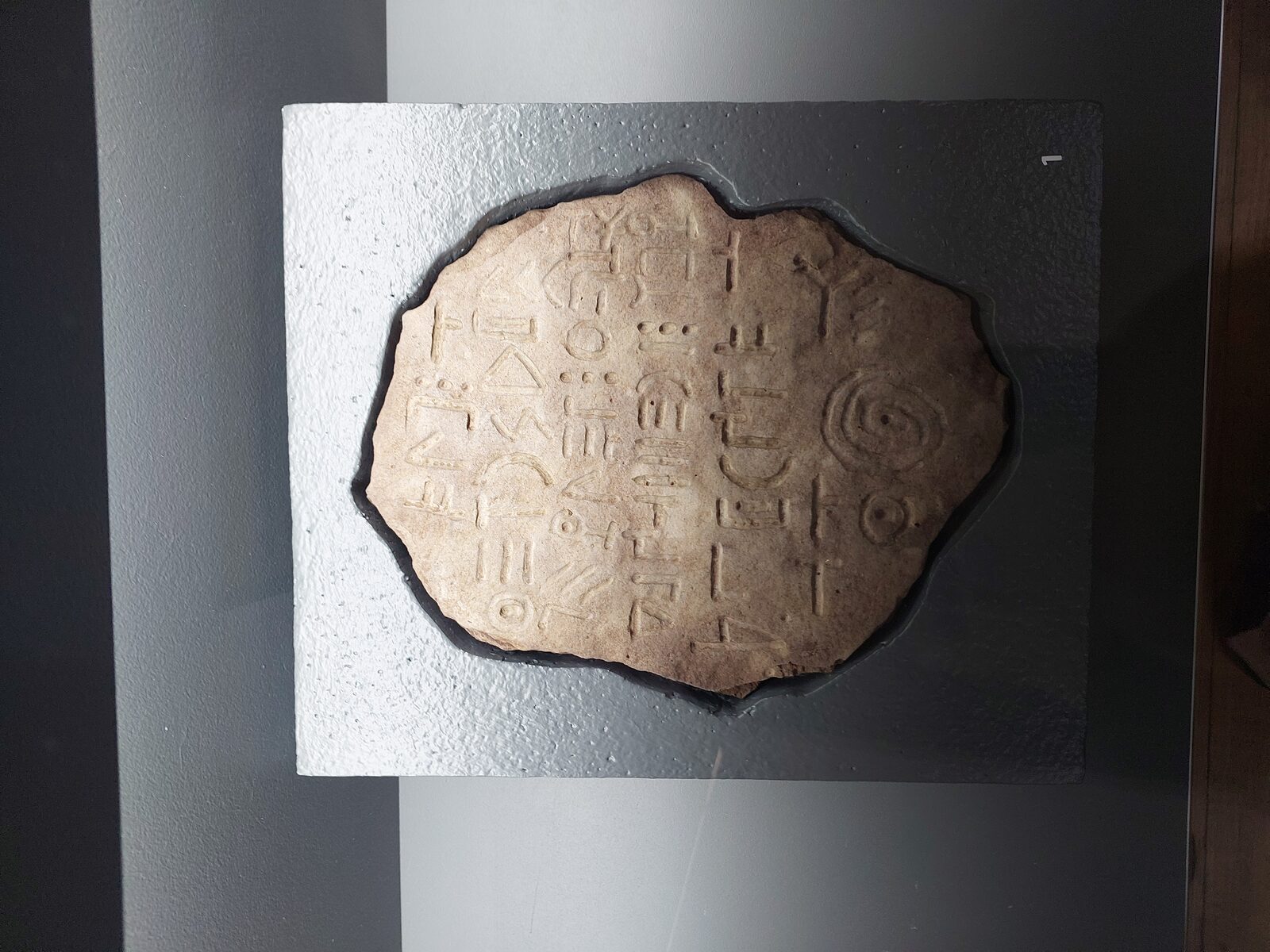
The Bashplemi Tablet is a small vesicular-basalt slab found near Lake Bashplemi in Georgia's Dmanisi municipality in the autumn of 2021, bearing sixty inscribed signs — thirty-nine of them distinct — in seven rows that match no known writing system. It was formally described in a 2024 peer-reviewed paper by a five-author Georgian team, who tentatively date it to the Late Bronze / Early Iron Age and argue it is authentic. The script remains undeciphered, the dating is indirect, and several outside linguists have publicly questioned both its age and its authenticity.
Filed 2026-07-18 · Last updated 18 July 2026
Briefing
In the autumn of 2021, a slab of local vesicular basalt inscribed with unknown
characters was recovered near Lake Bashplemi, in the Dmanisi municipality
of Georgia [1][3]. The find was reported to have been made by local lake-users
— described in coverage as fishermen — and subsequently passed to a team of
Georgian scholars for analysis [3].
Three years later, a five-author Georgian team published the sole primary
description of the object, tentatively dating it to the Late Bronze / Early
Iron Age and arguing for its authenticity [1]. The script it carries has not
been deciphered, its dating is indirect, and outside specialists have
questioned both its age and whether it is ancient at all [2]. This file sits
in the archive’s record of undeciphered manuscripts.
Sequence of events
The find — autumn 2021
- A basalt tablet bearing unknown characters was discovered near Bashplemi
Lake, in the Dmanisi municipality of Georgia [1].
- The find was reported to have been made by local people at the lake, and no
individual finder is named in the sources reviewed [3].
- The tablet passed to a team of Georgian scholars for analysis [3].
Publication — 2024
- The description appeared in the Journal of Ancient History and Archaeology,
Vol. 11, No. 3 (2024), titled “Discovery of Unknown Script Characters in
Georgia: The Bashplemi Lake Tablet” (DOI 10.14795/j.v11i3.1035) [1].
- The paper lists five authors: Ramaz Shengelia, Levan Gordeziani, Nikoloz
Tushabramishvili, Nodar Poporadze and Othar Zourabichvili [1].
- The article is published under a Creative Commons
Attribution-NonCommercial-NoDerivs (CC BY-NC-ND) licence [1].
Expert reaction — 12 December 2024
- The sinologist Victor Mair aggregated expert reaction in a Language Log
post, in which several linguists set out reservations [2].
Documentary record
The tablet is made of local vesicular basalt and carries sixty inscribed
signs, of which thirty-nine are distinct characters, arranged in seven
rows and read left to right [1][3]. Its face dimensions are given as
approximately 24.1 × 20.1 cm — “roughly the size of an iPad” [3]. The signs
were reported to have been produced in two stages: an initial series of holes
bored with a cone-shaped drill, then connected into flowing lines and smoothed
with a rounded tool — a technique the authors read as evidence of skilled
craftsmanship [3].
The 2024 paper is the only primary description of the object [1]. Its abstract
states that “the characters … bear some similarities with Semitic, Brahmani,
and North Iberian characters” while remaining undeciphered, and notes that the
artefact’s meaning and any connection to proto-Georgian origins are unclear
[1]. The authors conclude they see “no reason to doubt the authenticity of the
artifact,” citing the resemblance of its signs to Middle Eastern and
pre-Christian Georgian scripts as making a casual modern forgery unlikely [3].
Open questions
- What the text says. The script is undeciphered and matches no catalogued
writing system [1].
- A firm date. The Late Bronze / Early Iron Age attribution rests on
nearby associated finds — pottery and a stone mortar — rather than on direct
dating of the tablet itself; the paper concedes the exact age is uncertain
[2][3].
- Language affiliation. Whether the signs relate to any
Kartvelian/proto-Georgian tradition is stated to be unclear [1]. Claims
circulating that the script is confirmed proto-Kartvelian have no support in
the primary paper [1].
- Provenance chain. The reviewed sources do not fully document the tablet’s
path from lakeside discovery to laboratory, nor a secure stratigraphic
context [3].
- The authenticity dispute. The linguist David Marjanović argued it is
“hard to see how the presumed script makes sense as an alphabet or a
syllabary,” noting the object “comes out of nothing … and it disappeared
into nothing,” with the next attested writing in the region appearing some
1,000–1,500 years later; he held that the cross-script resemblances amount
to “simple shapes” of weak evidentiary value [2]. Stephen Goranson stated he
suspects forgery, observing that the stone appears shaped by modern tools
rather than ancient methods [2].
Status
This file is CONFIDENTIAL — admitted to the archive on the strength of a
single peer-reviewed primary description, the 2024 JAHA paper, rather than on
any settled reading or secure dating [1]. The authors’ proposed possibilities
for the text — a record of military spoils, construction or public-works
details, or “a receipt for a gift to the gods” — are explicitly offered as
possibilities, not decipherments, and are recorded here as such [3]. The
cross-script comparisons the team draws to Semitic, Brahmi, North Iberian,
Phoenician, Aramaic, Greek and pre-Christian Georgian traditions are likewise
interpretive [1][3]. Outside challenges to the object’s age and authenticity
remain unresolved [2]; as Marjanović noted, confidence would rise “if further
examples of this presumed script turned up, preferably not pre-cleaned” [2].
Updates pending independent examination.
References
- Shengelia, R., Gordeziani, L., Tushabramishvili, N., Poporadze, N. & Zourabichvili, O. (2024). “Discovery of Unknown Script Characters in Georgia: The Bashplemi Lake Tablet.” Journal of Ancient History and Archaeology, Vol. 11, No. 3. DOI 10.14795/j.v11i3.1035. Published under CC BY-NC-ND.
- Mair, Victor (2024). “Enigmatic writing from the Republic of Georgia.” Language Log, University of Pennsylvania, 12th December 2024 — aggregating expert reaction, including comments by David Marjanović and Stephen Goranson.
- ScienceAlert (2024). “Ancient Tablet Etched With Mysterious Language Found in Georgia.”
Frequently asked
- What is the Bashplemi Tablet?
- The Bashplemi Tablet is a small vesicular-basalt slab found near Lake Bashplemi in Georgia's Dmanisi municipality in the autumn of 2021. It carries sixty inscribed signs, thirty-nine of them distinct, arranged in seven rows and read left to right, in a script that matches no known writing system.
- Has the Bashplemi Tablet been deciphered?
- No. The script remains undeciphered and matches no catalogued writing system. The 2024 paper's authors note resemblances to Semitic, Brahmi and North Iberian characters but state that the text's meaning, and any connection to proto-Georgian origins, remain unclear.
- How old is the Bashplemi Tablet?
- The authors tentatively assign it to the Late Bronze / Early Iron Age, but that attribution rests on nearby associated finds — pottery and a stone mortar — rather than on direct dating of the tablet itself, and the paper concedes the exact age is uncertain.
- Is the Bashplemi Tablet genuine?
- The authors conclude they see "no reason to doubt the authenticity of the artifact." Several outside linguists disagree: David Marjanović questions how the signs work as a script, and Stephen Goranson has stated he suspects forgery, observing that the stone appears shaped by modern tools.