CONFIDENTIAL
MY-26003
The Connecticut "Vampire" Burial (JB55, Griswold)
- Incident
- 1990-01-01
- Location
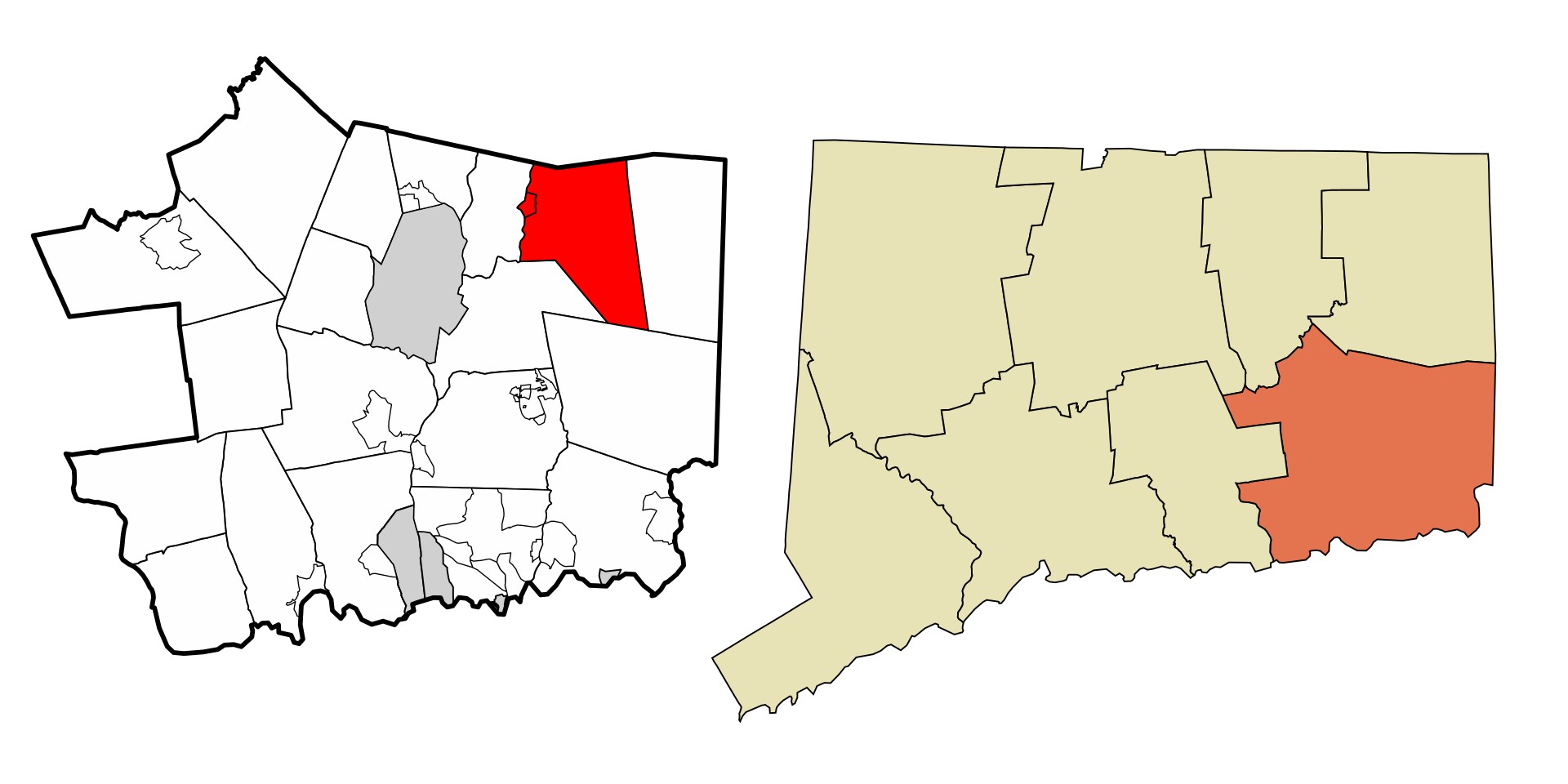
- Griswold, Connecticut, United States
- Coords
- 41.6015, -71.9273
Brief
In 1990, gravel quarrying in Griswold, Connecticut exposed an early-19th-century burial in which a middle-aged man's skull and thigh bones had been rearranged into a "skull and crossbones" pattern years after death — an apotropaic act tied to New England's tuberculosis-driven "vampire" folk belief. Brass coffin tacks read "JB55". In 2019 a forensic DNA team identified him, with putative confidence, as John Barber.
Filed 2026-07-13 · Last updated 13 July 2026
Briefing
In 1990, sand-and-gravel operations in Griswold, Connecticut exposed an
unmarked cemetery of the eighteenth to nineteenth centuries; twenty-seven
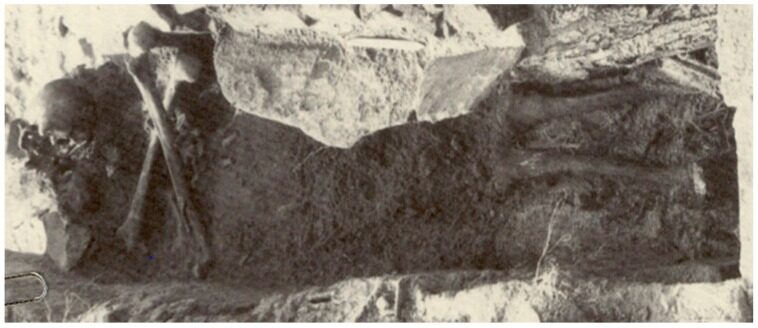
burials were recorded [1]. One stone-lined grave held a middle-aged man whose
coffin lid bore brass tacks spelling “JB55”, read as his initials and his
age at death [1]. The case is documented here as a forensic identification
cold case — an unnamed individual whose putative
identity was established almost two centuries later through DNA — and as one of
the best-attested examples of a New England folk practice.
Sequence of events
1990 — discovery
- An early-19th-century cemetery is exposed during quarrying; twenty-seven
burials are recorded [1].
- One grave is found stone-lined, holding a middle-aged male; coffin hardware
dates the burial to the early nineteenth century, and brass tacks on the lid
spell “JB55” [1].
- The skull and femora have been repositioned into a “skull and crossbones”
orientation — deliberate postmortem rearrangement [1].
1994 — the bioarchaeological report
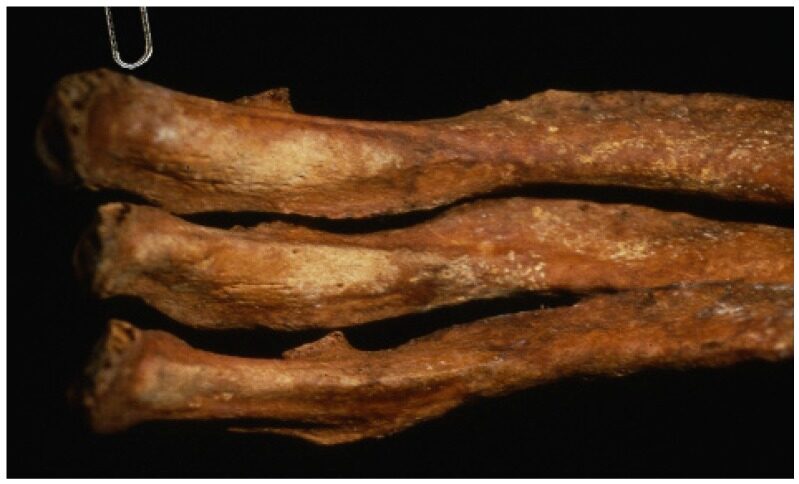
- The skeleton shows proliferative lesions on the inner (pleural) surfaces of
the ribs, consistent with chronic pulmonary infection and interpreted as
pulmonary tuberculosis [1][2].
- The published report states that “certain bones in the skeleton were
rearranged after decomposition was complete” — the grave was reopened some
time after death, not disturbed at burial [2].
- The authors place the act within a documented New England belief that a
deceased tuberculosis victim could return to “waste away” surviving
relatives, to be stopped by exhuming and disrupting the body; twelve historic
accounts of such activity are cited [2].
2019 — the DNA identification
- Initial 1990s mitochondrial DNA testing had produced control-region
sequences but could not identify JB55 without known maternal relatives [1].
- SNP ancestry testing indicates 100% European biogeographic ancestry; a full
Y-STR profile is obtained and assigned to Y-haplogroup R1b, refined to
R1b-P312 [1].
- Searched against a public R1b genealogy project, the profile returns two
closest matches, both surnamed “Barber” [1].
- Historical records name a John Barber whose son Nathan Barber was buried in
Griswold in 1826; a nearby subadult burial (“NB13”) is consistent with a son.
On this combined genetic and documentary basis the authors propose JB55’s
putative identity as John Barber [1].
November 2022 — facial reconstruction
- A DNA-informed facial reconstruction of “John Barber” is unveiled at the
International Symposium on Human Identification [3].
Documentary record
The primary source is the peer-reviewed 2019 Genes study, which sets out the
burial context, the DNA methods, the R1b haplogroup, the genealogy-database
match, and the John Barber identification [1]. It rests upon the original 1994
American Journal of Physical Anthropology communication by Sledzik and
Bellantoni, which first described the burial, the tuberculosis rib lesions, the
postmortem bone rearrangement, and the vampire folk-belief context [2]. The
2022 facial reconstruction is documented only through secondary reporting and
is treated as reported, not established [3].
Those involved include Nicholas Bellantoni, the Connecticut State
Archaeologist who excavated the cemetery in 1990 and co-authored both papers;
Paul S. Sledzik, forensic anthropologist and co-author of the 1994 report;
and Charla Marshall, corresponding author of the 2019 study at the Armed
Forces DNA Identification Laboratory (AFMES-AFDIL) [1][2]. The 2022
reconstruction was produced by Parabon NanoLabs, with a forensic artist and
AFDIL, whose Director of Bioinformatics Ellen Greytak is quoted on the
difficulty of phenotyping historical bone [3].
Open questions
- The identification is explicitly putative: the Y-STR match confirms the
paternal Barber surname line, not the specific individual, and no primary
vital record definitively naming “John Barber, 55” at this grave has been
located [1].
- The interval between burial and the exhumation and rearrangement is not
fixed in the primary abstract beyond “after decomposition was complete” [2].
- Whether JB55 was specifically feared as a “vampire” — as opposed to being
subject to a generic contagion or apotropaic ritual — is an interpretation,
not a recorded contemporary statement.
- Counts differ between accounts: some describe a “Walton family cemetery” of
roughly twenty-nine individuals, while the 2019 paper records twenty-seven
burials; both figures circulate and the papers do not fully reconcile them
[1][2].
- The phenotype percentages reported in some secondary outlets (for example
~92% fair skin, ~99.8% brown/hazel eyes) are not confirmed against a primary
release here; the primary secondary source gives fair skin, brown or hazel
eyes, and brown or black hair without percentages [3].
Status
This file is CONFIDENTIAL — admitted on the strength of two peer-reviewed
papers documenting the burial, the tuberculosis rib lesions, the postmortem
bone rearrangement, and the DNA analysis [1][2]. The John Barber identification
is carried as putative, in line with the primary study’s own language, and the
“vampire” framing is recorded as a modern interpretation rather than a
contemporary label. The 1994 authors’ hypothesis — that, in the absence of a
heart left to burn, the “skull and crossbones” arrangement served the same
apotropaic function — is logged as their theory, not as fact [2]. Updates
pending any primary confirmation of the phenotype figures and any direct vital
record for JB55.
References
- Daniels-Higginbotham, J. et al. (2019). “DNA Testing Reveals the Putative Identity of JB55, a 19th Century Vampire Buried in Griswold, Connecticut”, Genes 10(9):636, 22nd August 2019. DOI 10.3390/genes10090636 (open access, CC BY 4.0).
- Sledzik, P.S. & Bellantoni, N. (1994). “Brief communication: bioarcheological and biocultural evidence for the New England vampire folk belief”, American Journal of Physical Anthropology 94(2):269–274. PMID 8085617.
- Germain, J. (2022). “Scientists Digitally Reconstruct Face of 19th-Century Man Accused of Being a Vampire”, Smithsonian Magazine, 9th November 2022.
Frequently asked
- Who was JB55?
- JB55 is the label given to a middle-aged man buried in Griswold, Connecticut in the early 19th century, taken from brass tacks reading "JB55" on his coffin lid — interpreted as his initials and his age at death, 55. A 2019 forensic DNA study proposed his putative identity as John Barber, on the combined basis of a Y-chromosome surname match and collateral historical records.
- Why is JB55 called a "vampire"?
- Some years after burial the grave was reopened and the skull and thigh bones rearranged into a "skull and crossbones" pattern. The 1994 researchers placed this within a documented New England folk belief that a tuberculosis victim could return to waste away surviving relatives, and that disrupting the corpse would stop it. The "vampire" label is a modern interpretive framing; no contemporary document naming JB55 as a vampire has been located.
- How was JB55 identified as John Barber?
- The 2019 team obtained a full Y-STR profile (Y-haplogroup R1b, refined to R1b-P312) and searched it against a public genealogy database, returning two closest matches both surnamed "Barber". Historical records named a John Barber whose son Nathan Barber was buried in Griswold in 1826, and a nearby subadult burial was consistent with a son. The identification is explicitly described as putative — the match confirms the paternal Barber line, not the specific individual.
- Was JB55's face reconstructed?
- In November 2022 a DNA-informed facial reconstruction of "John Barber" was unveiled at the International Symposium on Human Identification, produced by Parabon NanoLabs with a forensic artist and AFDIL. Phenotype predictions reported in secondary coverage included fair skin, brown or hazel eyes, and dark hair, with the noted difficulty of phenotyping historical bone.