CONFIDENTIAL
CR-26009
The Jersey Devil and the Leeds–Franklin Printing Feud
- Incident
- 1700-01-01
- Location
- Burlington and Leeds Point, West Jersey, and Philadelphia, Province of Pennsylvania
- Coords
- 39.9526, -75.1652
Brief
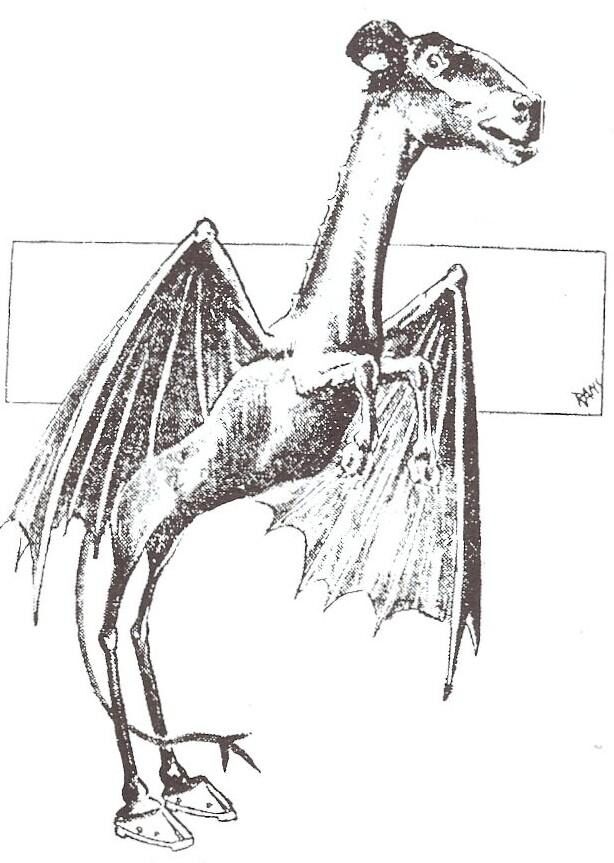
The claim under examination is that America's most famous cryptid began as a printing feud rather than a monstrous birth — Quaker polemicists branding the almanac-maker Daniel Leeds a servant of Satan in the 1690s, and Benjamin Franklin mock-prophesying the death of Daniel's son Titan in 1733. The surviving primary record confirms the pamphlet war, the Leeds family's demonisation in print, and Franklin's almanac hoax. It does not contain any colonial-era document linking those insults to a winged creature; that connection is a named modern scholarly thesis, not a documented fact.
Filed 2026-09-17 · Last updated 17 September 2026
Briefing
The traditional origin of the Jersey Devil places a
monstrous thirteenth child in the New Jersey Pine Barrens in 1735. The thesis
examined in this file places it somewhere else entirely — in a colonial
printing house. On this account the creature historically called the “Leeds
Devil” began as a slur: Quaker polemicists branding the West Jersey
almanac-maker Daniel Leeds a servant of Satan across a sequence of
Philadelphia and New York imprints between 1695 and 1700 [1][2][3], followed
four decades later by Benjamin Franklin’s mock-prophecy of the death of
Daniel’s son Titan Leeds [4][8].
The two halves of that story survive as documents and can be read. What does
not survive — in anything this desk was able to fetch and read — is a
colonial-era line connecting the insults to a winged monster. That linkage is
a named modern thesis, advanced by Brian Regal and Frank J. Esposito (Johns
Hopkins University Press, 2018) [6][7]. This file admits the print war as
documented, and records the monster connection as theory.
Sequence of events
The Leeds pamphlet war, 1687–1700
- Daniel Leeds (c. 1651–1720) is reported to have emigrated from England to
West Jersey as a Quaker and to have begun publishing almanacs in 1687, his
astrological content judged unacceptable by his meeting [6][9]. Secondary
accounts give the emigration variously as 1676 and 1677; this desk found no
primary record settling it [6].
- 1695. Leeds is in open print conflict with Friends, publishing The
Innocent Vindicated from the Falshoods & Slanders of Certain Certificates
Sent from America — fifty-nine pages, surviving in the Huntington Library
copy [3].
- 1697. Leeds publishes, via the printer William Bradford “at the Bible in
New-York,” News of a Trumpet Sounding in the Wilderness, or, The Quakers
Antient Testimony Revived, Examined and Compared With Itself, and Also With
Their New Doctrine — a 398-page attack on Quaker doctrine [1].
- In that work Leeds records his own disowning: he was “disowned the 3d of
November last” by the Burlington meeting, and he names sermons preached
against him [1].
- 1699. The London edition is retitled A Trumpet Sounded Out of the
Wilderness of America; Which may serve as a Warning to the Government and
People of England to Beware of Quakerism — printed by Bradford in New York,
sold in London by A. Sylvester and C. Browne [1].
- 1700. The Quaker apologist Caleb Pusey answers with Satan’s
Harbinger Encountered, Or, False Crooked Ways in the Wilderness Laid Open to
the View of the Impartial and Judicious, “Printed at Philadelphia By Reynier
Janſen” [2].
The Franklin hoax, 1732–1740
- 1716. Daniel Leeds is reported to have handed the almanac to his son
Titan Leeds (1699–1738) [9].
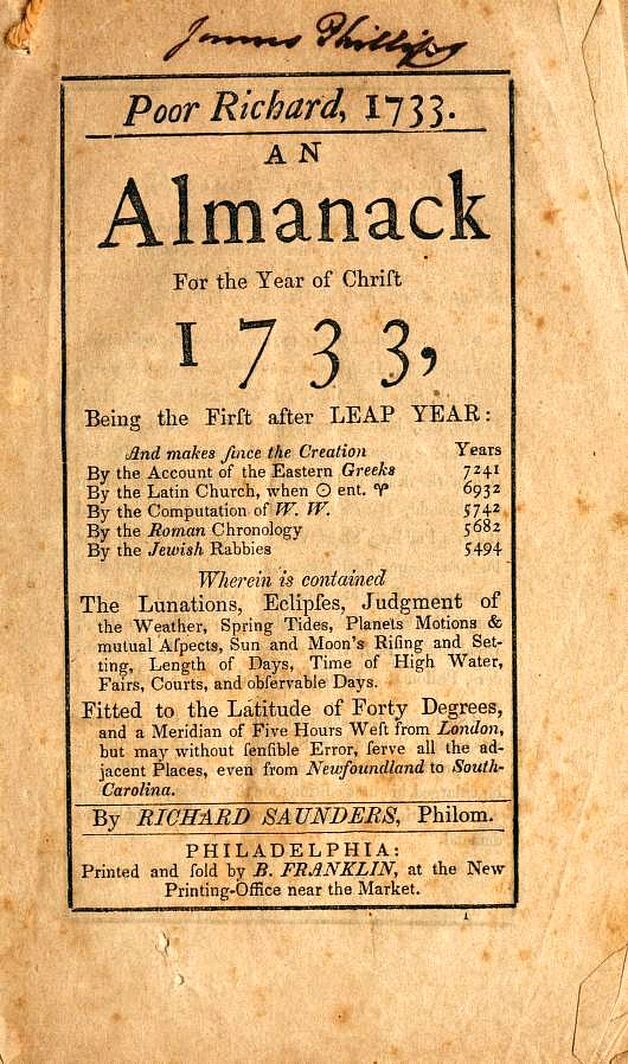
- Late 1732. Franklin enters the market with Poor Richard, 1733, imprint
“Philadelphia: Printed and sold by B. Franklin, [1732]”; an original is held
by the Rosenbach Museum & Library, Philadelphia [5].
- In that first preface Franklin is reported to have written that regard for
“my good Friend and Fellow-Student, Mr. Titan Leeds” had kept him from
publishing, but that the obstacle would soon be removed: “He dies, by my
Calculation made at his Request, on Oct. 17. 1733. 3 ho. 29 m. P.M. at the
very instant of the [conjunction] of [Sol] and [Mercury]” — adding that by
Leeds’s own calculation he would survive until the twenty-sixth [4].
- 1734. Leeds having failed to die, Franklin’s next preface asserts that an
almanac has appeared in Leeds’s name treating Poor Richard “in a gross and
unhandsome manner” — calling him a false predictor, an ignorant, conceited
scribbler, a fool and a liar. Franklin concludes that the real Leeds must
therefore be dead and his name usurped [4][8].
- 1738. Titan Leeds dies [8][9].
- 1740. Poor Richard, 1740 prints a letter purportedly written through
Franklin by Leeds’s ghost, repudiating further printings of the Leeds almanac
[8][9].
Documentary record
The load-bearing document is Pusey’s Satan’s Harbinger Encountered
(Philadelphia: Reynier Jansen, 1700; 128 pages) [2]. It is a printed, dated,
attributable association of the name Leeds with Satan, and the epithet is on
the title page itself. Inside, Pusey’s preface characterises Leeds’s book as
“abuſive” writing sent forth “to binder [hinder] the ſpreading of truth.”
Explicit demonic language beyond the title is sparse in the sections retrieved
[2].
Leeds’s 1697 News of a Trumpet Sounding in the Wilderness, with its 1699
London re-issue, establishes the content and ferocity of the campaign Pusey was
answering, and records Leeds’s disowning in his own words [1]. The Innocent
Vindicated (1695) shows the feud predates the 1697 tract by at least two
years [3]. All three are public domain.
For the Franklin half, the Poor Richard prefaces of 1733, 1734 and 1740 are
held in The Papers of Benjamin Franklin via Founders Online [4][8]. A caveat
applies: the Founders Online pages for those three almanacs would not render
for direct fetch, and the preface wording quoted above is reported from the
Founders Online record via search retrieval rather than from a page this desk
read in full. The 1733 imprint itself is independently confirmed by the
Rosenbach copy recorded in the Franklin Tercentenary exhibition material [5].
The sixth document usually cited in this case — W. F. Mayer, “In the Pines,”
The Atlantic Monthly, vol. 3, no. 19 (May 1859) — is widely described as the
first print appearance of the Leeds Devil [10]. That description does not
survive checking here; see below.
Open questions
- No document retrieved here shows any colonial-era text calling the Leeds
Devil a creature. The primary record supports “Leeds = Satan’s harbinger”
as polemic, not as monster-lore [1][2].
- Regal states that Titan Leeds printed the Leeds family crest — featuring a
wyvern, a winged dragon — beginning in 1728 [6]. This is a key link in the
thesis and could not be checked: no digitised American Almanack was
locatable in the repositories searched.
- The claim that “In the Pines” (May 1859) is the first printed appearance of
the Leeds Devil is repeated almost universally. The article does exist in
that issue and does discuss Pine Barrens folk populations (“The Big House was
full of legends of the Pine Rats”), but two targeted searches of the
archive.org OCR text of the issue returned no occurrence of “Leeds” and no
occurrence of “devil” anywhere in the article [10]. OCR failure or
retrieval truncation are possible causes; this desk cannot confirm the claim
and flags it as unverified.
- No 1735 birth record, baptismal entry, or contemporaneous account of “Mother
Leeds” and a thirteenth child was located in any repository searched. The
story appears only in later retellings.
- No pre-1800 printed use of the phrase “Leeds Devil” applied to a winged
creature was found. The 1887 Elkhart Sentinel “Devil of Leeds” item is
cited secondhand in reference works, but the Library of Congress Chronicling
America search endpoints returned HTTP 403 to this desk and the original
page could not be read.
- The Philadelphia and Burlington Yearly Meeting minutes said to order
suppression of Leeds’s 1687 almanac were not located in any accessible
repository.
- Japhet Leeds’s will — reportedly dated the fifth of February 1736 and naming
twelve children — could not be checked against the New Jersey State Archives
or the Calendar of New Jersey Wills; no volume covering 1730 to 1750 was
reachable.
Status
This file is CONFIDENTIAL. What is admitted on documentary strength is the
print war itself: Leeds’s tracts of 1695, 1697 and 1699 [1][3], Pusey’s 1700
reply attaching the Leeds name to Satan in print [2], and the Franklin almanac
hoax as a documented episode of the Franklin canon [4][5][8].
What is not admitted as documented is the causal chain from those insults to
the winged creature. Regal argues the legend “stem[s] from colonial-era
politics, religious disputes among Quakers, and the mischievous marketing
tactics of Benjamin Franklin,” rather than from the traditional 1735
monstrous-birth story, and that Franklin exploited an occultist reputation
already attached to the Leeds name to sell almanacs [6]. Regal and Esposito
together describe the monster as “a product of innuendo and rumor, as well as
scandal and media hype,” emerging from “bare-knuckled political fights and
religious upheavals of colonial America” [7]. That is a scholarly thesis, named
and attributable, and this archive records it as theory pending a colonial-era
document that closes the gap.
The file therefore sits at an unusual angle to the rest of the archive’s
cryptid record: the best-documented material here concerns
printers rather than sightings, and the sighting record — the part that would
make this a creature case at all — is the part that cannot be produced.
Updates pending a readable American Almanack for 1728 onward, an unthrottled
Chronicling America return on the 1887 item, and a clean full-text read of the
May 1859 Atlantic.
References
- Leeds, Daniel (1697). News of a Trumpet Sounding in the Wilderness, or, The Quakers Antient Testimony Revived, Examined and Compared With Itself, and Also With Their New Doctrine. New York: William Bradford, 398 pp.; 1699 London re-issue as A Trumpet Sounded Out of the Wilderness of America. Internet Archive (Harvard copy). Public domain.
- Pusey, Caleb [“C.P.”] (1700). Satan’s Harbinger Encountered, Or, False Crooked Ways in the Wilderness Laid Open to the View of the Impartial and Judicious. Philadelphia: Reynier Jansen, 128 pp. Internet Archive (Early English Books 1641–1700). Public domain.
- Leeds, Daniel (1695). The Innocent Vindicated from the Falshoods & Slanders of Certain Certificates Sent from America, 59 pp. Internet Archive (Huntington Library copy). Public domain.
- Franklin, Benjamin. Poor Richard, 1733 — The Papers of Benjamin Franklin, vol. 1. Founders Online, U.S. National Archives / Yale University Press.
- American Library Association / Benjamin Franklin Tercentenary. Benjamin Franklin: In Search of a Better World — exhibition panel text recording the Poor Richard, 1733 imprint, Rosenbach Museum & Library copy.
- Regal, Brian. “The Jersey Devil in Myth and History.” New Jersey Council for the Humanities, Public Scholars Project. Kean University.
- Regal, Brian, and Frank J. Esposito (2018). The Secret History of the Jersey Devil: How Quakers, Hucksters, and Benjamin Franklin Created a Monster. Baltimore: Johns Hopkins University Press.
- Museum of Hoaxes. “The Death of Titan Leeds (1732).”
- “Titan Leeds.” Wikipedia (CC licence).
- Mayer, W. F. “In the Pines.” The Atlantic Monthly, vol. 3, no. 19 (May 1859). Internet Archive periodical scan. Public domain.