Briefing
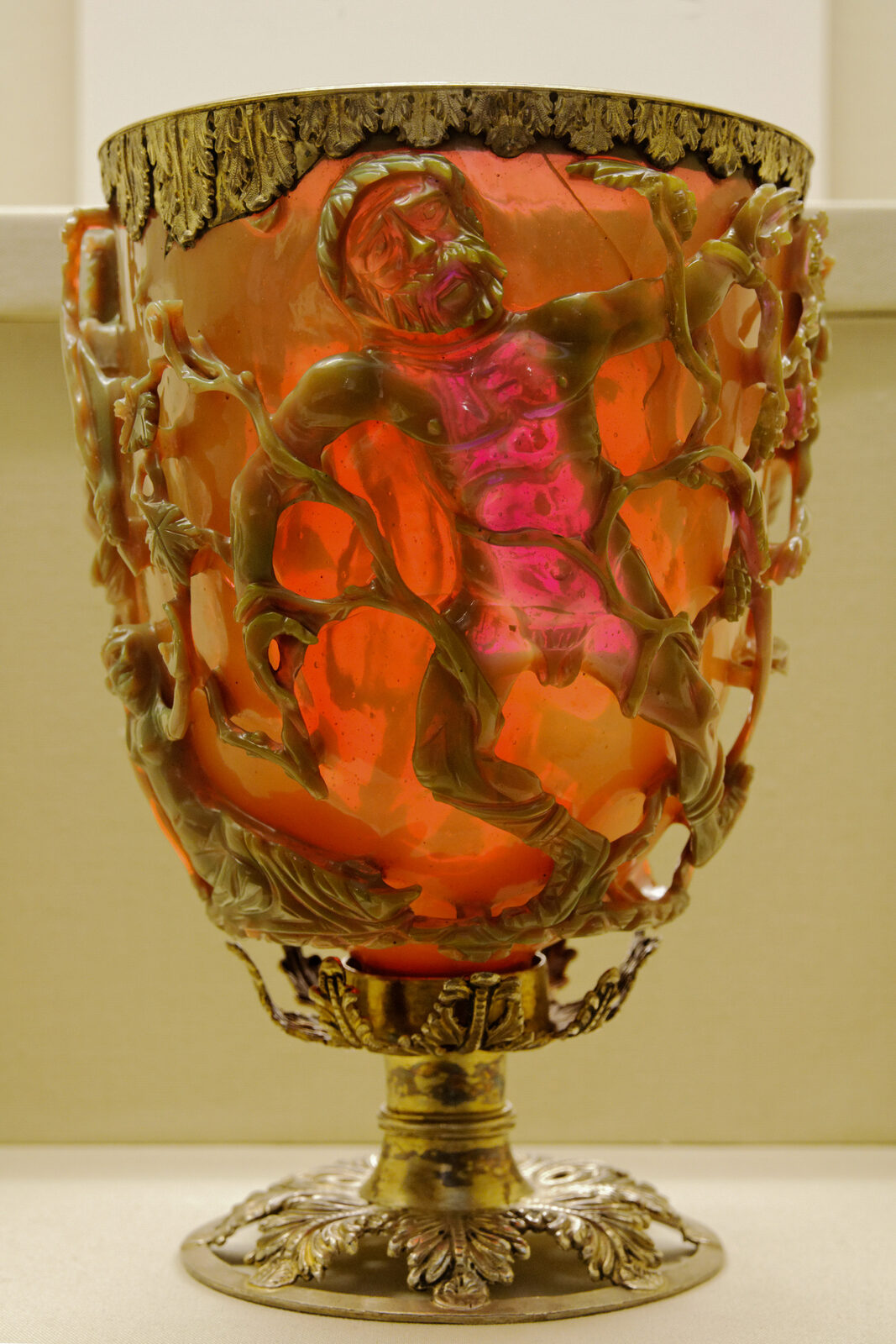
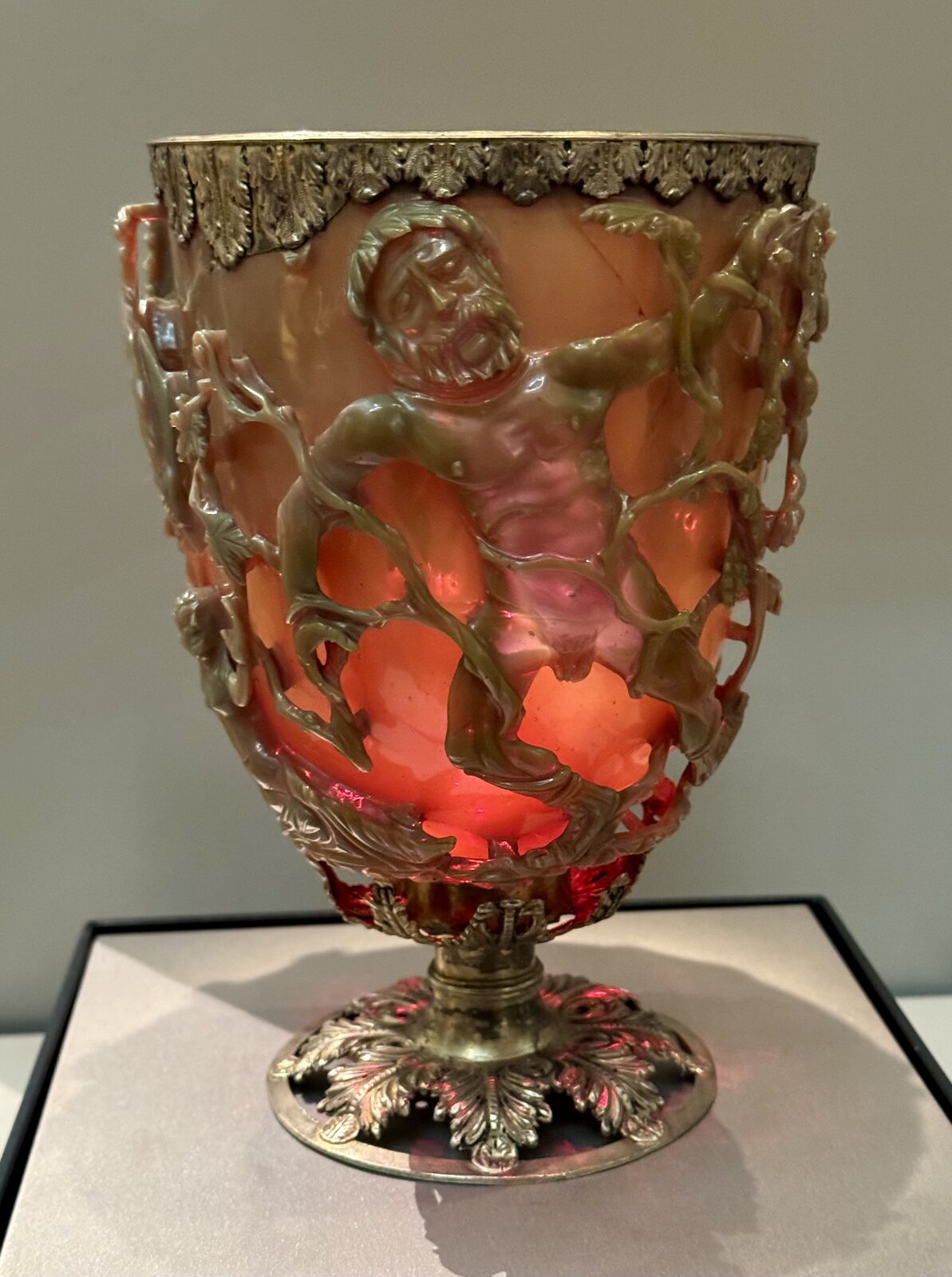
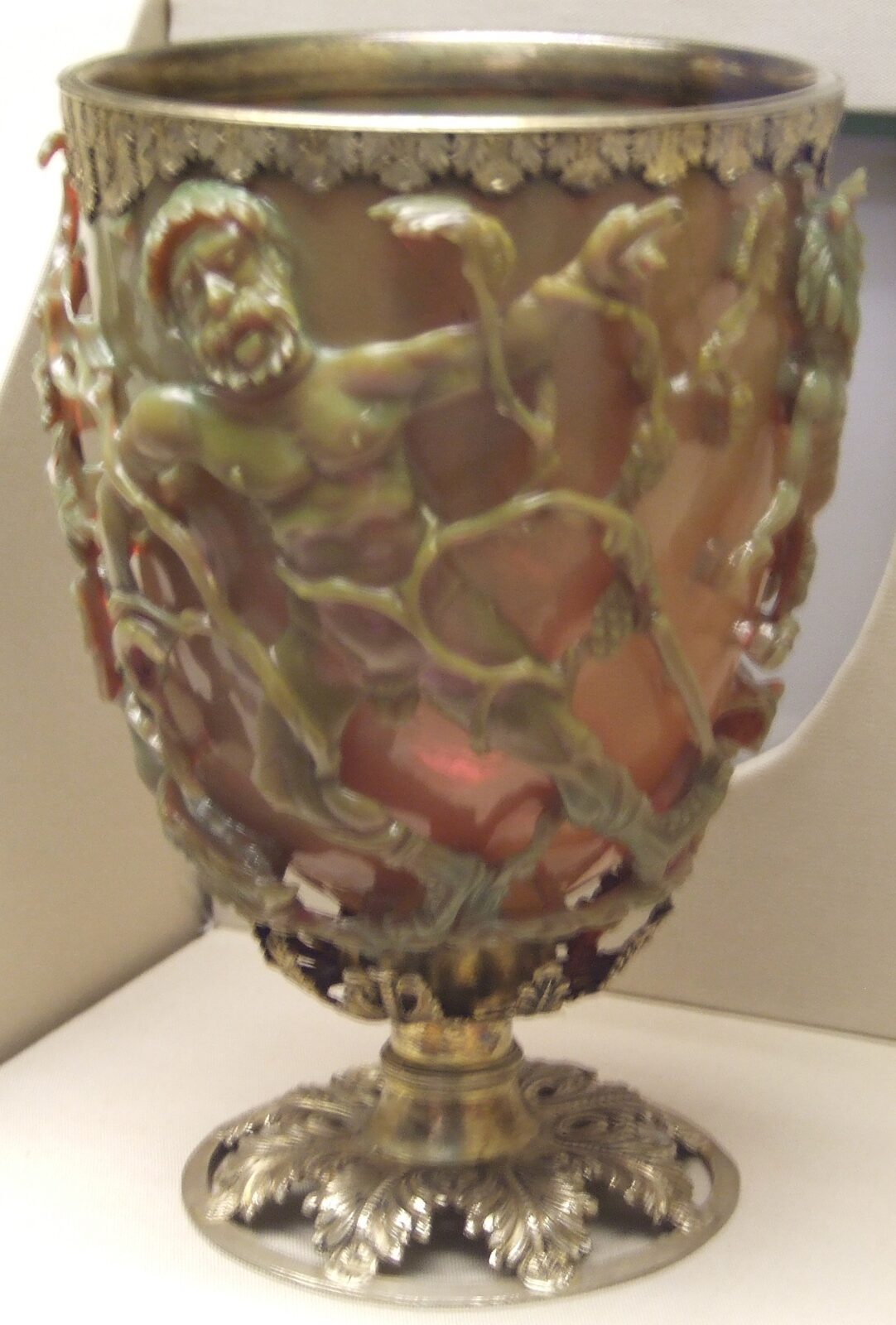
The Lycurgus Cup is a late Roman figurative cage cup — a diatretum — of the
fourth century AD, held by the British Museum as object 1958,1202.1 [1]. Held
one way it is opaque jade-green; lit from behind it turns translucent
ruby-red. That behaviour was, for a time, thought impossible for ancient
glass, and the object’s material identity was itself in question before it was
its chemistry [1].
The answer arrived in stages across four decades of analysis, and it is not
the answer usually reported. The cup is coloured by silver–gold alloy
particles typically 50–100 nanometres across, dispersed through an
otherwise unremarkable soda-lime-silica glass [1][3]. What the record does
not support is intent. The analysts’ own published position is that the
colouring process was poorly controlled and effectively did not survive the
fourth century [1].
Sequence of events
Fourth century AD — manufacture
- The cup belongs to the class of Roman cage cups or diatreta, in which
openwork decoration stands proud of the vessel body on shanks or bridges;
only in the region of 50–100 examples are known across the whole Roman
Empire [1].
- The frieze shows the death of Lycurgus, King of the Edoni in Thrace — the
moment he is enmeshed in vines by the nymph Ambrosia, with Dionysus, his
thyrsos and panther, a Pan and a satyr [1].
- The glass behind the figures and inside the cup was hollowed or bored out so
that similar amounts of light pass through the bodies and the adjacent
walls, showing the colour change to maximum advantage; the body of Lycurgus
is cut from an area of glass of slightly different colour [1].
1845 to 1958 — surfacing and acquisition
- First mentioned in print in 1845. The early history and the find spot
are unknown [1].
- No detailed study was made until 1950, when the cup was examined at Lord
Rothschild’s request by D. B. Harden and J. M. C. Toynbee, published as “The
Rothschild Lycurgus Cup” in Archaeologia 97 (1959) [1][4].
- Acquired from Lord Rothschild in 1958, with a contribution from the
National Art Collections Fund [1].
1959 to 1965 — is it even glass?
- Scholarly debate over whether the object was glass at all was settled by Dr
G. F. Claringbull, Keeper of Mineralogy at the British Museum (Natural
History), who concluded it was glass rather than opal or jade — confirmed by
X-ray diffraction in 1959 [1].
- In 1959 the British Museum sent a sample to the General Electric Company
research laboratories at Wembley. Chemical analysis showed a soda-lime-silica
glass much like other Roman glass, about 0.5% manganese, with silver and gold
among trace elements making up the final one per cent or so. B. S. Cooper of
GEC suggested colloidal metal as the cause [1].
- In 1962 a sample went to Dr Robert Brill of the Corning Museum of Glass,
together with a fragment of another dichroic diatretum. Brill linked the
effect to roughly 40 ppm gold and 300 ppm silver and inferred colloidal metal
particles — but with the technology then available he could not demonstrate
metallic particles unequivocally, nor establish whether they were an alloy or
separate silver and gold [1].
Late 1980s — the particles resolved
- A further small fragment was examined by D. J. Barber and I. C. Freestone
using analytical transmission electron microscopy, published in
Archaeometry 32 (1990) [1][3].
- TEM revealed metal particles typically 50–100 nm in diameter; X-ray
analysis showed them to be silver–gold alloy at a silver-to-gold ratio of
about 7:3, containing about ten per cent copper [1][3].
- The same work found numerous 15–100 nm particles of sodium chloride,
the chlorine probably derived from mineral salts used to supply the alkali.
Colourless and close to the glass in refractive index, their direct
contribution to the colour is likely minimal [1].
Documentary record
The fullest published account is Freestone, Meeks, Sax and Higgitt, “The
Lycurgus Cup — A Roman Nanotechnology,” Gold Bulletin 40/4 (2007), which
carries the analytical history, the nanoparticle data, the fabrication
evidence and the authors’ conclusion on how the technology arose [1]. The
underlying TEM identification is Barber and Freestone (1990); metadata is
verified, the full text paywalled [3]. The Rakow Research Library at the
Corning Museum of Glass maintains a bibliography of the primary literature,
including Harden and Toynbee (1959), Rothschild’s privately printed The
Lycurgus Cup (1954), Brill (1965) and Scott’s “A Study of the Lycurgus Cup,”
Journal of Glass Studies 37 (1995) [4].
Two findings in the 2007 paper bear directly on the question of control. The
gold-to-silver ratio in the alloy particles, around 3:7, is much higher than
in the glass as a whole, around 1:7 — indicating a substantial proportion of
the silver remained dissolved in the silicate matrix after the alloy particles
precipitated. Antimony, present at around 0.3%, is a likely agent of the
redox reaction that reduced the metals during heat treatment [1].
On fabrication, the British Museum tool-mark study of the openwork fragment
found crescent-shaped cuts indicating rotary abrasion and polishing on the
sides, non-rotary files and abrasives front and back, and mechanical removal
of glass from the undercut back. The high polish, once thought to be
fire-polishing, appears purely mechanical [1]. Rosemarie Lierke has argued
that diatreta such as this were moulded rather than cold-cut from blanks;
the tool-mark evidence runs against that reading, and both positions are on
the record [1].
Roman dichroic glass technology does not appear to have outlasted the fourth
century. Routine production of gold ruby glass in Europe is generally dated to
the seventeenth century and often credited to Johann Kunckel [1].
Two modern echoes are documented. A US patent granted on the eleventh of
October 2016 to Gang Logan Liu, Manas Ranjan Gartia and Austin Yin Kyai
Hsiao, assigned to the University of Illinois System and filed on the
sixteenth of January 2014, covers a “nano-Lycurgus-cup array” plasmonic
imaging sensor named explicitly after the cup, reporting refractive-index
sensitivity of approximately 46,000 nm/RIU [5]. Follow-on work by Wang, Chang,
Lin, Gartia and Liu in Analytical Chemistry (2017) reports detection limits
a hundred times better than microplate readers and thirty times better than
urine test strips [6]. Separately, Kool and colleagues in the Beilstein
Journal of Nanotechnology (2020) state the cup is the only intact ancient
glassware showing this property, with only a few other small human-made
dichroic fragments found worldwide, and report their own 3D-printable
silver/gold–PVA dichroic nanocomposite [2].
Open questions
- The find spot and the pre-1845 history of the cup are unknown [1]. As with
other out-of-place artefacts that surface
without provenance, the object arrives in the record already detached from
its context.
- The primary sources do not establish where the cup was made. Harden and
Toynbee’s Italian attribution is a stylistic suggestion, with Alexandria
left open [1][4].
- No source establishes how the gold–silver colouring recipe was discovered,
or whether any Roman glassworker understood gold to be the critical
colourant. Freestone and colleagues state it is “quite likely” they did not
[1]. The same authors speculate — and label it speculation — that oxidised
metallurgical by-products, dross or slag, were sometimes acquired to colour
glass, which might explain both the discovery and the relatively high
copper and lead oxide levels; they note accidents in producing
gold-leaf-decorated glass as another possibility [1].
- The date of the current silver-gilt foot and rim mount is given only as
“thought to date to the eighteenth or nineteenth centuries.” The original
base is lost to past breakage; whether the cup also had a taller rim is
stated only as a possibility [1].
- The choice of the Lycurgus myth has been thought to allude to Constantine’s
defeat of the emperor Licinius, who reigned from AD 308 to 324, in AD 324.
The source presents this without attribution to a named proponent [1].
- David Whitehouse drew attention to a passage in the Historia Augusta —
Vopiscus’s life of the third-century pretender Saturninus — reporting a
letter attributed to Hadrian that describes “parti-coloured cups that change
colour,” given by a temple priest and intended for feast-day banquets.
Whitehouse further speculates the green-to-red change symbolised the
ripening grape. This is a fourth-century literary source of contested
reliability, reaching this archive at second hand [1].
- The two published framings of the colour mechanism are not identical. Kool
and colleagues attribute the red transmission to gold particles and the
green reflection to silver particles [2]; Freestone and colleagues describe
a single silver–gold alloy nanoparticle population, with the earlier
Brill/GEC work suggesting gold drives transmission and silver reflection
[1]. Both are recorded here without adjudication.
Status
This file is CONFIDENTIAL — admitted on the strength of peer-reviewed
analytical publication by the institution holding the object, chiefly the 2007
Gold Bulletin paper and the 1990 Archaeometry TEM study [1][3]. There is
no mystery about the physics and this archive does not manufacture one.
Three commonly circulated claims are recorded here as not supported by any
source located. First, that the Romans “invented nanotechnology” or
knowingly engineered nanoparticles: the analysts’ published position is the
opposite [1]. Second, that the cup was used to detect poison or adulterated
wine: no traceable source was found in any primary or peer-reviewed material
consulted. Third, any specific named workshop, city of manufacture or original
owner: nothing traceable beyond the stylistic suggestion above.
Two corrections to the popular summary. The published particle figure is
“typically 50–100 nm,” not “about fifty nanometres” [1][3]. And the alloy is
silver-dominant at roughly 7:3 with about ten per cent copper — not an even
silver-gold split [1].
The effect is not even replicated exactly among the surviving dichroic glasses.
A comparable British Museum diatretum fragment, 1953,1022.2, runs from
opalescent buff to clear brown and carries 2270 ppm silver against only 13 ppm
gold, so its colourant is likely largely silver nanoparticles [1].
No public-domain image of the cup has been verified for this file. The
photographs in the cited paper are © The Trustees of the British Museum —
licence unverified, not reusable. The British Museum’s own online object
record returned HTTP 403 to every attempt; acquisition details here rest on
the 2007 paper by British Museum staff [1].
References
- Freestone, I., Meeks, N., Sax, M. & Higgitt, C. (2007). “The Lycurgus Cup — A Roman Nanotechnology.” Gold Bulletin 40/4, 270–277. DOI 10.1007/BF03215599 — full-text PDF copy fetched from a third-party mirror.
- Kool, L. et al. (2020). “Gold and silver dichroic nanocomposite in the quest for 3D printing the Lycurgus cup.” Beilstein Journal of Nanotechnology 11, 16–23. DOI 10.3762/bjnano.11.2 — CC BY 4.0.
- Barber, D. J. & Freestone, I. C. (1990). “An Investigation of the Origin of the Colour of the Lycurgus Cup by Analytical Transmission Electron Microscopy.” Archaeometry 32, 33–45 — bibliographic record. Metadata verified; full text closed.
- Rakow Research Library, Corning Museum of Glass. “Lycurgus Cup: A Guide to Resources” — bibliography including Harden & Toynbee 1959, Rothschild 1954, Brill 1965 and Scott 1995.
- US Patent 9,464,985 B2 — “Plasmon resonance imaging apparatus having nano-lycurgus-cup arrays and methods of use,” granted 11th October 2016. United States Patent and Trademark Office, via Google Patents. Public domain.
- Europe PMC record: Wang, Chang, Lin, Gartia & Liu, “Self-Referenced Smartphone-Based Nanoplasmonic Imaging Platform for Colorimetric Biochemical Sensing,” Analytical Chemistry (2017). DOI 10.1021/acs.analchem.6b02484