Briefing
On the tenth of August 1901, two English academics — Charlotte Anne
Moberly, first Principal of St Hugh’s College, Oxford, and Eleanor Jourdain,
her deputy and eventual successor — walked from the Palace of Versailles
towards the Petit Trianon, took a lane, and lost their way [1][4]. Both women
later wrote that from the moment they left the lane the character of the place
changed, and that they encountered figures in eighteenth-century dress in a
landscape they could not afterwards find [1].
Ten years later they published their separate narratives as An Adventure
(Macmillan and Co., 1911) under the pseudonyms “Elizabeth Morison” and
“Frances Lamont” [1]. The published editions are the only primary documents
that survive: the November 1901 manuscripts were destroyed in 1906 after being
copied into a notebook, and the Society for Psychical Research declined to
pursue the case, its reviewer attributing the experience to memory error
[4][5].
Sequence of events
The tenth of August 1901 — the walk
- Both women visited the grounds of the Petit Trianon, having walked from the
palace and taken a lane; they lost their way [1]. (Documented.)
- Moberly wrote that “from the moment we left the lane an extraordinary
depression had come over me, which, in spite of every effort to shake off,
steadily deepened.” Jourdain independently recorded “a feeling of depression
and loneliness about the place” [1]. (Witness testimony.)
- Both described two men in official dress. Moberly: “we spoke of them as
gardeners, because we remembered a wheelbarrow of some kind close by and the
look of a pointed spade, but they were really very dignified officials,
dressed in long greyish-green coats with small three-cornered hats.”
Jourdain: “Two men there in official dress (greenish in colour), with
something in their hands; it might have been a staff” [1]. (Witness
testimony.)
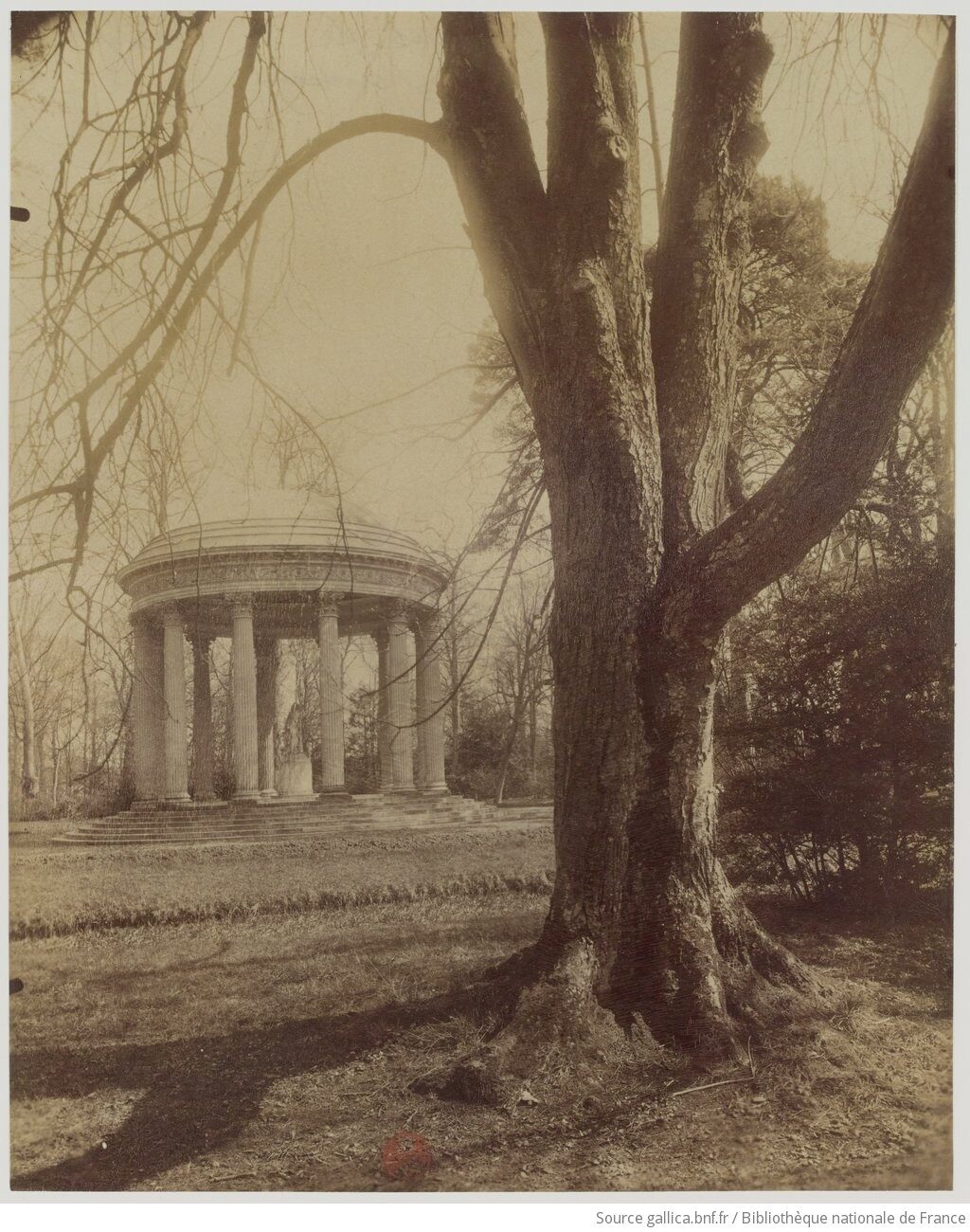
- Both described a garden building with a seated man. Moberly recorded “a
light garden kiosk, circular, and like a small bandstand, by which a man was
sitting… The man’s face was most repulsive,—its expression odious.”
Jourdain recorded “a building consisting of some columns roofed in… Seated
on the steps was a man with a heavy black cloak round his shoulders… The
expression was very evil” [1]. (Witness testimony.)
- Both recorded a second man who ran up and redirected them, using the words
“Il ne faut pas passer par là… par ici… cherchez la maison.” Jourdain noted
that the accent “seemed to me unusual” [1]. (Witness testimony.)
- Moberly alone described a lady seated on the terrace holding a paper at
arm’s length, wearing “a shady white hat perched on a good deal of fair
hair,” a light summer dress arranged “in handkerchief fashion,” and a pale
green fichu. Jourdain did not see this figure [1]. (Single-witness
testimony.)
- Jourdain alone described a cottage where “a woman and a girl were standing
at the doorway… both wore white kerchiefs tucked into the bodice… The woman
was passing a jug to the girl.” Moberly recorded no such scene [1].
(Single-witness testimony.)
- Both described a young man emerging from a door and slamming it, who
directed them to the cour d’honneur [1]. (Witness testimony.)
The aftermath, 1901 to 1906
- Neither woman raised the subject for about a week afterwards. Both wrote
accounts in November 1901; the Preface states that they “resolved to write
down independent accounts of our expedition to Trianon, read up its history,
and make every enquiry about the place” [1]. (Documented.)
- Jourdain returned alone on the second of January 1902. Moberly returned on
the fourth of July 1904 and again on the ninth of July 1904 [1].
(Documented.)
- By 1904 the features could not be located: “Neither bridge, nor cascade, nor
ravine can be found,” and, of the kiosk, “Repeated searches during seven
years… have failed to discover this building” [1]. (Documented.)
- The first accounts were sent to the Society for Psychical Research in
October 1902 [5]. (Documented.)
- The original documents were destroyed in 1906 after being copied into a
notebook [5]. (Documented.)
Publication, 1911 to 1955
- An Adventure was published by Macmillan and Co. in 1911. The Publishers’
Note states: “The ladies whose Adventure is described in these pages have for
various reasons preferred not to disclose their real names, but the
signatures appended to the Preface are the only fictitious words in the book”
[1]. (Documented.)
- A second edition, “with appendix and maps”, followed from Macmillan in 1913;
five editions appeared in total, the last from Faber and Faber in 1955
[2][3][5]. (Documented.)
Documentary record
The archive holds no contemporaneous record of the walk itself. What survives
is the published text and the editions that followed it.
An Adventure (Macmillan, London, 1911) is the primary text: a
Publishers’ Note, a Preface, both women’s separately-signed narratives, and
their own historical research [1]. The second edition of 1913 adds the
appendix and the maps on which the authors based their archival argument [2].
The fifth and final edition, from Faber and Faber in 1955, runs to 131 pages
with illustrations, portraits and folded maps [3].
Against these the estate’s own documentation can be set. The Château de
Versailles dates the Temple of Love to a design of 1777 and completion in July
1778, the Belvedere to 1781 and the Grotto to 1782, and records that Louis XV’s
botanical gardens were replaced by an Anglo-Oriental garden after
Marie-Antoinette took possession in 1774 [6]. The English garden and its
structures were laid out from 1774 by Richard Mique, Marie-Antoinette’s
official architect [6].
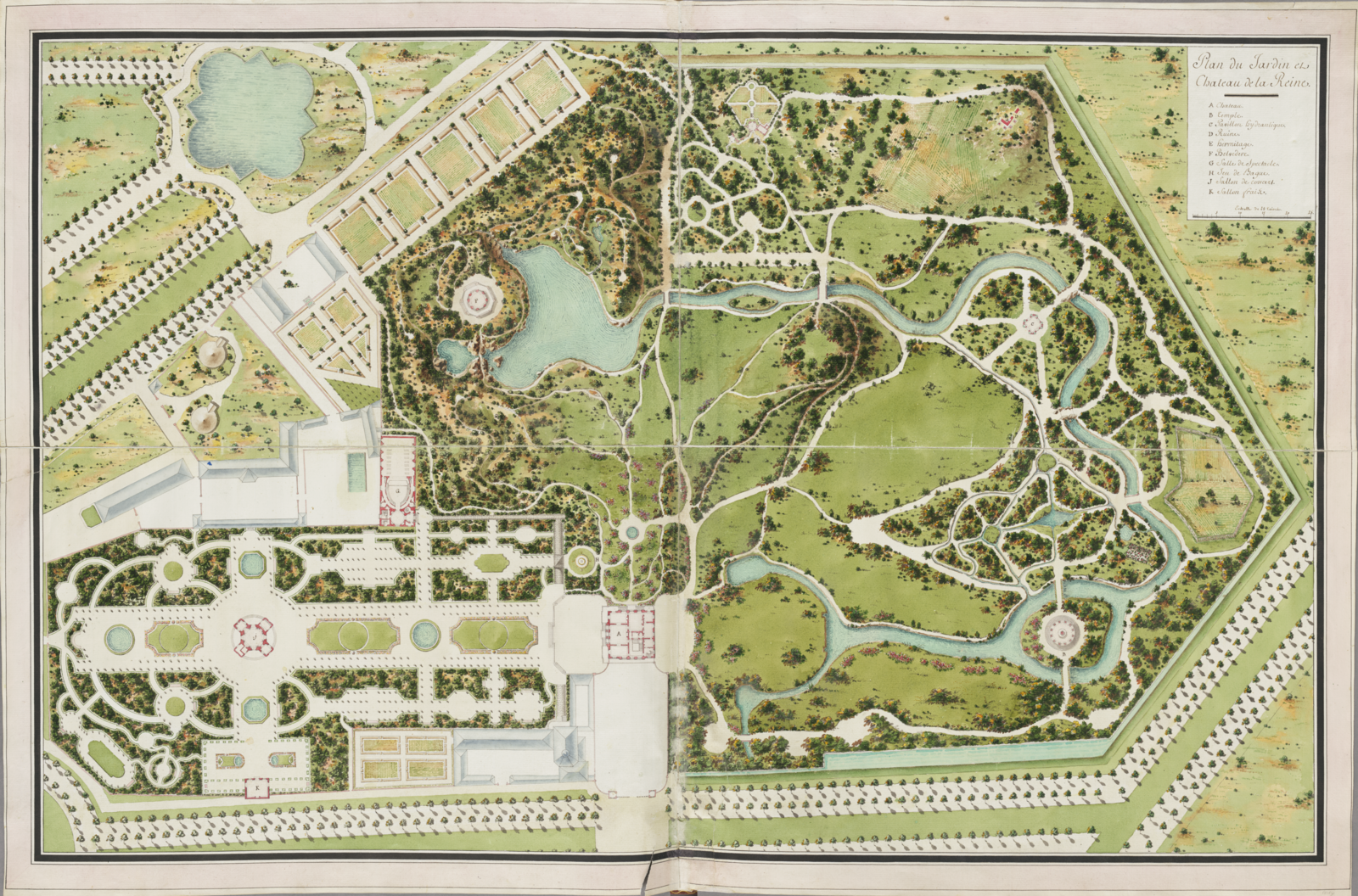
The authors claimed archival corroboration of their own: manuscript maps
showing a small bridge in the right position relative to the lakes, a “Le
Kiosque” marking, an estimate for a “ruine” with seven Ionic columns, and an
1783 map indicating a building against a wall matching Jourdain’s cottage [1].
This archive records those claims as reported — they rest on the authors’
own reading of the maps, which the surviving text presents rather than
reproduces for independent test.
Eleanor Mildred Sidgwick wrote the unsigned SPR review of the case,
attributing the experience to memory error and holding that “a good deal of
evidence would be required before a phenomenon of this kind could be accepted
as a fact” [4]. Later commentary is set out below; none of it is primary.
- W.H. Salter (SPR, 1949–50) argued the documentation was too delayed and
successively embellished, and that later research had fed back into the
“memories” [4].
- G.W. Lambert (1953–62) proposed the scenes belonged to about 1774, in Louis
XV’s reign, and involved the gardener Antoine Richard [4].
- Philippe Jullian (1967) suggested the women had encountered costume
tableaux vivants hosted nearby by Robert de Montesquiou [4].
- Lucille Iremonger (1957) attacked the women’s personal and professional
credibility [4].
- Michael Coleman (SPR, 1988) restated the methodological objections [4].
- Mark Lamont (2021) concluded that the successive accounts “were not written
independently, indicate the subsequent inclusion of elements which evoke the
eighteenth-century, and are more slanted to favour a paranormal
interpretation” — directly contradicting the Preface’s claim of independent
composition. Lamont dismissed the Montesquiou theory while allowing that the
earlier dating may have merit; the reviewer Tom Ruffles favoured fatigue,
heat and unreliable memory [5].
The authors’ own proposed dating is recorded here as theory, not finding. They
first linked the date to the tenth of August 1792 and the sacking of the
Tuileries, then argued for the fifth of October 1789 — the Queen’s last visit
to Trianon before the mob marched on Versailles — citing a tradition that a
messenger was sent to warn her [1]. They further proposed that they may have
“inadvertently entered within an act of the Queen’s memory when alive,” rather
than witnessed a conventional haunting [1] — a framing that sits closer to the
time slip category than to the archive’s
files on ghosts.
Open questions
- The primary text does not resolve which figures, if any, correspond to
identifiable people. The widely repeated identification of the sketching
lady as Marie-Antoinette is inference, not documentation [1].
- The 1911 and 1913 editions cannot be checked against the November 1901
manuscripts, because those were destroyed in 1906 after copying [5]. The
central evidential question of the case — whether the published narratives
match what was written ten years earlier — is therefore closed to testing.
- No independent 1901 witness, photograph, or contemporaneous third-party
record of the walk has been located in the sources consulted.
- The identity of the SPR officer who declined the October 1902 submission,
and the stated grounds for declining, were not traceable in the sources
consulted. Only the submission date is documented [5].
- The Publishers’ Note gives no documented reason for the pseudonyms beyond
“for various reasons” [1]. Accounts that supply a motive are supplying it
themselves.
- The claim, sometimes repeated, that the women “walked into a garden
demolished in 1774” is not supported by any source consulted. The official
record shows that Marie-Antoinette replaced Louis XV’s botanical garden from
1774, and that the structures the women described post-date it — Temple of
Love 1778, Belvedere 1781, Grotto 1782 [6]. The 1774 date belongs to
Lambert’s sceptical theory about the scene, not to a demolition of the
garden the women crossed [4][6].
- The authors themselves declined to explain: “It is not our business to
explain or to understand—nor do we pretend to understand—what happened” [1].
Status
This file is CONFIDENTIAL — admitted to the archive on the strength of a
published, public-domain primary text with two separately-signed narratives, a
documented publication history across five editions, and a documented
institutional trail through the Society for Psychical Research [1][2][5]. It is
not admitted as evidence that a displacement in time occurred.
The evidential weight rests entirely on testimony recorded, on the authors’
own account, some three months after the event, and preserved only in copies
made before the originals were destroyed in 1906 [5]. Both women were held by
associates to have special powers of perception and reported other anomalous
experiences together — a detail the archive records as reported, and one that
cuts both ways [4]. Where the two narratives diverge — the seated lady seen by
Moberly alone, the cottage seen by Jourdain alone — this archive treats each as
single-witness testimony and nothing more [1].
The case is retained for the quality of its paper trail rather than the
strength of its claim. Its central document has been contested on
methodological grounds by the society best placed to test it, and the material
that would settle the contest no longer exists [4][5]. Updates pending any
located copy of the November 1901 notebook transcriptions.
Note: the official published history of St Hugh’s College names Moberly only
as “St Hugh’s first Principal”, does not mention Jourdain, and makes no
reference to An Adventure [7].
References
- Moberly, C.A.E. and Jourdain, E.F. (1911). An Adventure. Macmillan and Co., Limited, London; digitised by Project Gutenberg. Public domain. Published under the pseudonyms “Elizabeth Morison” and “Frances Lamont”.
- An adventure, with appendix and maps, 2nd edition (1913). Macmillan, London; 244pp. Public domain scan, University of Toronto copy, via the Internet Archive.
- An adventure (1955). Faber and Faber, London; 131pp, with illustrations, portraits and folded maps. The fifth and final edition. McGill University Library via the Internet Archive; licence unverified.
- Versailles ‘Time-Slip’. Psi Encyclopedia, Society for Psychical Research. Accessed 6th September 2026.
- Ruffles, Tom. Review of The Mysterious Paths of Versailles: An Investigation of a Psychical Journey Back in Time, by Mark Lamont (2021). Society for Psychical Research. Accessed 6th September 2026.
- The English Gardens — The Estate of Trianon. Château de Versailles (Établissement public du château, du musée et du domaine national de Versailles). Accessed 6th September 2026.
- History. St Hugh’s College, University of Oxford. Accessed 6th September 2026.