CONFIDENTIAL
CR-26002
The Patterson-Gimlin Film
- Incident
- 1967-10-20
- Location
- Bluff Creek, Del Norte County, California, United States
- Coords
- 41.4347, -123.7022
Brief
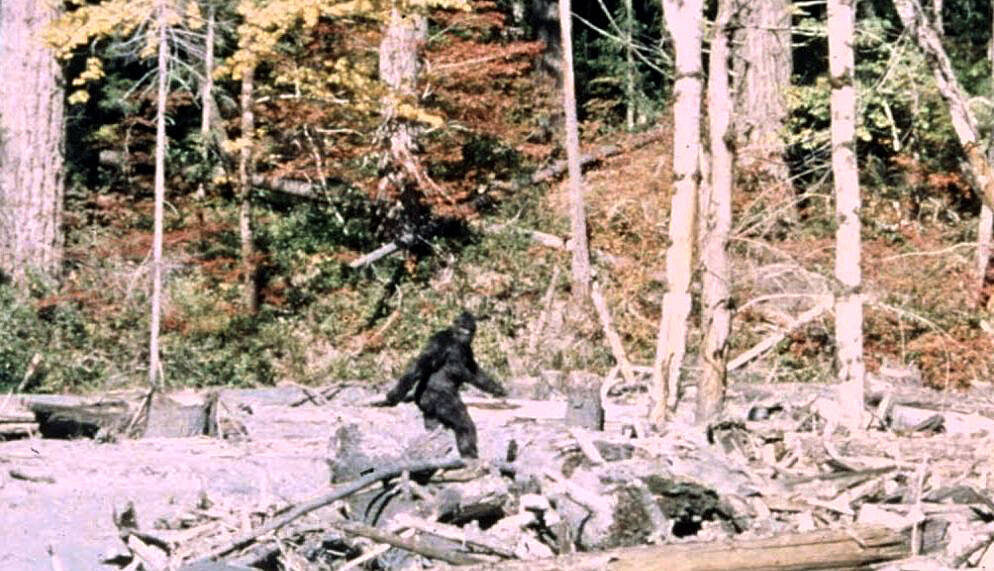
The Patterson-Gimlin film is a short 16mm colour motion picture, reportedly shot on the twentieth of October 1967 at Bluff Creek in northern California, depicting a large, dark, bipedal figure walking across a sandbar. Six decades on it remains both undebunked and unconfirmed: journal analyses argue the subject is a non-human primate, named individuals claim it was a costume hoax, and no government or court record adjudicates the question.
Filed 2026-06-25 · Last updated 25 June 2026
Briefing
The Patterson-Gimlin film is a short 16mm colour motion picture, reportedly
shot on the twentieth of October 1967 at Bluff Creek
in northern California by Roger Patterson and Bob Gimlin, depicting a large,
dark, bipedal figure walking across a sandbar [1][4]. The surviving reel runs
to roughly 954 frames and is freely viewable on the Internet Archive [1][3].
Six decades on it remains both undebunked and unconfirmed: journal analyses
argue the subject is a non-human primate, while named individuals claim it was a
costume hoax — and no government or court record adjudicates the question.
Sequence of events
The filming — the twentieth of October 1967
- [Reported] The footage was filmed between 1:15 and 1:40 p.m. alongside a
tributary of the Klamath River, about 25 logging-road miles (40 km) northwest
of Orleans, California, in Del Norte County on the Six Rivers National Forest.
This timing and location is the filmmakers’ own account [4].
- [Reported] Patterson used a Cine-Kodak K-100 camera he had rented on the
thirteenth of May 1967 from photographer Harold Mattson at Sheppard’s Camera
Shop in Yakima, loaded with Kodachrome II colour film [4].
- [Reported] Bob Gimlin accompanied Patterson on horseback; he is the only
living eyewitness and has consistently denied any hoax [1][4].
- [Documented] The surviving film consists of 954 individual 16mm frames; the
single most-reproduced image is frame 352, the “look-back” frame in which the
figure turns its torso toward the camera [2][3][4].
- [Documented] The clearest walking sequence spans roughly 40 feet of travel;
frame 364 is described as the last best image, after which the figure turns
left (northward) into thick forest and presents its back [2].
Documentary record
The film reel itself — a complete reel of about 3 minutes 28 seconds “shot by
Roger Patterson in and around Bluff Creek, CA, in 1967” — is hosted on the
Internet Archive, uploaded on the eleventh of August 2017. The Archive item
page carries no explicit licence or rights statement, and the licence is
therefore unverified [1].
Two analytical papers form the principal published record, both in The Relict
Hominoid Inquiry, an Idaho State University journal edited by Dr Jeff Meldrum.
Munns and Meldrum (2013), Surface Anatomy and Subcutaneous Adipose Tissue
Features in the Analysis of the Patterson-Gimlin Film Hominid (RHI 2:1–21),
argues that surface-anatomy and fat-deposition features attributed to a
“costume” also occur naturally in human and ape bodies, concluding the subject
is “consistent with… a novel primate species” [3]. The same authors report, by
direct frame-by-frame observation, that roughly forty per cent of the 954
frames are relatively sharp without significant motion blur and about one
hundred may be considered “pristine” — contradicting the claim that camera
shake renders the film unanalysable [3].
Murphy (2017), The Patterson/Gimlin Film — Some Noteworthy Insights (RHI
6:1–16), provides stature and gait measurements [2]. Murphy calculates the
subject’s standing height at about 94 inches (walking height about 87.5
inches), citing a height estimate of over seven feet attributed to Glickman
(1998); using a 46-frame sequence (frames 307–352, about three seconds at 16
fps) covering 16.6 feet, he derives a walking speed of 3.85 mph against an
average human’s roughly 3.1 mph [2]. He further reports the subject as about
5.9 heads tall — between an adult male gorilla (5.5) and human adults (7.5–8) —
arguing the head-to-stature ratio is “essentially beyond human proportions” [2].
These figures are model-dependent reconstructions rather than measurements made
at the scene. The footprint casts made at the site measured 14.5–15 inches
long, one foot slightly larger [2].
Separately, the FBI’s released “Bigfoot” file, made public in 2019, documents
that researcher Peter Byrne sent the Bureau about 15 hairs with skin in 1976,
and that examiners concluded in late 1976 or early 1977 they were “of deer
family origin” [5]. This file concerns hair samples, not the Patterson-Gimlin
film; the primary document could not be retrieved directly, and the point rests
on secondary reporting [5].
Open questions
- No primary source establishes the camera’s frame-rate setting at the moment
of filming; Patterson did not record it. The 16-versus-18-versus-24 fps
debate is unresolved at the documentary level, which in turn affects every
speed and stature figure derived from frame counts [2].
- No government report, court ruling, or peer-reviewed forensic finding
establishes the figure as either a real animal or a costume.
- The exact line of travel, the distances, and the scale object — a
26.25-inch wood fragment retrieved by René Dahinden in 1971 — rest on later
reconstruction, not on documentation made at the scene on the day [2].
- Two costume claims stand unresolved: Bob Heironimus claimed he wore the suit,
going public via a press release by his lawyer Barry Woodard on the thirtieth
of January 1999; and Philip Morris claimed he sold Patterson a gorilla
costume, first stating this publicly on the sixteenth of August 2002 [4].
Neither claim is supported by a contemporaneous document.
- The origin of the figure’s popular nickname “Patty” has no traceable primary
source in the materials reviewed, and no signed 1967 witness statement by
either filmmaker was located [4].
Status
This file is CONFIDENTIAL — admitted to the archive on the strength of the
surviving film itself and two named journal analyses, while the central
question remains open [1][2][3]. The archive records the analysts’ conclusions
(Munns and Meldrum hold that the surface anatomy “defies the limits of
fabricated costumes employing materials available in 1967”) as theory, the
filming circumstances and the rival costume claims as reported, and Bob
Gimlin’s statement that he stayed true to “every detail of that October day in
1967” as witness testimony [1][3][4]. Witness testimony and contested
measurement alone would not clear our editorial bar for a higher tier. The case
sits alongside the archive’s other contested
bipedal-hominid cryptid reports as a
documented artefact attached to an unresolved claim. Updates pending any
primary forensic finding.
References
- Complete Patterson-Gimlin Bigfoot film. Internet Archive, uploaded 11 August 2017. Complete reel (~3 min 28 sec); item page carries no explicit licence statement (licence unverified).
- Murphy, Christopher (2017). “The Patterson/Gimlin Film — Some Noteworthy Insights”, The Relict Hominoid Inquiry 6:1–16. Idaho State University.
- Munns, Bill & Meldrum, Jeff (2013). “Surface Anatomy and Subcutaneous Adipose Tissue Features in the Analysis of the Patterson-Gimlin Film Hominid”, The Relict Hominoid Inquiry 2:1–21. Idaho State University.
- Patterson–Gimlin film. Wikipedia, accessed 25 June 2026.
- FBI Records: The Vault — Bigfoot. Federal Bureau of Investigation, released 2019. Primary document not directly retrievable at time of writing; facts rest on secondary reporting.