Briefing
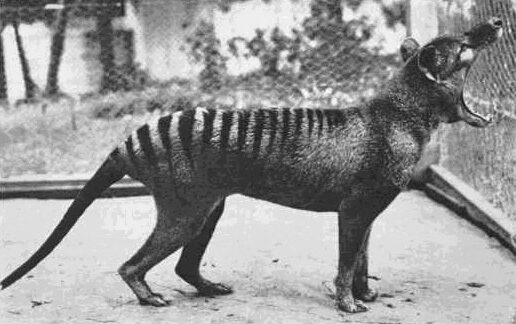
The thylacine (Thylacinus cynocephalus), Tasmania’s striped marsupial
predator, is officially extinct. The last known captive animal died at Hobart
Zoo on the seventh of September 1936, and the Tasmanian government formally
declared the species extinct in 1986 [1]. Yet reported sightings never stopped.
A Tasmanian government file, released under the Right to Information Act 2009,
logs seven fresh eyewitness reports between the twenty-seventh of December
2016 and the fifteenth of August 2019 — every one officially assessed as
“inconclusive” [2][1]. The case for this file, like that of the claimed
surviving Mokele-mbembe, rests on a persistent
stream of testimony that no physical evidence has yet confirmed.
Sequence of events
The documented history of the species runs from bounty to protection to
declared extinction, followed by an unbroken record of unverified reports.
-
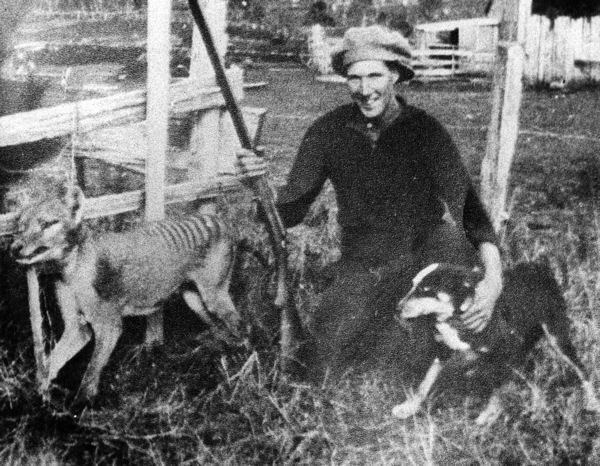
- The Van Diemen’s Land Company introduces a private bounty on
thylacines [1].
-
- The Tasmanian Parliament places a price of £1 on a thylacine’s head [1].
-
- The government bounty scheme is terminated, by which point 2,184
bounties have been paid [1].
-
- The thylacine is added to Tasmania’s list of protected wildlife [1].
Protection is reported to have taken effect on the tenth of July 1936, 59 days
before the last captive animal died [3].
- The seventh of September 1936. The world’s last known captive thylacine dies
at Hobart Zoo [1].
-
- The IUCN lists the species extinct [3].
-
- Tasmania declares the thylacine extinct “by international standards” [1].
The 2016–2019 sighting reports
Each of the following is a firsthand account logged and assessed by the
department, and released in the Right to Information file [2].
- The twenty-seventh of December 2016, Murchison Highway (~16 km north of
Waratah; report filed the third of January 2017). The observer described an
animal crossing the road some 150–200 m ahead at around 19:00 in a “half trot,
half run”, with a straight tail “at least a foot or two foot long”, a body
about two feet long, and a “sandy” colour — “no stripes were observed” [2].
- The twenty-third of April 2017, Bass Highway into Launceston (report filed
the twenty-fourth of April 2017). Two occupants reported an animal that ran
across the road at around 19:30, stopped and turned to give a side-on view;
“a strongly striped pattern was observed by both”, with a tail “not being fox
like, not fluffy, a bit cat like?” at 20–30 m [2].
- The eighteenth of February 2018, King William Saddle, Lyell Highway (report
filed the same day). A motorcyclist in a group of seven described “a large
cat like creature” crossing the road near Derwent Bridge at around 17:15–18:00
that kept “its body gliding at the same height”, unlike a fox [2].
- The twenty-first of January 2018, near Corinna (report filed the
twenty-fifth of February 2018). A couple visiting from Western Australia said
an animal walked across the gravel road in clear view for 12–15 seconds at
around 15:30, just after they drove off the Fatman Barge; it had “a stiff and
firm tail, that was thick at the base”, “stripes down its back”, and was “the
size of a large Kelpie”. They stated they were “100% certain that the animal
they saw was a Thylacine” and supplied a grid reference (339747E 5386956N) [2].
- The twenty-fourth of November 2018, Hartz Mountains (report filed the
twenty-sixth of November 2018). The reporter believed she saw “a Tasmanian
Tiger and two cubs” [2].
- Sleeping Beauty mountain, Mountain River area (report filed the twenty-ninth
of July 2019). The reporter recorded a footprint sighting on the walk up the
mountain; no photograph was taken, but after searching online at home she
“believes it was a Tasmanian Tiger footprint” [2].
- Midlands (report filed the fifteenth of August 2019). The record notes a
witness who “thinks she saw a Tassie Tiger on his land 7 years ago” [2].
Documentary record
Two primary documents anchor this file.
The RTI-DL-RELEASE-DPIPWE release — “Thylacine Sighting Reports, 1 September
2016 to 19 September 2019” — is a tabular government log (date reported,
location, time, duration, details) of the seven public sighting reports, with
personal identifiers redacted, released under Tasmania’s Right to Information Act
2009. It is the primary document behind every sighting above [2]. The Department
of Primary Industries, Parks, Water and Environment (now Natural Resources and
Environment Tasmania) redacted the Corinna witnesses’ names and contact details,
and the assessing officer’s identity, before release [2].
The NRE Tasmania official “Tasmanian Tiger” species page states the 1936
death date, the protection listing, the 1986 extinction declaration, the
1830/1888/1909 bounty milestones and the 2,184 bounties paid, and confirms that
sighting reports have “continued” but remain “inconclusive”. In its own words:
“Since 1936, no conclusive evidence of a thylacine has been found. However, the
incidence of reported thylacine sightings has continued,” and “all sightings
have remained inconclusive” [1].
Open questions
- The primary documents contain no physical evidence — no verified
photograph, carcass, scat, or DNA — corroborating any post-1936 sighting; the
government’s stated position is that all remain inconclusive [1].
- The Right to Information file does not record the department’s per-report
verdict, any follow-up investigation, or whether any site was searched [2].
- The primary sources do not resolve whether the reports reflect surviving
thylacines, misidentified foxes, quolls, feral cats or dogs, or hoaxes — they
are logged, not adjudicated [2][1].
- The descriptions conflict on the diagnostic feature: some witnesses report
clear stripes (Launceston, Corinna), while the Murchison Highway witness
explicitly saw “no stripes” [2].
- Reported but outside the government record: Western Australia’s Department of
Conservation and Land Management is said to have logged 203 thylacine sighting
reports between 1936 and 1998 — on a mainland where the species was thought
extinct millennia earlier [3]. A 2023 study led by the researcher Barry Brook
modelled a likely extinction window from the late 1990s to early 2000s; the
conservationist Nick Mooney is reported to have criticised the underlying
dataset as unreliable [3].
Status
This file is CONFIDENTIAL — admitted to the archive on the strength of an
official government log, the RTI-DL-RELEASE-DPIPWE file, and the NRE Tasmania
species page, both primary and contemporaneous to the reports they record
[2][1]. The seven eyewitness accounts within that file are, however,
uncorroborated firsthand testimony: the Corinna reporters’ “100% certain…
Thylacine” is the most emphatic, but it is single-party and photograph-free [2].
Witness conviction alone does not clear our editorial bar, and the archive holds
no verified physical evidence for any post-1936 survival. Popular figures such
as “more than 4,000 sightings since 1936” could not be traced to any official
register; the only counts verifiable from primary or official records are the
seven in the RTI file and the reported Western Australian figure of 203 [2][3].
This file remains open pending any authenticated physical evidence.
References
- Tasmanian Tiger — species page, Department of Natural Resources and Environment Tasmania (Tasmanian Government). Accessed 15th July 2026.
- Thylacine Sighting Reports, 1 September 2016 to 19 September 2019 (RTI-DL-RELEASE-DPIPWE). Department of Primary Industries, Parks, Water and Environment (Tasmanian Government), released under the Right to Information Act 2009. Accessed 15th July 2026.
- Thylacine — Wikipedia. Accessed 15th July 2026.