CONFIDENTIAL
CS-26004
The Universe 25 Experiment (Calhoun's Mouse Utopia)
- Incident
- 1968-07-09
- Location
- National Institute of Mental Health, Poolesville, Maryland, United States
- Coords
- 39.1463, -77.4172
Brief
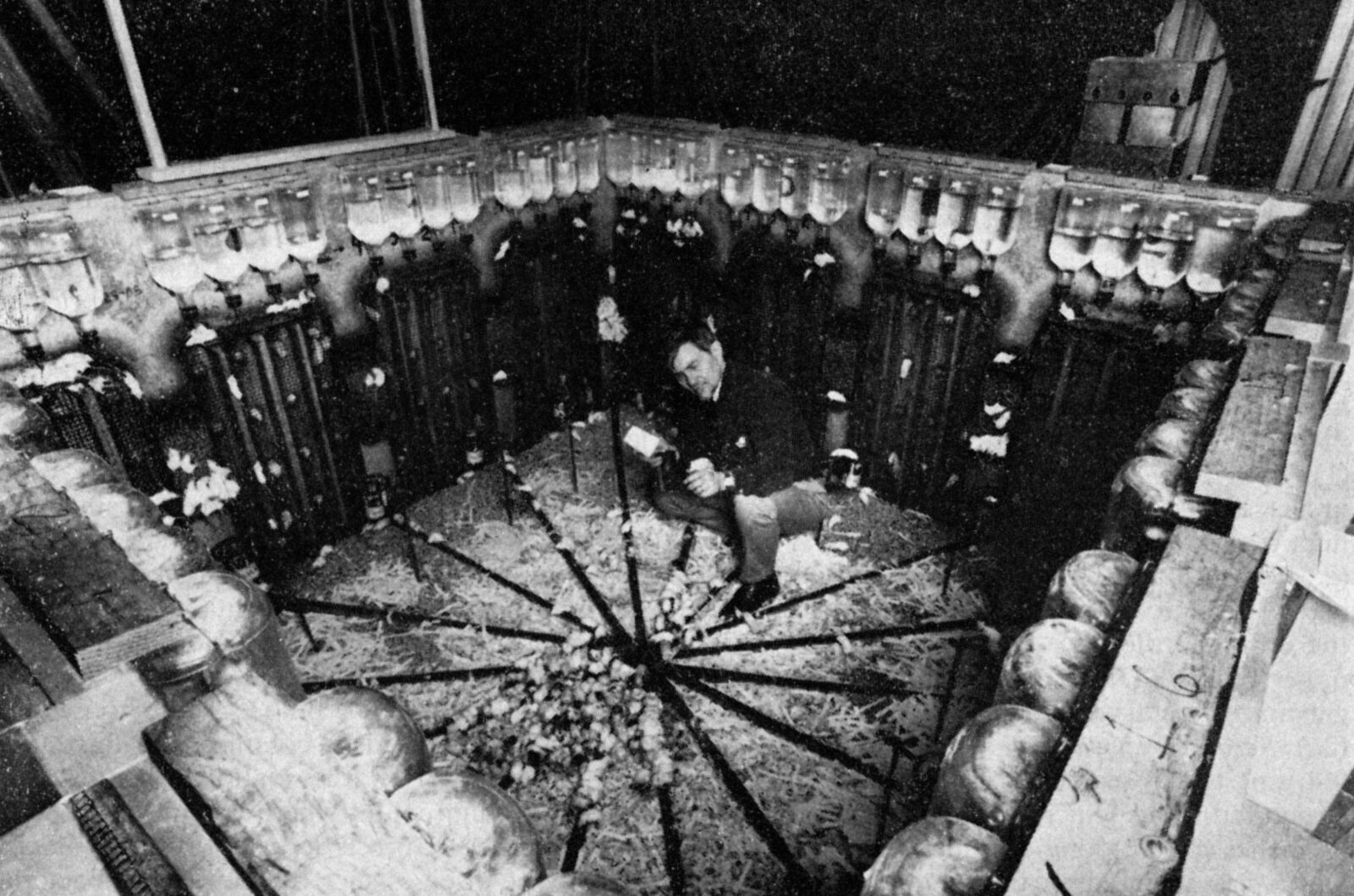
Universe 25 was a mouse-population experiment run by the ethologist John B. Calhoun at the U.S. National Institute of Mental Health, begun on the ninth of July 1968 with four breeding pairs in an enclosure of unlimited food, water and space. The colony grew to roughly 2,200 mice, then suffered total social breakdown and went extinct. The experiment is genuine and peer-published, but its popular framing as proof of human "societal decay" is interpretation, not finding.
Filed 2026-06-26 · Last updated 26 June 2026
Briefing
On the ninth of July 1968, four breeding pairs of mice — eight animals,
all forty-eight days old — were placed into a purpose-built enclosure at the
U.S. National Institute of Mental Health, where the
research psychologist and ethologist John B. Calhoun had constructed what he
described as a mouse utopia [1][2]. Food, water and nesting space were
effectively unlimited; there were no predators and no weather. Over the next
four years the colony rose to roughly 2,200 animals, passed through a
progressive collapse of normal social behaviour, and went extinct [2]. The
work is genuine and peer-published; what remains contested is what, if
anything, it says about people.
Sequence of events
Calhoun divided the colony’s history into four phases [2].
Phase A — days 0 to 104 (from the ninth of July 1968)
- A “strive” or adjustment period in which the founder mice established
themselves, before the first births [2].
- The habitat was a metal pen approximately 101 inches (about 2.57 m) square
with 54-inch walls, divided into sixteen “cells” with 256 nest sites [2].
- Calhoun calculated the pen could shelter about 3,840 mice, with water
capacity for roughly 6,144 and food for roughly 9,500 [2].
Phase B — days 104 to 315
- Rapid growth, with a population-doubling time of roughly fifty-five days [2].
Phase C — days 315 to 560
- “Stagnation”: the doubling time slowed to about 145 days as social pathology
spread [2].
- As density rose, normal social behaviour collapsed — dominant males failed
to hold territory, females became aggressive and then ceased maternal care,
abandoning or attacking their young, while some mice withdrew entirely [2].
- A cohort Calhoun named “the beautiful ones” emerged: males that never
courted and never fought, and only ate, drank, slept and groomed, leaving
them with pristine coats but socially and reproductively inert [2][3].
Phase D — from day 560
- Decline, with deaths outpacing births [2].
- The population peaked at about 2,200 — well below the enclosure’s physical
capacity — around day 560 [2].
- The last viable births occurred around day 600 and the last recorded
conception around day 920; thereafter the colony was reproductively dead
while still alive [2].
The final census — the twenty-second of June 1972
- The colony numbered 122 mice (22 males, 100 females), all past breeding
capacity [2].
- Calhoun projected that the last male would die around the twenty-third of May
1973 — approximately day 1,780 — making extinction inevitable [2].
Documentary record
The primary source is Calhoun’s 1973 paper, “Death Squared: The Explosive
Growth and Demise of a Mouse Population”, published in the Proceedings of
the Royal Society of Medicine (volume 66, pages 80–88) — the origin of all
phase data, the enclosure dimensions, the “beautiful ones”, the final census
and the extinction projection [1][2]. Calhoun’s title framed two deaths: a
“first death” of the spirit or social self — the loss of complex social
behaviour — preceding the inevitable physical death of the population [2].
Universe 25 was a mouse application of ideas Calhoun had developed earlier with
brown rats. In his 1962 Scientific American paper, “Population Density and
Social Pathology” (experiments of roughly 1958–1962), he had coined the term
“behavioral sink” [4][7]. The designer and author was John Bumpass Calhoun
(1917–1995), a research psychologist and ethologist who joined NIMH in 1954
and worked at its Bethesda and later Poolesville, Maryland laboratories, having
earlier been part of the Rodent Ecology Project at Johns Hopkins from 1946 to
1949; NIMH funded and housed the work [5]. The U.S. National Library of
Medicine holds official documentation of his NIMH career, films and “rodent
universe” research programme [3][5].
Open questions
- The primary paper documents what the mice did but does not establish that
the same mechanism governs human populations; Calhoun’s human analogies are
interpretive, not experimental results [2].
- Whether the collapse was driven by density itself, by social-role
saturation, by genetic founder effects from eight mice, or by accumulated
abnormal rearing is not resolved within the paper [2].
- Replication details and raw mortality tables are summarised rather than
fully tabulated in the 1973 article [2].
- Some popular accounts date the experiment to “1970–1972” and cite a habitat
capacity of “4,000”; the primary paper gives a ninth-of-July-1968 start and
a shelter capacity of about 3,840. Round-number popular figures should be
treated as approximations [2][6].
Status
This file is CONFIDENTIAL — admitted to the archive on the strength of a
peer-published primary source, Calhoun’s 1973 Proceedings of the Royal Society
of Medicine paper, corroborated by U.S. National Library of Medicine records
of his NIMH career [1][2][5]. The experiment itself is documented; the wider
claims attached to it are not. Calhoun explicitly read the work as a parable
for human overpopulation and urban “spiritual death”, invoking biblical
“second death” imagery — his stated interpretation, not a demonstrated finding
[2]. Secondary histories report that the work heavily influenced 1970s
urban-crowding anxiety and dystopian fiction [4], while modern commentators —
including Snopes, the Science History Institute and academic critics — argue
that Universe 25 does not prove human society is collapsing and that mouse
density is a poor model for human societies, noting founder genetics and
confinement as confounds [6].
Two cautions on figures often circulated online. The dramatic “96% infant
mortality / cannibalism / hypersexuality” numbers appear to derive from
Calhoun’s earlier rat experiments of 1958–1962 rather than from Universe 25’s
mice, and the two are frequently conflated [4][7]. The claim that the beautiful
ones numbered “exactly 120” has no single authoritative figure in the primary
paper; the traceable number is the final census of 122 mice (22 males, 100
females) [2]. No human-extinction date appears in the primary source — only the
mouse colony’s projected terminal date of around May 1973 [2].
References
- Calhoun, J. B. (1973). “Death Squared: The Explosive Growth and Demise of a Mouse Population.” Proceedings of the Royal Society of Medicine 66(1 Pt 2): 80–88 (PubMed Central / U.S. National Library of Medicine)
- Calhoun, J. B. (1973). “Death Squared” — full-text reproduction, Indian Institute of Science, ENVIS / CES
- The Falls of 1972: John B Calhoun and Urban Pessimism — U.S. National Library of Medicine (NIH), Medicine on Screen
- Ramsden, E. & Adams, J. — The urban animal: population density and social pathology in rodents and humans (Bulletin of the WHO / PubMed Central)
- John B. Calhoun biographical / NIMH career record — U.S. National Library of Medicine (NIH)
- Universe 25 ‘Rodent Utopia’ Experiment Doesn’t Mean Human Society Is Dying — Snopes
- Calhoun, J. B. (1962). “Population Density and Social Pathology” — Scientific American
Frequently asked
- What was the Universe 25 experiment?
- Universe 25 was a mouse-population study run by the ethologist John B. Calhoun at the U.S. National Institute of Mental Health, begun on the ninth of July 1968 with four breeding pairs placed in an enclosure of unlimited food, water and space. The colony grew to about 2,200 mice, then suffered total social breakdown and went extinct.
- Did Universe 25 prove that human society is collapsing?
- No. The primary paper documents what the mice did but does not establish that the same mechanism governs human populations; Calhoun's human analogies are interpretive, not experimental results. Modern commentators, including Snopes and academic critics, argue that mouse density is a poor model for human societies and note confinement and founder genetics as confounds.
- Who were "the beautiful ones"?
- "The beautiful ones" was Calhoun's name for a cohort of male mice that never courted and never fought, and only ate, drank, slept and groomed. Lacking the wounds of social conflict, their coats stayed pristine, but they were socially and reproductively inert.
- Are the cannibalism and "96% infant mortality" figures from Universe 25?
- The dramatic figures most often quoted online appear to derive from Calhoun's earlier brown-rat experiments of around 1958–1962, not from Universe 25's mice; secondary histories report that the two studies are frequently conflated.