CONFIDENTIAL
CS-26003
U.S. Military 'Psychic Warfare' and Psychotronics Programs
- Incident
- 1972-01-01
- Location
- Stanford Research Institute, Menlo Park, California, United States
- Coords
- 37.4567, -122.1759
Brief
From 1972 to 1995 the U.S. intelligence community funded a documented effort to test whether "remote viewing" could collect intelligence, a programme that ended its life as the Defense Intelligence Agency's STAR GATE. The CIA-commissioned 1995 evaluation by the American Institutes for Research found laboratory effects statistically significant but operationally useless and recommended termination. In parallel, U.S. Army officers publicly theorised about offensive "psychotronic" mind-influence weapons.
Filed 2026-06-20 · Last updated 20 June 2026
Briefing
Between 1972 and 1995 the U.S. intelligence community funded a real,
continuously documented effort to test whether “remote viewing” — the claimed
psychic perception of distant targets — could be used to collect intelligence
[1][4]. The work began at the Stanford Research Institute (SRI) and ended
its institutional life as the Defense Intelligence Agency’s STAR GATE
programme [1][4]. Running alongside this research was a separate, openly
published strand of official-channel interest: in December 1980 a serving U.S.
Army officer set out in print the theory of offensive “psychotronic”
mind-influence weapons [2]. This file is admitted on the strength of that
documentary record, not on the operational claims made within it.
Sequence of events
1972 — the SRI programme begins
- According to the firsthand account of physicist Harold E. (Hal) Puthoff,
he founded the SRI programme in early 1972 and directed it until 1985 [4].
- An eight-month pilot, the “Biofield Measurements Program”, was funded at
$49,909 following initial tests with the artist Ingo Swann [4].
- In June 1972 Swann gave a magnetometer demonstration; the programme developed
“Scanate” (scanning by coordinate), designating targets by latitude and
longitude with no on-site observer [4].
1974 — the Semipalatinsk session
- Puthoff’s account states that in mid-1974 the viewer Pat Price described
the Soviet site at Semipalatinsk, USSR, including “a multistory gantry crane”
[4]. The operational accuracy of such sessions is disputed (see Open
questions) [1][4].
December 1980 — the “psychotronics” article
- In Military Review (Vol. LX, No. 12), Lt. Col. John B. Alexander
published “The New Mental Battlefield: Beam Me Up, Spock”, asserting that
“PSYCHOTRONICS may be described as the interaction of mind and matter” and
that weapons systems operating “on the power of the mind” had had their
“lethal capacity … already … demonstrated” [2].
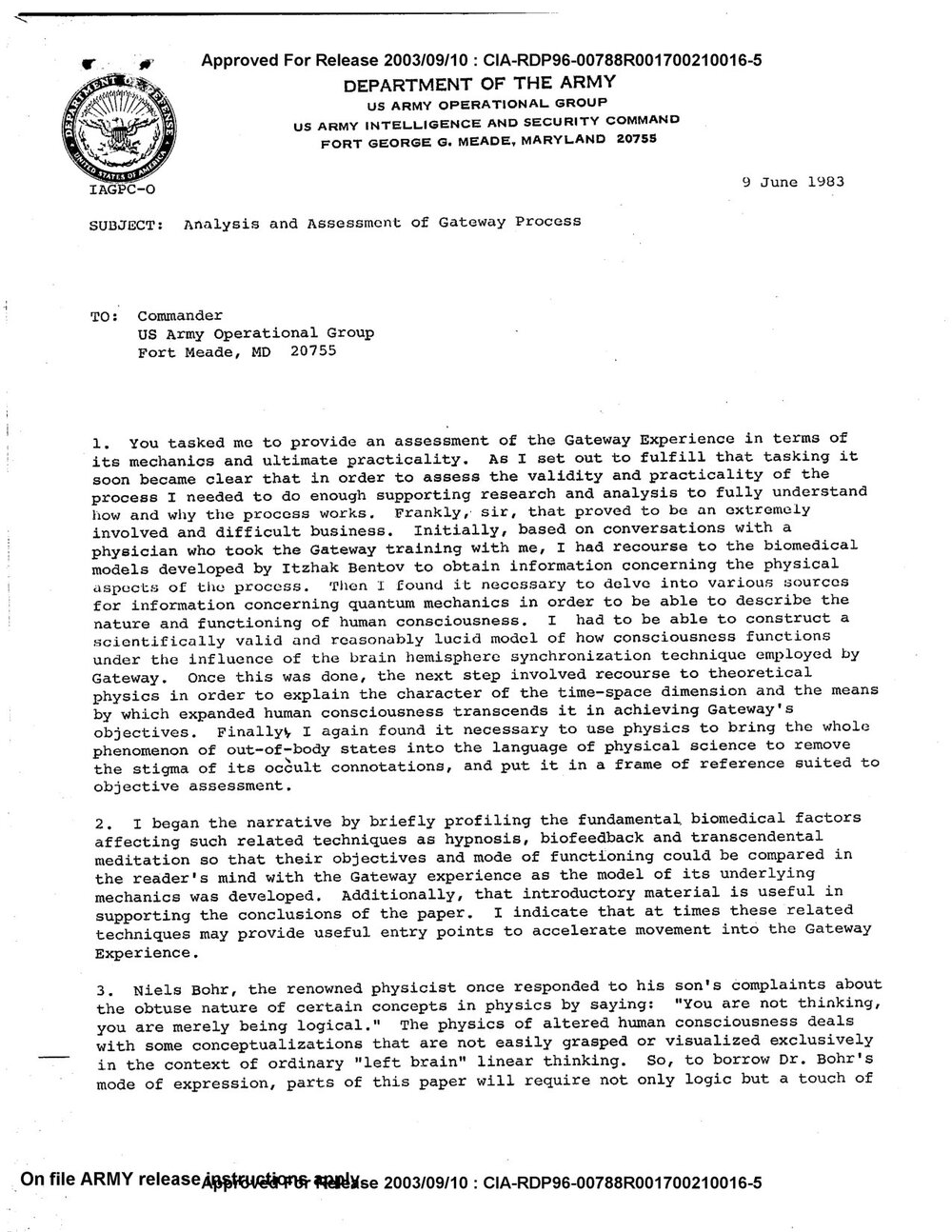
1983 — the Gateway assessment
- A U.S. Army report, “Analysis and Assessment of Gateway Process”, dated the
ninth of June 1983, assessed consciousness and “hemi-sync” techniques
associated with the Monroe Institute’s “Gateway Experience” [3].
1985–1995 — DIA leadership and closure
- The work eventually became an integrated joint-services programme under
single-agency (DIA) leadership, operating under codenames including “Grill
Flame” [4]. The DIA’s direct involvement began about 1985 [1].
- In June 1995 the CIA’s Office of Research and Development contracted the
American Institutes for Research (AIR) for an external review. The report,
dated the twenty-ninth of September 1995, concluded that “continued use of
remote viewing in intelligence gathering operations is not warranted”, and the
programme was closed [1].
Documentary record
The AIR evaluation of the twenty-ninth of September 1995 is the definitive
closing assessment [1]. It confirms the programme history — a CIA effort from
1972 to 1977 and a DIA-led arm from about 1985 — and records that its two
contracted expert reviewers disagreed: the statistician Dr Jessica Utts
wrote that “psychic functioning has been well established” by the standards
applied to any other area of science, while the psychologist Dr Raymond
Hyman dissented on sceptical grounds [1]. The overall recommendation was to
discontinue operational use [1].
The primary published evidence of official-channel interest in mind-influence
weaponry is Alexander’s 1980 article [2]. It includes the claim that
“Telepathic behavior modification, which includes the ability to induce hypnotic
states up to distances in excess of 1,000 kilometers … has been reported”, and
that an influenced “recipient will not be aware that thoughts have been
implanted” [2]. The 1983 Gateway assessment (CIA-RDP96-00788R001700210016-5,
declassified 2003) is a separate, widely cited Army document on
consciousness-alteration techniques [3]. The fullest firsthand programme history
is Puthoff’s own account, the source for the $49,909 figure and the SCANATE
method [4]. Readers may compare the institutional secrecy here with the archive’s
MK-Ultra file in the wider record of Cold-War human
research programmes, though the two efforts are documented separately and share
no established operational link.
Open questions
- The primary sources verified here do not confirm a total programme cost;
the often-quoted ”~$20 million” figure does not appear in the documents
examined.
- None of the sources independently verifies the operational accuracy of any
session, including Semipalatinsk; that rests on Puthoff’s own account [4],
and Hyman’s dissent disputes such inferences [1].
- The full chain of codenames (reported elsewhere as GONDOLA WISH, CENTER LANE,
SUN STREAK) is not present in the documents anchored here; only GRILL FLAME
and STAR GATE are confirmed [1][4].
- Whether any “psychotronic weapon” with “demonstrated lethal capacity” ever
existed is asserted by Alexander [2] but is unsupported by any corroborating
document found.
- Alexander’s view that “the Soviets and their allies are well in the lead in
parapsychological research” reflects a Cold-War “psi gap” fear; it is his
stated assessment, not an established fact [2].
Status
This file is CONFIDENTIAL — admitted to the archive on the strength of
government and official-channel documentation, chiefly the 1995 AIR evaluation,
the 1980 Military Review article, the 1983 Gateway assessment, and Puthoff’s
firsthand programme history [1][2][3][4]. The documentary existence of the
research effort and of published military interest in psychotronics is well
attested; the efficacy claims within those documents are not, and are recorded
here as reported or witness testimony rather than established fact. Popular
adjacent threads — the term “tulpoid”, the “First Earth Battalion”, and named
operational viewers — were omitted for want of a primary source rather than
reported unverified. Updates pending any further declassification.
References
- American Institutes for Research (1995). “An Evaluation of Remote Viewing: Research and Applications”, 29 September 1995. Commissioned by the CIA Office of Research and Development; authors Michael D. Mumford, Andrew M. Rose and David A. Goslin. Via the National Security Archive, George Washington University.
- Alexander, John B. (1980). “The New Mental Battlefield: ‘Beam Me Up, Spock’”, Military Review, Vol. LX, No. 12, December 1980. U.S. Army Command & General Staff College.
- U.S. Army (1983). “Analysis and Assessment of Gateway Process”, 9 June 1983. CIA FOIA Reading Room document CIA-RDP96-00788R001700210016-5, declassified 2003 (via Internet Archive).
- Puthoff, Harold E. “CIA-Initiated Remote Viewing At Stanford Research Institute” (conference proceedings, Geneva 1975; reprinted).
Frequently asked
- What was Project Stargate?
- Project Stargate is the best-known name for a U.S. government remote-viewing research effort that ran, under a succession of codenames, from 1972 to 1995. According to the 1995 American Institutes for Research evaluation, a research effort began at the CIA in 1972 and was discontinued in 1977, with the Defense Intelligence Agency's direct involvement beginning about 1985 until the programme's closure in 1995.
- Did the U.S. military investigate psychic powers?
- Yes. The intelligence community funded laboratory research into remote viewing at the Stanford Research Institute and later under joint-services and DIA leadership. Separately, in December 1980 a U.S. Army officer, Lt. Col. John B. Alexander, published an article in Military Review theorising about "psychotronic" mind-influence weapons.
- Why was the remote-viewing programme shut down?
- In 1995 the CIA's Office of Research and Development contracted the American Institutes for Research for an external review. Its report, dated the twenty-ninth of September 1995, concluded that continued use of remote viewing in intelligence-gathering operations was not warranted, and the programme was closed.
- Were psychic weapons ever proven to work?
- No corroborating document found in this research supports the existence of a working "psychotronic weapon". Lt. Col. Alexander's 1980 article asserts that such systems exist, but that claim is unsupported by any other primary source examined here, and the 1995 evaluation found remote viewing operationally useless.