Briefing
France is the only major state to run a permanently staffed, publicly funded
unidentified aerospace phenomena unit inside its civil space agency. GEIPAN
sits within CNES, which has studied such phenomena since 1977 [1][2].
Separately, in July 1999, a private committee of retired French generals,
admirals, engineers and one serving space-agency official — COMETA —
published a ninety-page report, Les OVNI et la Défense : à quoi doit-on se
préparer ?, arguing that the extraterrestrial hypothesis could not be
dismissed [8][9]. The two are frequently conflated. They should not be: GEIPAN
is a state body that remains operational, headed by Frédéric Courtade since
January 2024 [2]; COMETA was a one-off private association whose
recommendations, so far as the record shows, were not adopted [8][9].
Sequence of events
The state unit
- 1974. French national police — the gendarmerie — were reported to have
been asked to collect UFO reports [9].
- 1976. A committee of IHEDN auditors, chaired by gendarmerie member Robert
Blanchard, recommended the creation of a study group [9].
- The first of May 1977. GEPAN (Groupe d’Étude des Phénomènes Aérospatiaux
Non identifiés) is created as a section of CNES [1][9]. CNES director general
Yves Sillard initiated its creation; Claude Poher was its first
director [1].
- The eighth of January 1981. A reported landing at Trans-en-Provence (Var)
produced physical ground traces. GEPAN analysed soil and plant samples and
published Technical Note No. 16, Analyse d’une trace. The case remains
classified D — unexplained [8][10].
- 1988. GEPAN is replaced by SEPRA (Service d’Études des Phénomènes de
Rentrées Atmosphériques), broadening the remit to atmospheric re-entry
phenomena [1].
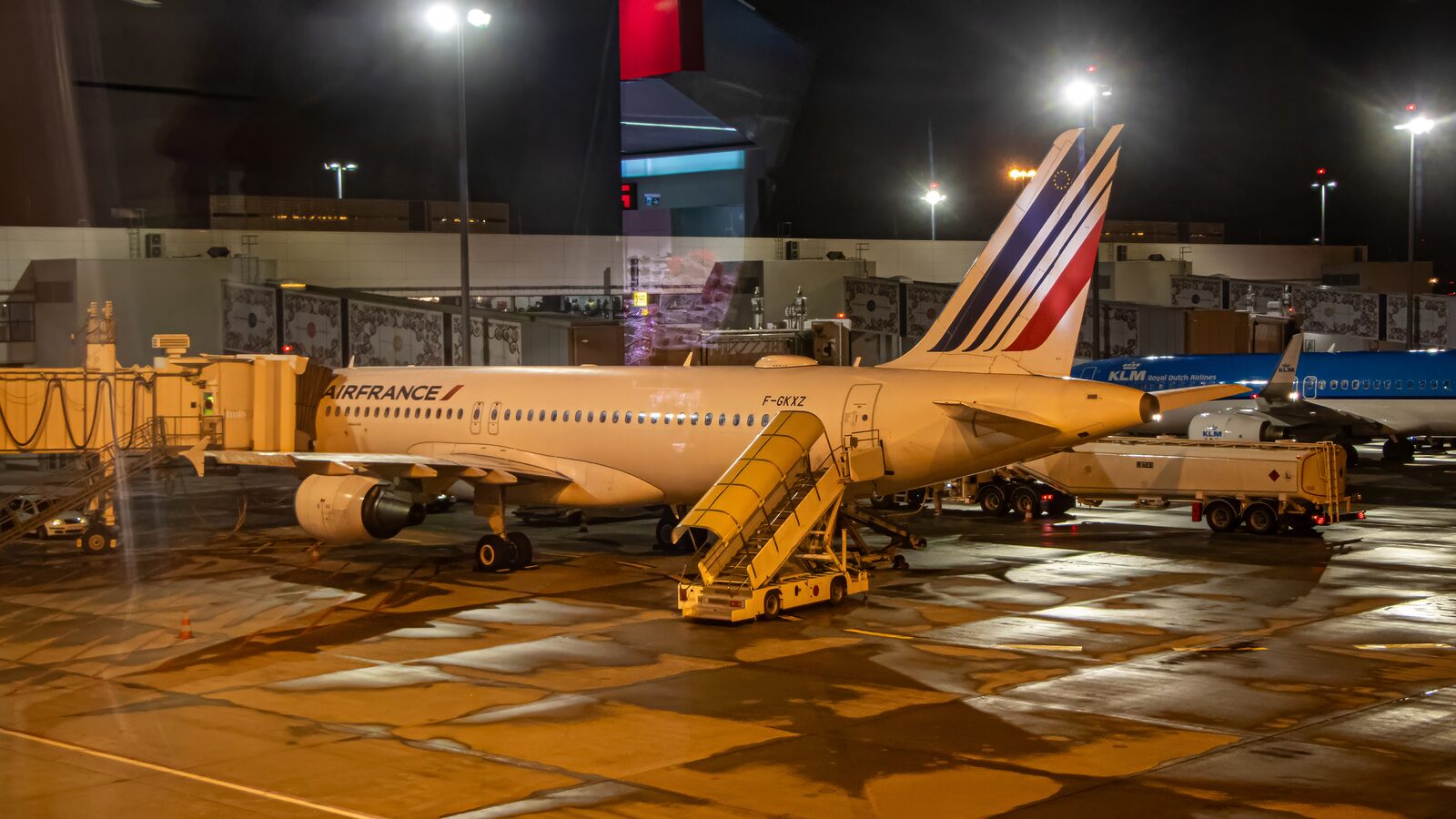
- The twenty-eighth of January 1994, 13:14. The crew of Air France flight
AF3532, an A320 on the Nice–London route, reported “a brown or reddish-dark
disc changing shape before disappearing suddenly” near Coulommiers
(Seine-et-Marne). A radar echo was recorded for fifty seconds by the
Cinq-Mars-la-Pile radar, crossing the aircraft’s track and matching no filed
flight plan. GEIPAN’s file concludes “Ce cas s’avère donc inexpliqué” and
classifies it D1 [7].
- End of 2001. CNES management commissions an audit to decide the
activity’s future [1].
- 2005. The CNES president restructures the unit: GEIPAN replaces SEPRA,
adding “Information” to the acronym, with the explicit recommendation to
“informer le public en toute transparence” [1].
- 2007. GEIPAN begins publishing its archives and case files online [1].
- January 2024. Frédéric Courtade becomes head of GEIPAN [2].
The private committee
- March 1995. General Denis Letty is reported to have approached IHEDN
director General Bernard Norlain to propose a new committee on UFOs [9].
- Early 1996. COMETA is formed; it worked for approximately three years [9].
- July 1999. Les OVNI et la Défense is published [8][9]. One secondary
account gives the date as the sixteenth of July and states the report was
initially intended only for President Jacques Chirac, Prime Minister Lionel
Jospin and other officials, reaching print “at the instigation of a
journalist” as a special issue of the magazine VSD. The COMETA text itself,
as fetched, carries no such delivery statement [9].
Documentary record
The COMETA report runs to ninety pages and analyses named cases including
Trans-en-Provence (the eighth of January 1981), Cussac (the twenty-ninth of
August 1967), Valensole (the first of July 1965) and Air France AF3532 (the
twenty-eighth of January 1994) [8][9]. Its central claim is stated directly:
“The accumulation of well-documented sightings made by credible witnesses
forces us to consider from now on all of the hypotheses regarding the origin of
unidentified flying objects, or UFOs, and the extraterrestrial hypothesis, in
particular” [8]. It closes with six recommendations: inform decision-makers;
reinforce SEPRA; check whether space-surveillance agencies have detected UFOs;
create a strategic committee at the highest level of the French state;
undertake diplomatic action with other nations, especially the United States;
and study emergency measures [8][9].
The committee was chaired by Gen. Denis Letty (Air Force) and included
Michel Algrin (Doctor of Political Science, attorney), Gen. Pierre
Bescond (weapons engineer), Denis Blancher (Chief of Police), Gen.
Bruno Le Moine (Air Force), Christian Marchal (chief mining engineer,
ONERA research director), Adm. Marc Merlo and Alain Orszag (Doctor of
Physical Sciences, weapons engineer general), with Jean-Jacques Vélasco
(then head of SEPRA), François Louange (Fleximage), the pilots
Jean-Charles Duboc, Jean-Pierre Fartek and René Giraud, and
Michel Périvier (Gendarmerie squadron commander) [8]. Gen. Bernard
Norlain, former IHEDN director, wrote the foreword; André Lebeau, former
CNES chairman, the preamble [8][9]. Notwithstanding those credentials, the
report’s own copyright page identifies COMETA as “an association governed by
the Law of July 1, 1901” — a private association under French law, not a
government body [8][9].
GEIPAN case file 1994-01-01345 lists among its attachments a meteorological
radiosonde report, an investigation report, a CODA chronology, two gendarmerie
witness statements (PV n°351) and technical testimony forms [7]. The
disc-shaped object reported by the AF3532 crew, taken
together with the fifty-second radar track, is what carries the file to D1.
GEPAN Technical Note No. 16 records the Trans-en-Provence analysis. The
plant biochemistry was performed by Michel Bounias of INRA, Avignon, with
Vélasco leading the GEPAN investigation; the analysis is reported to have found
young leaves showing the biochemical characteristics of aged leaves, from which
Bounias concluded the results “might be consistent with an electromagnetic
source of stress” [10]. That is a conditional finding and is recorded here as
such.
The classification standard is GEIPAN’s own: A, “phenomenon perfectly
identified after investigation”; B, “probably identified”; C, “not identified
due to lack of data”; D, “not identified after investigation”, split since 2008
into D1 (strange, medium consistency) and D2 (very strange, high consistency —
multiple independent witnesses and/or photo-video and/or ground traces) [3][5].
GEIPAN receives accounts “directly on its website or from statements recorded
by the gendarmerie, civil aviation or other authorities”, and is overseen by
COPEIPAN, a steering committee drawing on the gendarmerie, police, air and
space force, CNES, CNRS, Météo-France, psychologists and other experts [2].
Open questions
- The percentages do not agree. CNES publishes 24.6% clearly identified,
39.7% probably identified, 32.4% unidentified for lack of data and 3.3%
unidentified after investigation [2]. GEIPAN’s classification page gives
63.2% A+B, 33.4% unassessable and approximately 3.4% unexplained, falling to
2% over the last decade, with roughly 10% of cases receiving on-site
investigation [3]. Its mission page states approximately 7% unexplained
historically [4]. Its February 2016 statistics note gives “11 à 13% selon le
mode de calcul” for category D across 2,200-plus published cases [6], and its
December 2016 note gives 227 D cases out of 2,292 for 1975–2014 falling to 24
of 1,159 for 2005–2014 — attributing the drop to case-volume growth, stricter
D1/D2 criteria and improved investigation methods rather than to fewer
genuine anomalies [5]. GEIPAN does not reconcile the spread beyond noting
that the calculation basis differs.
- COMETA’s own figures do not match GEIPAN’s. The report cites GEPAN/SEPRA
category D cases as “4 to 5% of the cases”, over 5,000 gendarmerie reports
since 1974 and roughly 100 joint field investigations [8].
- No official response to COMETA has been located. The primary sources do
not state what, if anything, the French government did with the six
recommendations. Mark Rodeghier of the Center for UFO Studies wrote in
Summer 2000 that they had “not been heeded by French decision-makers”; that
is his assessment, not a state statement [9].
- The source of the fifty-second radar track in the AF3532 file is not
identified by GEIPAN [7].
- The total number of published case files, and the D1/D2 split, are not
stated in any primary source retrieved.
- Three widely repeated claims could not be sourced at all and are excluded
from this file: that France is the only nation to publish its entire UFO case
file; that a CNES report of 2007 found 28% of sightings unidentified; and the
“1,600 cases / 100,000 pages” figures attached to a March 2007 archive-launch
press release. No official document carrying any of them was retrievable, and
the 28% figure conflicts with every GEIPAN percentage that was verified.
Status
This file is CONFIDENTIAL — admitted on the strength of published
government records from CNES and GEIPAN, chiefly the unit’s own history,
classification standard and the AF3532 case file [1][2][3][7]. The COMETA
material is admitted as a document of record: the report demonstrably exists
and its authorship is established, but it is the product of a private
association and its conclusions are not findings of the French state [8][9].
Several of COMETA’s positions are held at arm’s length by this archive. The
report is reported to treat the 1947 Roswell event seriously, and Rodeghier’s
summary has the authors coming down “on the side of the hypothesis that what
crashed there was an alien spacecraft, which was recovered by the U.S.
government”, with Letty quoted as conceding there is no proof while maintaining
that U.S. authorities know more than they say [9]. The report also gives weight
to magnetohydrodynamic propulsion, associated with the physicist Jean-Pierre
Petit, and to the “space island” generation-ship concept of the astronomers
Jean-Claude Ribes and Guy Monnet [9]. These are the committee’s theories,
recorded here because they are part of the document, not because the archive
endorses them.
The Air France sighting’s reported shape places this file alongside the
archive’s record of disc and saucer reports; the
Trans-en-Provence ground traces bear comparison with other physical-trace cases
such as Rendlesham Forest, though the two
events share no connection beyond that class of evidence. Updates pending any
official French response to COMETA entering the public record.
References
- GEIPAN / CNES — “Its history”. Accessed 6th September 2026.
- CNES (Centre National d’Études Spatiales) — “GEIPAN” project page. Accessed 6th September 2026.
- GEIPAN / CNES — “Classification”. Accessed 6th September 2026.
- GEIPAN / CNES — “Mission & GEIPAN”. Accessed 6th September 2026.
- GEIPAN / CNES — “Forte baisse des CAS D sur les 10 dernières années”, 14th December 2016.
- GEIPAN / CNES — “Des statistiques mises à jour”, 1st February 2016.
- GEIPAN / CNES — case file « AF3532 » [AERO AFR] COULOMMIERS (77), 28th January 1994, ref. 1994-01-01345.
- COMETA (1999). Les OVNI et la Défense : à quoi doit-on se préparer ? — English translation, full text. Via the Internet Archive.
- Rodeghier, Mark, ed. (2000). “The 1999 French Report on UFOs and Defense”, International UFO Reporter, Summer 2000, pp. 20–23, 30. Center for UFO Studies. Reproduced under fair use.
- The Black Vault — “Trans-en-Provence, France, Physical Trace Case – 8th January 1981”. Accessed 6th September 2026.