Briefing
Between March 1979 and June 1980 two parallel official responses to the
American cattle-mutilation panic were recorded. The first was a narrowly-scoped
FBI investigation, opened on Department of Justice authority and limited to
Indian lands in New Mexico, which was closed within months [1]. The second was
“Operation Animal Mutilation”, a federally-funded state investigation run by the
former FBI agent Kenneth M. Rommel Jr. out of the First Judicial District
Attorney’s office in Española, New Mexico [1][6]. Both concluded the damage was
predator and scavenger activity on animals that had generally died of natural
causes [1][5][7].
The FBI file — a 1974–1978 core with later FOIA supplements — is public at
vault.fbi.gov [4]. Rommel’s June 1980 report was never a federal publication and
survives mainly through library copies and transcriptions [6][7].
Sequence of events
The eleventh of September 1975
- Senator Floyd K. Haskell of Colorado telephoned the FBI Director’s office
asking the Bureau to enter the mutilation investigations; the FBI recorded his
description of carcasses missing “left ear, left eye, sex organ, and the blood
drained” [2].
- The FBI explained its statutory limits: the Interstate Transportation of
Stolen Cattle Statute, Title 18 U.S.C. § 2311, required an interstate
transportation, which Haskell said he had no information had occurred. He was
told a new law would probably be needed, and was referred to the Department of
Justice Criminal Division [2].
The nineteenth of September 1978
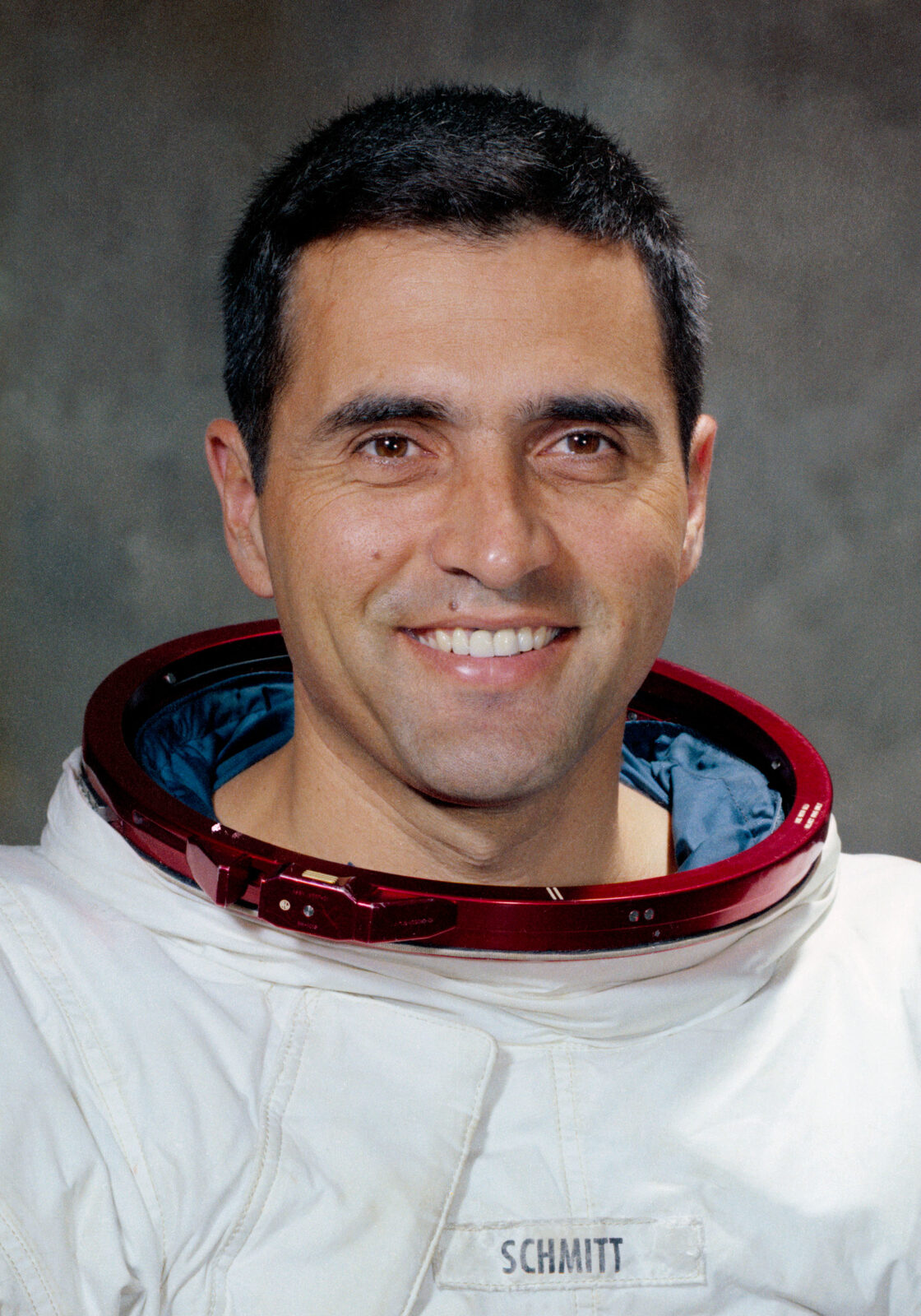
- New Mexico State Police Director Martin E. Vigil sent Senator Harrison
Schmitt the official Offense/Incident Reports of Officer Gabe Valdez, plus
New Mexico Livestock Board reports, following a request from Manuel S. Gomez
of Dulce, New Mexico [3].
- Vigil stated that Valdez’s investigation was continuing “but so far has
developed no positive leads as to the identity of the mutilator(s)” [3].
The second and sixth of March 1979
- By memorandum dated the second of March 1979, Assistant Attorney General
Philip B. Heymann of the Criminal Division asked the FBI to investigate
fifteen animal mutilations in New Mexico Indian country as a possible Crime on
an Indian Reservation, citing correspondence from Senator Schmitt. The memo
noted DOJ awareness that such acts “are performed by persons as part of a
ritual or ceremony” [1].
- On the sixth of March 1979, FBI Headquarters instructed the Albuquerque
Division to investigate mutilations occurring on Indian lands in New Mexico [1].
The twentieth of April 1979 — the Albuquerque conference
- A multi-state livestock-mutilation conference was convened in Albuquerque by
Senator Harrison Schmitt and U.S. Attorney for New Mexico R. E. Thompson.
Approximately 180 people attended, including investigators from several
states, FBI representatives and press [1].
- SAC Forrest S. Putman Jr. told the conference that DOJ had authorised FBI
investigation of mutilations occurring in Indian country [1].
- The FBI’s own summary records that “numerous theories were expounded” —
satanic cults, predators, pranksters, extraterrestrial visitors, and “some
unknown Government agency” — and that it was decided one agency would be
designated coordinator for all jurisdictions [1]. This archive notes that the
claim of an “unknown Government agency” is recorded here as a theory
expounded at the conference, not as a finding; readers tracing that thread
may wish to consult the archive’s files on documented
government programmes run without public knowledge.
- [REPORTED] Per a transcription of the FBI conference record dated the
twenty-fifth of April 1979, Officer Gabe Valdez reported investigating around
ninety cattle deaths over three years and stated he did not believe predators
were responsible, while the forensic veterinarian Dr Richard Prine attributed
all six carcasses he examined to predators [10].
May to August 1979
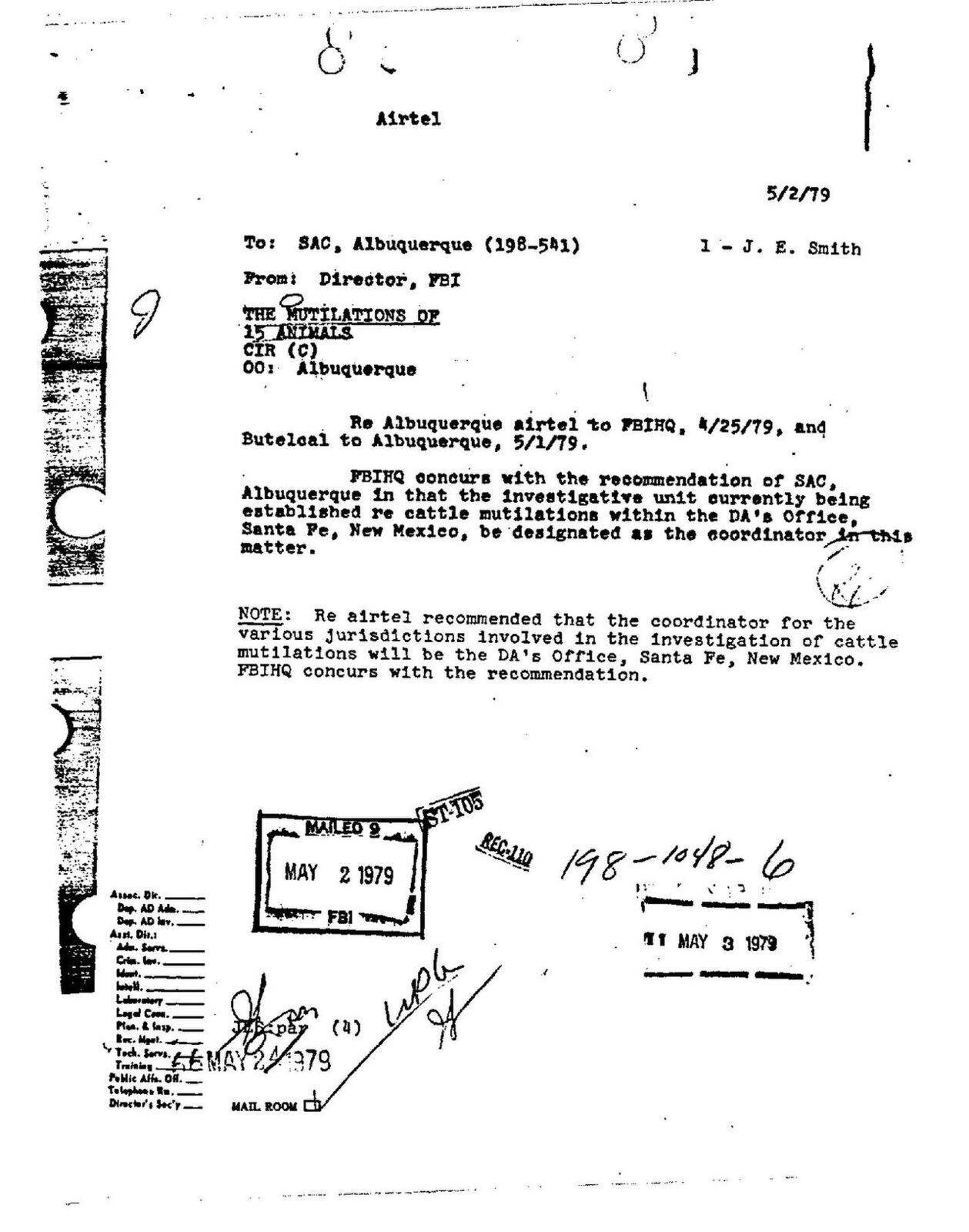
- In May 1979 the District Attorney’s Office for the greater Santa Fe area
received Law Enforcement Assistance Administration (LEAA) funds — recorded by
the FBI as “approximately $50,000” — to act as coordinating investigative
agency. Kenneth M. Rommel was appointed to head the resulting Special
Investigative Unit [1].
- In a letter received on the eleventh of June 1979, Senator Schmitt asked FBI
Director William H. Webster for a status update, a timetable, and confirmation
of whether the Bureau needed additional funding, noting that he sat on the
Senate Appropriations Committee and that mark-up was imminent [1].
- Following an Albuquerque letter of the first of August 1979, the Albuquerque
office reported that no mutilations had been reported on Indian lands since it
was instructed to investigate, and placed the matter in closed status [1].
The fifteenth of January 1980
- Rommel advised the FBI that his unit “has determined that none of the reported
cases has involved what appear to be mutilations by other than common
predators”, that he had conferred with investigators in other states, and that
damage to every carcass he examined “has always been consistent with predator
action” [1].
- The same day, Assistant U.S. Attorney Richard J. Smith stated there was
“no Federal interest in continuing an investigation in this matter” absent
further reports [1].
The fifteenth of April and June 1980
- At a press conference on the fifteenth of April 1980, Rommel stated that all
mutilations he investigated were due to natural predation, scavenger activity
and normal decay. Thirty-seven mutilations were reported during the study year
and he was personally present at thirteen or fourteen of them [5].
- The final report, Operation Animal Mutilation: Report of the District
Attorney, First Judicial District, State of New Mexico, is dated June 1980
and runs to six chapters [6].
Documentary record
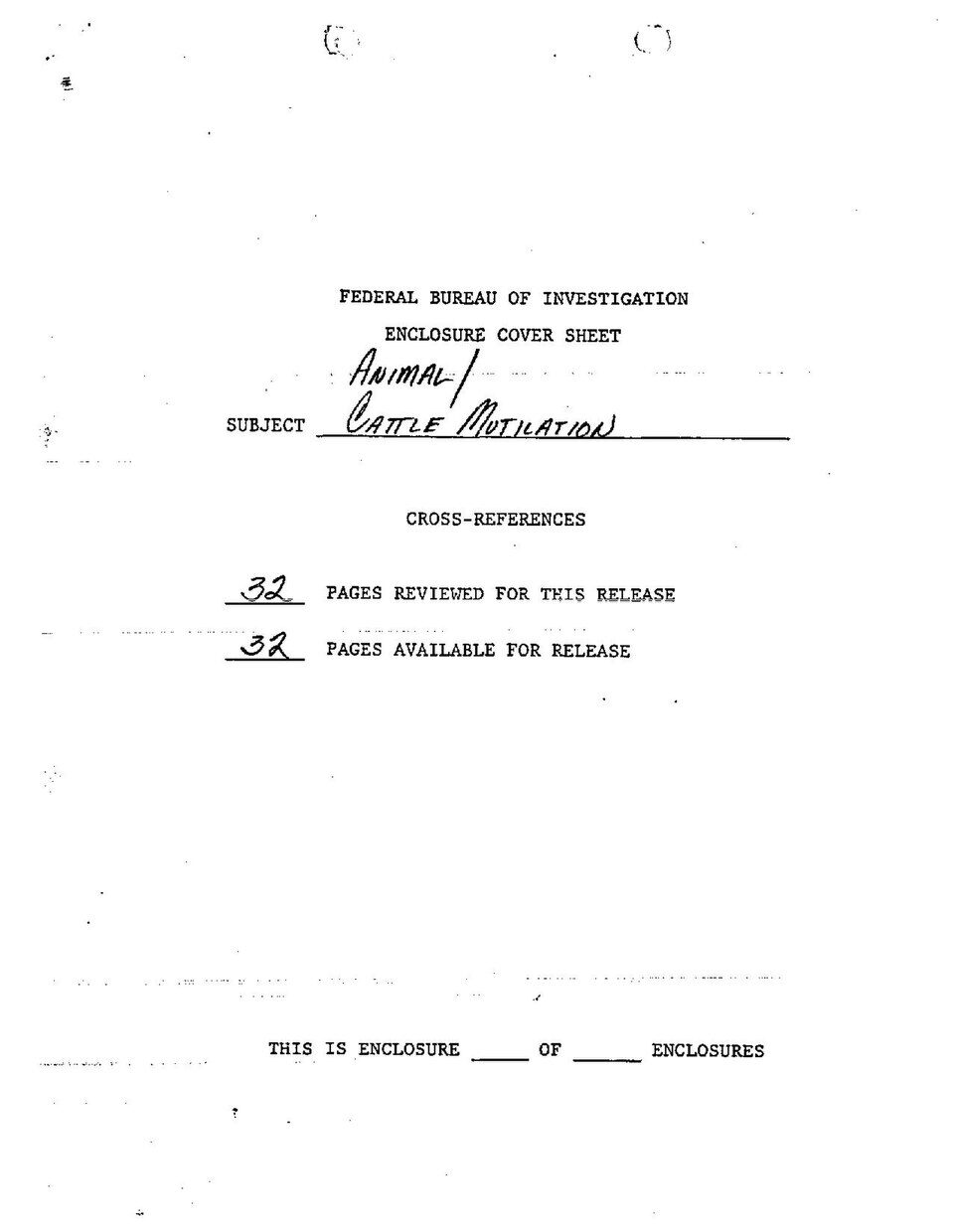
The FBI “Animal Mutilation” file, Parts 1–5, is public at vault.fbi.gov with
a public-domain mirror on the Internet Archive. The Bureau’s own description
records reports “in western and mid-western states” in the mid-1970s which it
could not investigate “because of a lack of jurisdiction (except when such
mutilations were found on Indian lands)”, and states that the file consists
“mainly of press clippings and correspondence… between 1974 and 1978” [4].
The FBI Albuquerque Letterhead Memorandum of the fifteenth of January 1980,
captioned “Mutilation of Animals on Indian Lands in New Mexico — Crime on Indian
Reservation”, is the single most substantive investigative document in the file.
It carries the standard caveat that it “contains neither recommendations nor
conclusions of the FBI” [1].
The press-conference summary of the fifteenth of April 1980 is held in a New
Mexico manuscript collection (MSS 370, Box 33, Folder 12). It records Rommel’s
pre-publication statements and his recommendation “that not any more of the
taxpayer’s money be spent in this regard” [5]. The report itself states that
Rommel found “no single case which, after careful scrutiny of available
evidence, could be confirmed as a ‘classic mutilation’”, covering twenty-seven
incidents investigated during the project — twenty-five classified as
mutilations — plus a review of some ninety earlier New Mexico cases, one hundred
and seventeen since 1975 [7].
On confidence. Three items in the record are held here at a lower grade. The
LEAA grant is given as “approximately $50,000” in the FBI’s own memorandum [1]
but as $44,170 in later secondary reporting on the report [9]; no award document
was found to adjudicate, and both figures are recorded. The 1980 press summary
states that knife cuts were present in “less than 25 of all cases reported
nationally” — the typescript appears to omit a percent sign, and the archive
reads it as approximately 25 per cent [5]. Rommel’s report is described — from
a transcription, not a scan — as criticising media handling, saying the natural
explanation “lacks credibility to the public”, and stating of
organised-government-mutilation theories: “I have not found one shred of hard
evidence to substantiate this theory” [7]. Separately, three FOIA release
tranches are catalogued by a secondary archive: 131 pages (1974–1978); 10 pages
requested in 2018, with the FBI confirming in August 2018 that no additional
records existed; and 41 pages released after a July 2021 request, covering
2000–2005 [8].
A press clipping preserved inside the FBI file quotes Senator Schmitt as saying:
“Either we’ve got a UFO situation or we’ve got a massive, massive conspiracy
which is enormously well funded” [1]. The clipping’s own sourcing is not
established, and the FBI filed it as media, not as a finding. The same clipping
asserts “at least 8,000 cattle and horses” mutilated across a 1.8-million-square-mile
area; no official record in the file corroborates that figure, and this archive
holds it as unverified [1].
Open questions
- The primary documents do not explain why the Department of Justice memorandum
of the second of March 1979 framed the mutilations as possible ritual crime,
nor what evidence underlay that framing [1].
- No document in the FBI file explains why, after March 1979, not one new
mutilation was reported on New Mexico Indian lands [1].
- The exact LEAA grant figure differs between records, and no grant award
document was located [1][9].
- Nothing in the FBI file addresses the earlier Colorado wave of 1975 beyond
correspondence [2].
- Rommel’s photographic exhibits — over eighty photographs — were not located
in any digitised repository [6].
- The frequently-repeated figure of “10,000 mutilated cattle” nationwide since
1967 has no traceable official source in the documents examined here, and is
not carried by this archive.
Status
This file is CONFIDENTIAL — admitted to the archive on the strength of
contemporaneous federal and state documentation: the FBI’s own Albuquerque
memoranda, the Department of Justice referral of March 1979, the state-police
correspondence of 1978, and the published June 1980 report [1][2][3][6][7]. The
documentary spine is strong; the interpretive claims around it are not, and are
held separately above.
Two corrections to the popular account are recorded here. Operation Animal
Mutilation was not an FBI programme: the Bureau’s records locate it in the
New Mexico District Attorney’s office under LEAA funding [1]. And no primary
record of the report’s alleged suppression was found — it was announced publicly
and offered for sale [5][6]. Where the case touches this archive’s other
holdings, it does so through the conference record’s list of theories, which
placed extraterrestrial visitors alongside
predators and pranksters in the same paragraph of an FBI summary [1]. This file
takes no position on that theory; it records that officials heard it.
Updates pending location of a page-scanned copy of the full 1980 report and of
Rommel’s photographic exhibits.
References
- FBI file: Animal Mutilation, Part 5 of 5 (OCR text of the vault.fbi.gov release). Federal Bureau of Investigation, via the Internet Archive. Public domain. Includes the DOJ memorandum of 2 March 1979, the 20 April 1979 conference summary, the LEAA/Rommel appointment record, the Schmitt–Webster correspondence, and the Albuquerque Letterhead Memorandum of 15 January 1980.
- FBI file: Animal Mutilation, Part 1 of 5 — 1975 Senator Haskell memorandum. Federal Bureau of Investigation, via the Internet Archive. Public domain.
- FBI file: Animal Mutilation, Part 3 of 5 — Schmitt / Vigil / Valdez correspondence. Federal Bureau of Investigation, via the Internet Archive. Public domain.
- FBI Records: The Vault — Animal Mutilation (file description and parts index). Federal Bureau of Investigation. Public domain.
- Kenneth Rommel Press Conference on Cattle Mutilations, 15 April 1980. New Mexico manuscript collection MSS 370, Box 33, Folder 12 (scan host: illumeumbra.org). Licence unverified.
- Operation Animal Mutilation — report front matter and table of contents (transcription). rr0.org. Transcription, not a scan.
- Operation Animal Mutilation — Chapter 6, Conclusions and Recommendations (transcription). rr0.org. Transcription, not a scan.
- FBI Files: Cattle & Animal Mutilations — FOIA release history. The Black Vault. Secondary catalogue of release tranches.
- Cattle Mutilations — The Rommel Reports (Jon Elliston, ParaScope mirror), think.cz. Secondary reporting; source of the $44,170 grant figure.
- FBI record of the 20 April 1979 Albuquerque livestock-mutilation conference, dated 25 April 1979 (transcription). rr0.org. Transcription, not a scan.