CONFIDENTIAL
UF-26019
The Exeter Incident
- Incident
- 1965-09-03
- Location
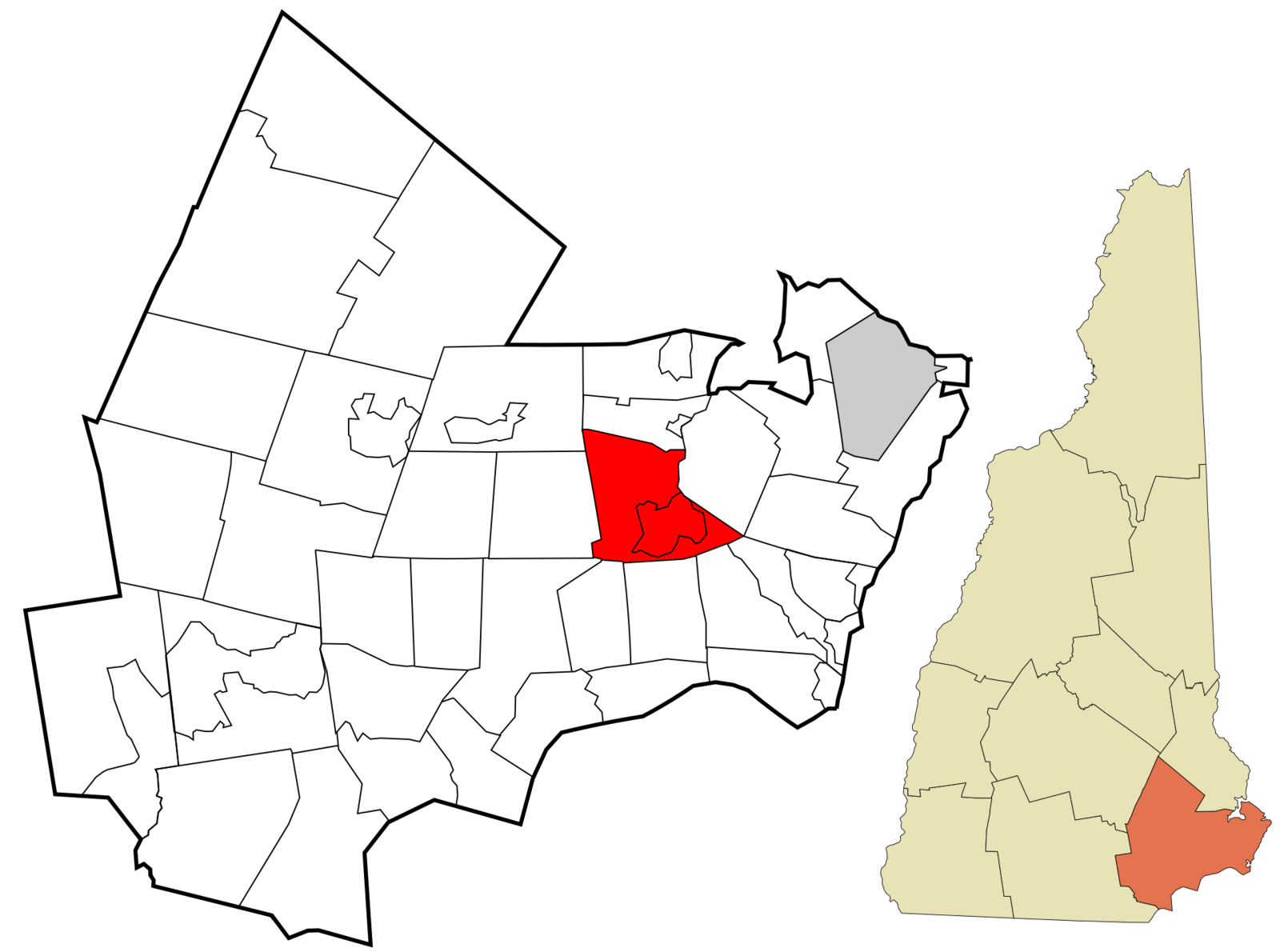
- Kensington, near Exeter, New Hampshire, United States
- Coords
- 42.9376, 70.9539
Brief
In the early hours of the third of September 1965, an eighteen-year-old hitchhiker and two Exeter, New Hampshire police patrolmen reported a large, silent object carrying five pulsating red lights manoeuvring at roughly one hundred feet over a field three miles south-west of the town. The US Air Force's Project Blue Book investigated the case, proposed a Strategic Air Command exercise as the cause, then conceded in writing that the officers' post-two-a.m. observation could not be identified. The Project 10073 record card carries the conclusion "UNIDENTIFIED".
Filed 2026-08-26 · Last updated 26 August 2026
Briefing
In the early hours of the third of September 1965, an eighteen-year-old
hitchhiker walking Route 150 outside Exeter, New Hampshire, reported a group of
five bright red lights descending toward him over a house about a hundred feet
away [15]. Within the hour two patrolmen of the Exeter Police Department had
seen the same lights over the same field and filed signed statements [16][17].
The US Air Force investigated the case under AFR 200-2, proposed a Strategic Air
Command exercise as the cause, tested that hypothesis against Eighth Air Force
records, and abandoned it. The Project 10073 record card for the case carries
the conclusion “UNIDENTIFIED” [2].
Sequence of events
The night of the second to third of September 1965
- Circa 02:00. The teenage witness, hitchhiking on Route 150 about three
miles south-west of Exeter, stated that “a group of five bright red lights
appeared over a house about 100 ft from where I was standing”, in a line at
about a sixty-degree angle, “pulsating 1,2,3,4,5,5,4,3,2,1”. He watched them
for about fifteen minutes and reported that at one point “they seemed to come
so close I jumped into a ditch to keep from being hit” [15].
- 01:00. Separately, Patrolman Eugene F. Bertrand Jr. stated that on the
Route 108 by-pass he had found a woman parked at the roadside who “stated a
light had been following her and had stopped over her car”. He remained about
fifteen minutes, saw nothing, and returned to the station — where he found the
teenager [17].
- Circa 02:45. Bertrand drove the youth back to the field, parked and killed
the cruiser lights. In his statement: “When we had gone about 50 ft a group of
five bright red lights came from behind a group of trees near us. They were
extremely bright and flashed on one at a time… At one time they came so close
I fell to the ground and started to draw my gun. The lights were so bright I
was unable to make out any form. There was no sound or vibration but the farm
animals were upset in the area and making a lot of noise” [17].
- Circa 02:55. Patrolman David R. Hunt stated that he received Bertrand’s
radio call, arrived, and “observed a group of bright red lights flashing in
sequence… about ½ mile over a field to the South East”, which moved off
south-easterly and disappeared, remaining at an estimated altitude of about one
hundred feet [16][17].
The official investigation, September 1965 – March 1966
- 15 September 1965. Headquarters 817th Combat Support Group (SAC) at Pease
AFB filed the initial AFR 200-2 report: object “Round”, apparent size
“Baseball”, “Bright red”, “Five red lights in a row”, “Lights were close
together and moved as one object”, at approximately one hundred feet, moving
through an arc of 135 degrees and departing on a magnetic heading of about 160
degrees. Weather was recorded as “clear with no known weather phenomenon” with
“a 5 degree inversion from surface to 5000 ft”. Both patrolmen were rated
“Reliable” [12][13].
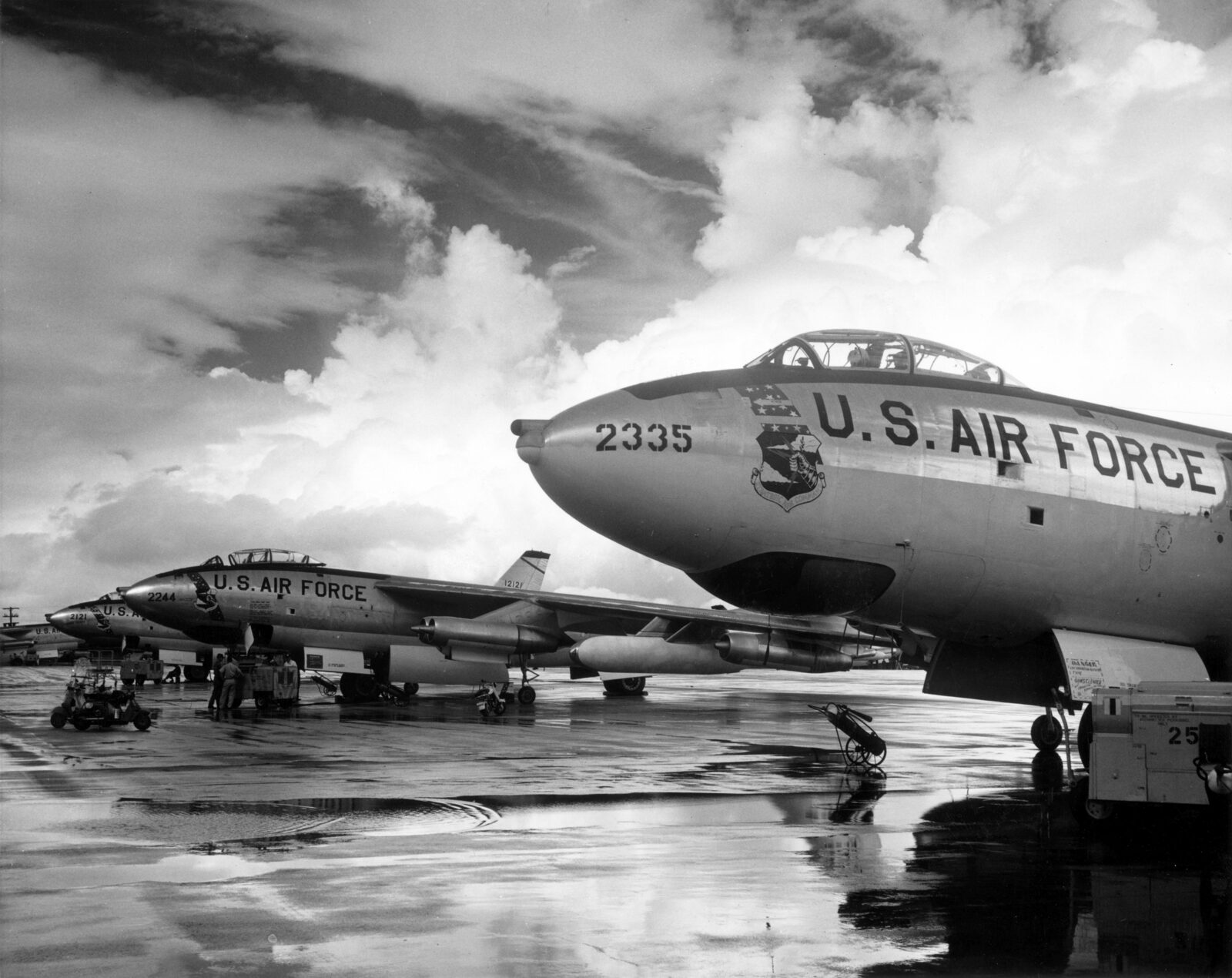
- The investigating officer, Maj. David H. Griffin, wrote: “At this time have
been unable to arrive at a probable cause of this sighting. The three observers
seem to be stable reliable persons, especially the two patrolman… Pease AFB had
5 B-47 aircraft flying in the area during this period but do not believe they
had any connection with this sighting” [14].
- 19 October 1965. The Foreign Technology Division told Pease AFB that Exeter
was the one report of the past year that could not be evaluated without further
investigation, that the “Fur Trapper” and “Down Date” refuelling areas were
closed 03/0500Z–03/0600Z for Eighth Air Force operation “Big Blast”, and: “It
is our belief that aircraft from this operation and various stars and planets
were the causes of the various reports on the night of 2-3 September from this
area” [3][4].
- 24 November 1965. Headquarters Eighth Air Force replied that Big Blast
“Coco” was a SAC/NORAD training mission flown on the second and third of
September 1965; that by 03/0430Z the operational portion was complete; and that
ten B-47s from Pease AFB were estimated to reach their initial approach fix
between 03/0444Z and 03/0535Z — roughly a quarter to one until half past one
local — with Exeter lying inside the recovery traffic pattern [5].
- Blue Book chief Maj. Hector Quintanilla Jr. wrote to Bertrand and Hunt
asking whether either had seen aircraft during the period, noting that if they
had, “this would tend to eliminate this air operation as a plausible
explanation for the objects observed” [6].
- 11 January 1966. FTD advised Hq USAF that the aircraft information
“conflicted with the time of the sighting and eliminated these aircraft as a
possible evaluation of this incident”, and that while earlier sightings that
night were attributed to Big Blast “Coco”, “the subsequent observation by
Officers Bertrand and Russel occurring after 2 A.M. are regarded as
UNIDENTIFIED”. The document reads “Russel”, not “Hunt” [9].
- 9 February 1966. Lt Col John P. Spaulding, Office of Information, wrote
to the two patrolmen: “Based on the additional information you submitted to our
UFO investigation office at Wright-Patterson Air Force Base, Ohio, we have been
unable to identify the object you observed on September 3, 1965” [10].
- 3 March 1966. An FTD summary records that Dr J. Allen Hynek was
consulted, that Pease AFB was asked to interrogate the B-47 crews, and that a
TWX received on the eleventh of February 1966 “indicated that no unusual
sightings were made by crews during the time period of the unidentified flying
object report” [11].
Documentary record
The Air Force case file is held by the US National Archives as the file unit
“Exeter, New Hampshire, September 1965” (NAID 302543878), 131 pages, within the
series “Sanitized Version of Project Blue Book Case Files on Sightings of
Unidentified Flying Objects”, Record Group 341, microfilm publication T1206 roll
57 [1]. Within it sit the Project 10073 record card — source “Civilians
(MULTIPLE)”, multiple objects, a two-hour observation, ground-visual, no photos,
no physical evidence, conclusion “UNIDENTIFIED” [2]; the Pease AFB initial
report of the fifteenth of September 1965 with Maj. Griffin’s conclusion
[12][13][14]; three signed witness statements [15][16][17]; and the
FTD/Blue Book correspondence chain from October 1965 to March 1966 that shows
the aircraft hypothesis proposed, tested and abandoned [3][4][5][6][9][11].
Also filed are the officers’ own rebuttals. Writing to Quintanilla on the
second of December 1965, Bertrand and Hunt stated they “saw this object at
close range, checked it out with each other, confirmed and reconfirmed the fact
that this was not any kind of conventional aircraft, that it was at an altitude
of not more than a couple of hundred feet”; that immediately after it
disappeared “we did see what probably was a B-47 at high altitude, but it bore no
relation at all to the object we saw”; and that their observation was “nearly an
hour after 2:00 AM”, which they argued eliminated Big Blast [7]. In a further
letter of the twenty-eighth of December 1965 they wrote that the craft “was
not more than 100 feet in the air, and it was absolutely silent, with no rush of
air from jets or chopper blades whatever. And it did not have any wings or tail.
It lit up the entire field, and two nearby houses turned completely red. It
stopped, hovered, and turned on a dime” [8]. These are witness assertions, not
findings of the investigation, and the archive records them as such.
A civilian investigation by Raymond E. Fowler, Chairman of the NICAP
Massachusetts Subcommittee, was copied to Blue Book on the third of October 1965
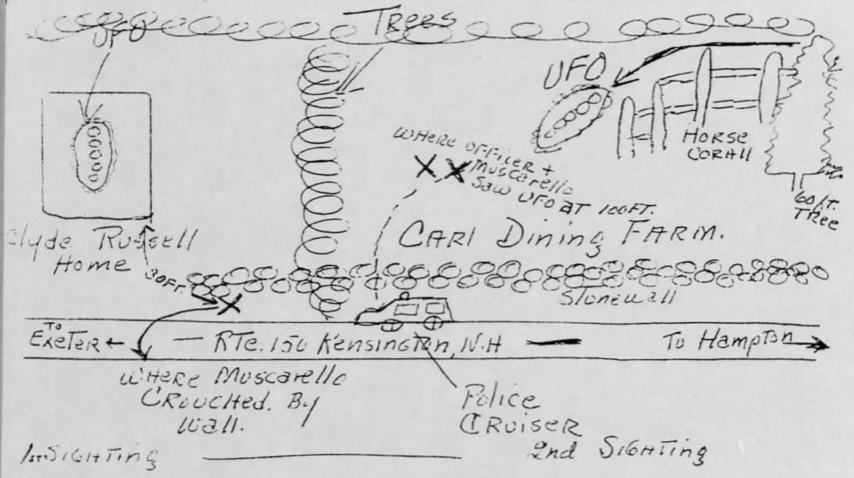
and filed with the case [18]. Fowler reported the sighting as occurring over the
field of Carl Dining in Kensington, New Hampshire, on Route 150 about three miles
south of Exeter; that the moon had set and the sky was “studded with stars”; that
no interference was noticed on the police radio and no scorch marks or
indentations were found in the field; and that horses in a nearby barn “whinnied
and kicked their stalls” while a dog across the road barked furiously [21][22].
He recorded Bertrand’s estimate of the object at closest approach as the apparent
size of a “grapefruit” held at arm’s length, and Hunt’s — arriving later and
further away — as a “baseball” [21]. Fowler wrote that Bertrand “stated that it
was definitely not an airplane or helicopter and that in his opinion that it was
an intelligently constructed and operated vehicle”, while neither officer would
venture an opinion as to what the object was [22]. That is an opinion recorded by
a civilian investigator, and carries no evidential weight here.
The Condon Report of 1968 indexes the case and records the hypothesis put
forward by Philip J. Klass, that the Exeter lights were a form of coronal
discharge or plasma associated with high-tension power lines, Exeter being close
enough to the sea for salt to form on the wires and the summer having had little
rainfall to wash it away [23]. The same report records two criticisms of that
hypothesis: “(1) that other seacoast towns with high tension wires did not report
UFO activity during the drought period, and (2) the luminosity, although near the
wires, was occasionally some angular distance away” [23]. The Condon Report also
notes that the sightings were “made the basis of a brief article in the Saturday
Review for 2 October 1965, and later of a book, Incident at Exeter by John G.
Fuller (1966)”; a copy of the Saturday Review article is attached in the Blue
Book file [24][6].
Open questions
- The woman motorist Bertrand encountered on the Route 108 by-pass is not
identified in any primary document. Fowler recorded that Bertrand “did not
attach enough importance to the woman’s account to warrant obtaining her
name” [22][20].
- No Air Force document in the file offers an alternative positive
identification for the post-two-a.m. observation. The case was closed as
unidentified rather than resolved [9][10][2].
- The file does not contain the text of the Pentagon press release that Bertrand
and Hunt describe as attributing their sighting to “multiple high altitude
objects” and “weather inversion”. Only the officers’ characterisation of it
survives in the examined pages [7][8].
- Witness ages and exact sighting times conflict between the Air Force report
and the NICAP report — Bertrand is given as thirty and thirty-two, Hunt as
twenty-eight and twenty-six — and are not reconciled in the file [13][19][21].
- The record card gives the aircraft window as 03/0444Z–03/0535Z, while the FTD
letter of the nineteenth of October 1965 gives the refuelling-area closure as
03/0500Z–03/0600Z. The file does not explain the difference [2][3].
- The frequently repeated claim that Blue Book publicly blamed the sighting on
the planet Jupiter is not supported by any page of the case file examined. The
Air Force wording located is the generic “various stars and planets” [3].
- No photograph or physical evidence of the object exists in the file; the record
card marks both “Photos” and “Physical Evidence” as “No” [2].
Status
This file is CONFIDENTIAL — admitted to the archive on the strength of
contemporaneous US military documentation: a signed AFR 200-2 report by an
investigating officer who found no probable cause, three signed witness
statements, a correspondence chain in which the Air Force’s own explanation was
tested and withdrawn, and a record card bearing the official conclusion
“UNIDENTIFIED” [2][9][10][12][14]. Witness testimony alone would not clear our
editorial bar; here the documentary trail carries the case. The reported
formation of five pulsating red lights moving as a single body places this file
alongside the archive’s other records of luminous spheres and orbs,
and its structure — military witnesses, an official file, and a withdrawn
conventional explanation — parallels the Rendlesham Forest
material, though the two events share no other connection. Updates pending should
the Pentagon press release referenced by the patrolmen be located.
References
- Exeter, New Hampshire, September 1965 — Project Blue Book case file, RG 341, T1206 roll 57, 131 pages. U.S. National Archives and Records Administration (NAID 302543878).
- Project 10073 Record Card — 2–3 September 1965, Exeter, New Hampshire — Conclusion: UNIDENTIFIED. USAF Project Blue Book / NARA.
- FTD (TDEW) letter to Directorate of Information, 817th Air Division (SAC), Pease AFB — “Unidentified Flying Objects”, 19 October 1965. USAF Foreign Technology Division / NARA.
- FTD (TDEW/UFO) letter to Hq 8th Air Force, “UFO Sighting”, 15 November 1965. USAF Foreign Technology Division / NARA.
- Hq Eighth Air Force (SAC), Westover AFB — reply on Big Blast “Coco”, 24 November 1965, Lt Col William A. McGilpin Jr. U.S. Air Force / NARA.
- Letter, Maj. Hector Quintanilla Jr., Chief Project Blue Book, to Mr Eugene F. Bertrand Jr. and Mr David R. Hunt, Exeter Police Department. USAF Project Blue Book / NARA.
- Letter, Patrolmen Eugene Bertrand and David Hunt to Maj. Hector Quintanilla Jr., 2 December 1965. Exeter Police Department / NARA (Blue Book case file).
- Letter, Patrolmen Eugene Bertrand and David Hunt to Maj. Hector Quintanilla Jr., 28 December 1965. Exeter Police Department / NARA (Blue Book case file).
- FTD (TDEW/UFO) memorandum to Hq USAF SAFOICC, “Request for UFO Information”, 11 January 1966. USAF Foreign Technology Division / NARA.
- Letter, Lt Col John P. Spaulding, Office of Information SAF, 9 February 1966 — “we have been unable to identify the object you observed on September 3, 1965”. U.S. Air Force / NARA.
- FTD (TDEW/UFO) summary, “UFO Information, Exeter, New Hampshire”, to RADC (EMYS), 3 March 1966. USAF Foreign Technology Division / NARA.
- Initial Report of Unidentified Flying Object (UFO), Hq 817th Combat Support Group (SAC), Pease AFB, 15 September 1965 — page 1. U.S. Air Force / NARA.
- Initial Report of UFO, Pease AFB, 15 September 1965 — page 3 (witnesses, reliability, weather and winds, 5-degree inversion). U.S. Air Force / NARA.
- Initial Report of UFO, Pease AFB — page 4: Maj. David H. Griffin’s conclusion and list of attachments. U.S. Air Force / NARA.
- Statement, UFO Sighting — teenage hitchhiker witness (name redacted), attachment 3 to the Pease AFB report. U.S. Air Force / NARA.
- Statement, UFO Sighting — Patrolman David R. Hunt, Exeter Police Department. U.S. Air Force / NARA.
- Statement, UFO Sighting — Patrolman Eugene F. Bertrand Jr., Exeter Police Department. U.S. Air Force / NARA.
- NICAP memorandum, “UFO Reports”, Raymond E. Fowler, Chairman NICAP Massachusetts Subcommittee, 3 October 1965, cc Project Bluebook. NICAP, filed in USAF Project Blue Book case file / NARA.
- NICAP UFO Summary Sheet, UFO Reports 9/3/65 — witness list, ages, locations and times. NICAP, filed in USAF Project Blue Book case file / NARA.
- NICAP UFO Report 9/3/65, page two — Sighting Accounts #1, #2 and #3. NICAP, filed in USAF Project Blue Book case file / NARA.
- NICAP UFO Report 9/3/65, page three — timing analysis, location (Carl Dining field, Kensington N.H.), observing conditions and object description. NICAP, filed in USAF Project Blue Book case file / NARA.
- NICAP UFO Report 9/3/65, page four — environment, animal reactions, no radio interference, Sighting Accounts #4 and #5, military investigation. NICAP, filed in USAF Project Blue Book case file / NARA.
- Scientific Study of Unidentified Flying Objects (Condon Report), Volume 3, DTIC AD0680977 — Klass plasma hypothesis re Exeter and criticisms, pp. 1190–1191. University of Colorado / USAF, via DTIC on the Internet Archive.
- Scientific Study of Unidentified Flying Objects (Condon Report), Volume 2, DTIC AD0680976 — reference to the 3 September 1965 Exeter sightings, the Saturday Review article and Fuller’s Incident at Exeter. University of Colorado / USAF, via DTIC on the Internet Archive.