Briefing
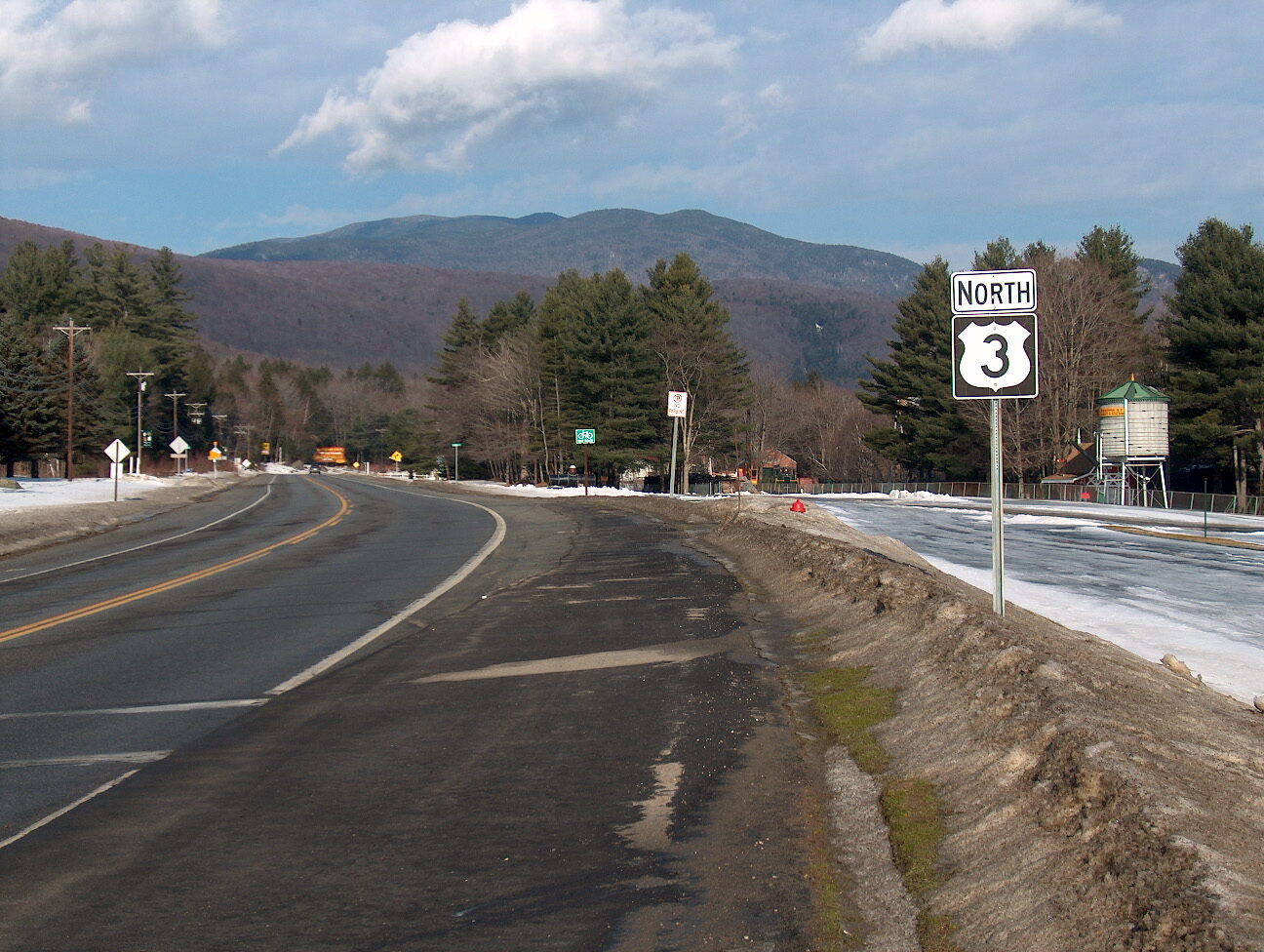
On the night of the nineteenth to twentieth of September 1961, Betty and
Barney Hill of Portsmouth, New Hampshire were driving south on US Route 3
through the White Mountains when they reported a close encounter with an
unidentified object, and afterwards could not account for roughly two hours of
the journey [3]. The US Air Force logged the sighting through Pease AFB into
Project Blue Book, where the stated conclusion shifted across several
explanations before settling on “insufficient data” [1]. The abduction
narrative for which the case is best known emerged later, in hypnosis sessions
conducted in 1963–64 with the psychiatrist Dr Benjamin Simon; the surviving
case papers are held publicly at the University of New Hampshire [5][8][9].
This file separates the three strands deliberately. The Air Force paperwork is
documented. The couple’s account of the drive is reported. The hypnosis
material is later still, and is treated here as testimony about testimony.
Sequence of events
The night of the nineteenth to twentieth of September 1961
- Betty Hill (41) and Barney Hill (39) were driving home to Portsmouth at
around 11:00 pm [3].
- Through binoculars Barney reported that he “saw beings in it looking at
him”, returned to the car, and the couple drove away at speed [3].
- They are recorded as arriving home around 5:00 am, roughly two hours later
than expected. Barney found the tops of his shoes scuffed and burrs in his
cuffs and socks [3].
The official record of the same night
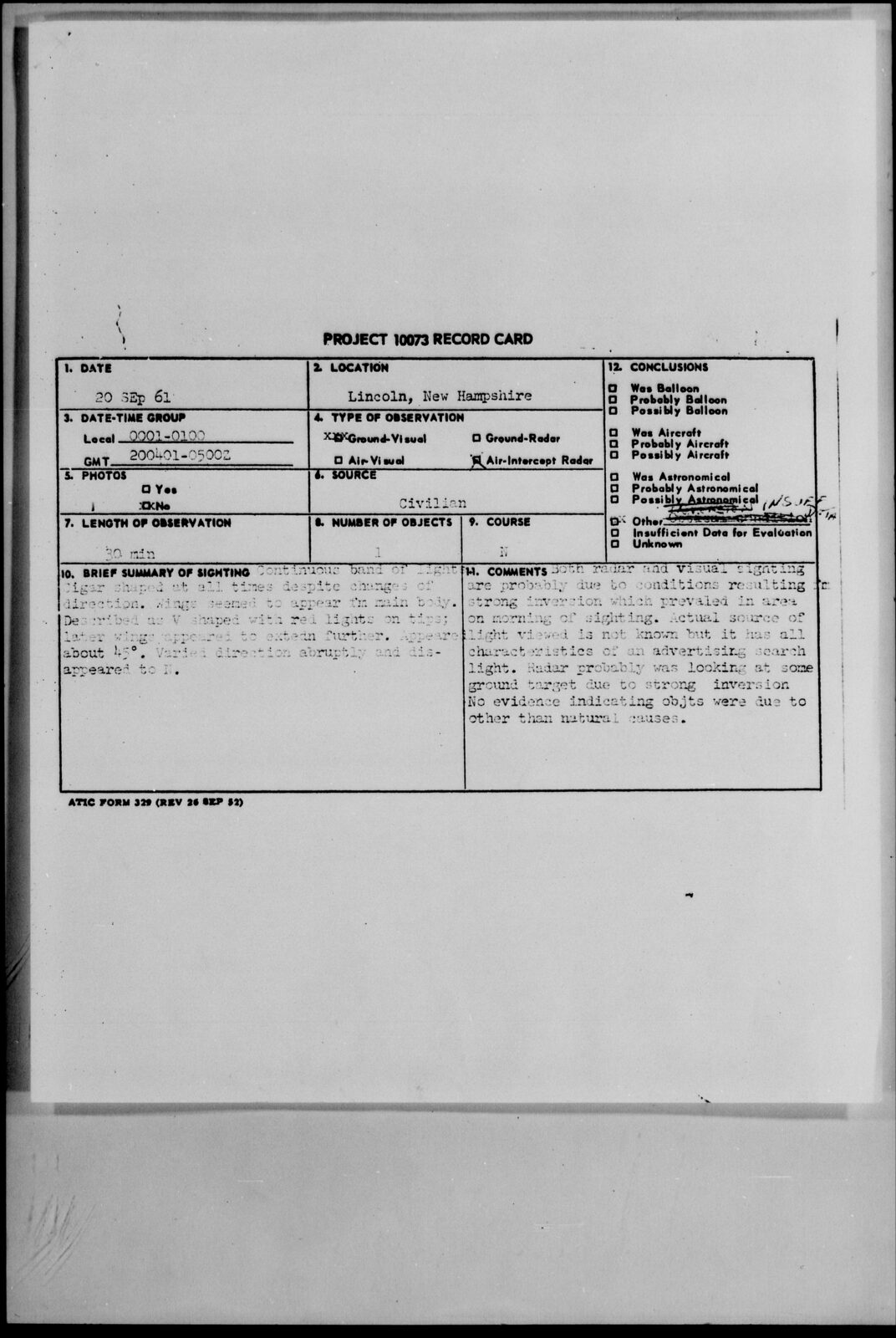
- A visual sighting was logged at Lincoln, New Hampshire on the twentieth of
September 1961, observation window approximately midnight to 01:00, duration
recorded as thirty minutes in the official report; an Air Force release gave
“at least one hour” [1].
- The Air Force description records a “continuous band of lights. Cigar-shaped,”
with wings appearing to extend and red lights on the tips, movements
“descending, ascending, and swooping,” and direction varying abruptly before
it disappeared northward — a description sitting alongside the archive’s other
cigar-shaped craft reports [1].
- Separately, Pease AFB precision approach radar recorded an unidentified
aircraft at 02:14 local (06:14Z) on the twentieth of September. The target
“came on PAR 4 miles out”, made an approach and “pulled up at 1/2 mile”; a
weak target then appeared on the downwind leg before contact was lost. The
report notes “TWR UNABLE TO SEE ANY A/C AT ANY TIME” [1][4].
- A further radar track was logged at N. Concord AFS on the nineteenth of
September at 21:22Z — a single aircraft-sized target at 62,000 ft, duration
eighteen minutes, concluded “probably balloon” [1].
Afterwards
- Ten days after the encounter, Betty is reported to have begun having vivid
recurring nightmares, which eventually led to psychiatric consultation [3].
- Walter N. Webb, a lecturer on the staff of Boston’s Hayden Planetarium and a
NICAP scientific adviser, interviewed the Hills on the twenty-first of
October 1961 and produced a first report and a sixty-one-page final report to
NICAP, both preserved in the Webb/CUFOS files [2][13].
- Barney Hill suffered a cerebral hemorrhage on the twenty-fifth of February
1969 and died the same day, aged 46 [5].
Documentary record
Air Force Information Report No. 100-1-61 was prepared by Major Paul
Henderson at Pease AFB, and an Air Force Intelligence Report dated the
twenty-first of September 1961 is held in the Hill collection at the University
of New Hampshire [1][8]. Captain Robert O. Daughaday, Commander, 1917-2
AACS DIT, documented the radar observation; Major Gardiner B. Reynolds of
the 100th B Wing is named in connection with disclosure of the radar incident;
Colonel Paul J. Slocum, Chief, Electronics Division, handled the Foreign
Technology Division analysis; Major Friend was Blue Book director of the
period [1].
The fullest documentary reconstruction of the official handling is Air Command
and Staff College research study 0450-74, “Radar Tracked UFO At Pease,” which
quotes the Blue Book Project 10073 record cards, the radar teletypes and the
internal correspondence [1]. That study catalogues a series of procedural gaps:
the Pease radar report was not mailed until the twenty-ninth of September 1961,
citing “non-availability of observers for early interrogation”; Foreign
Technology Division was asked for review on the twenty-fifth of September and
answered on the twenty-eighth with a balloon explanation that Blue Book did not
verify against actual balloon launches; Rawinsonde weather data was not
requested until the fifteenth of November 1961, and Lincoln, New Hampshire kept
no such records. Blue Book never re-contacted the Hills personally and never
visited the reported site [1].
The Betty and Barney Hill Papers, MC 197, in Milne Special Collections and
Archives at the University of New Hampshire, hold correspondence, journals,
essays, manuscripts, clippings, photographs, slides and DVDs, together with the
Air Force Intelligence Report, Betty’s 1964 hypnosis-drawn star chart, the
dress she wore, and “Junior”, a commissioned bust. The collection is open by
appointment; reproduction rights are administered by UNH Innovation [8][9].
The Black Vault hosts a laboratory analysis of the dress, a December 2004 DNA
report, and October 2016 comments by Phyllis Budinger [7].
For wider context, the Condon Report (University of Colorado, 1968),
Section VI Chapter 3 by Mark W. Rhine, states that “hypnosis has nothing to
contribute to the routine evaluation of the creditability of the eye-witness”
[11]. Project Blue Book itself ran from 1947 to 1969, recorded 12,618 sightings
of which 701 remain classed “Unidentified”, and was terminated on the
seventeenth of December 1969; its surviving records amount to roughly
forty-two cubic feet of textual material plus ninety-four rolls of 35mm
microfilm (T-1206) [10].
Open questions
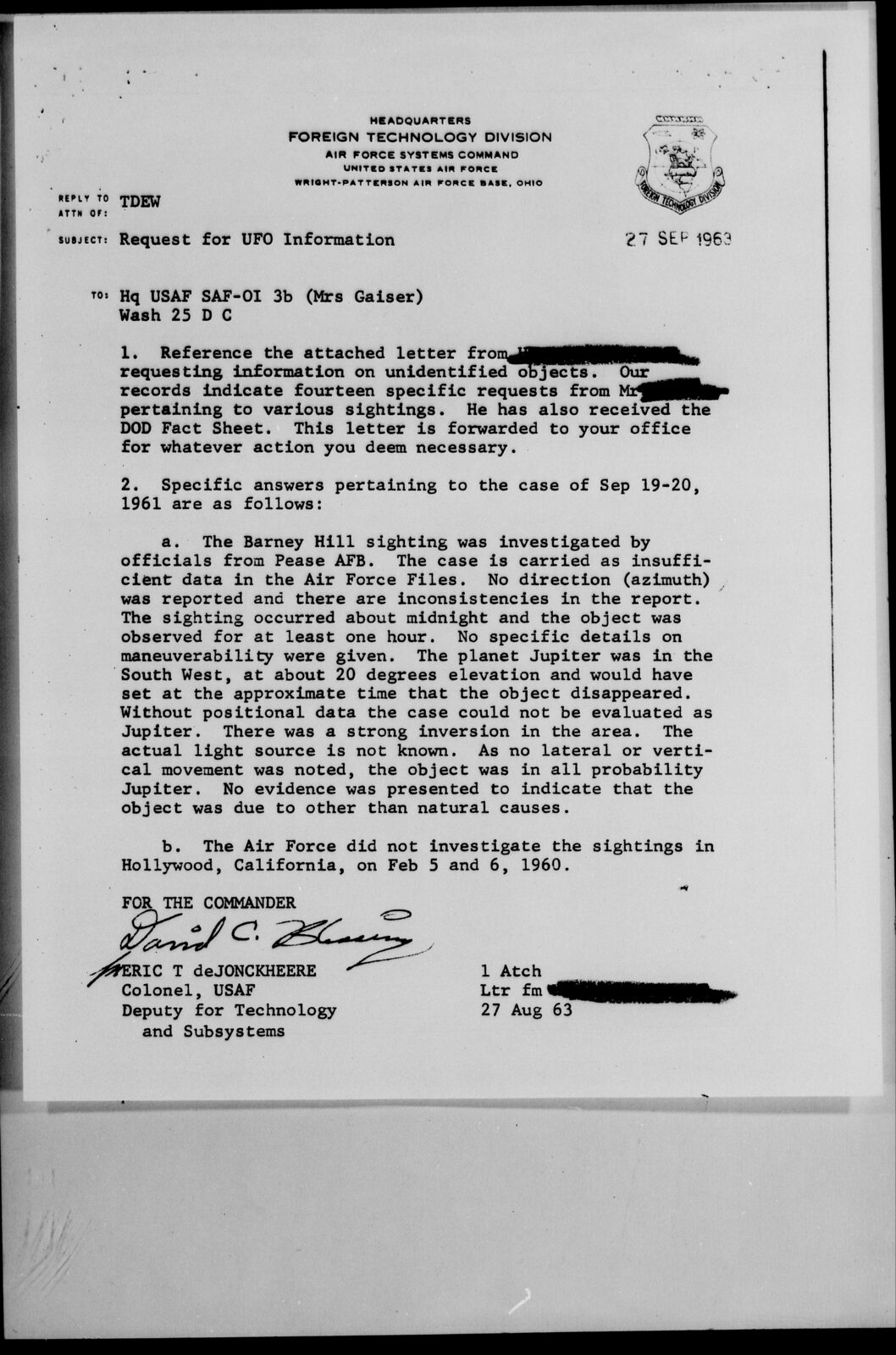
- The primary Blue Book file does not resolve why the stated conclusion
migrated from inversion, to Jupiter, to optical condition, to “insufficient
data” [1].
- No primary document establishes any causal link between the Pease radar
track and the Hills’ visual sighting; the correlation was never investigated
[1][4]. Richard Hall records that internal reports by Walter Webb and John
Oswald concluded the two “probably were unrelated” despite coinciding in
time, and that Betty Hill’s claims of multiple radar sets tracking a UFO and
of pilot chases rested “purely on her memory of verbal statements by
acquaintances” [4].
- The balloon explanation for the N. Concord track was never checked against
launch records [1].
- Dr Benjamin Simon’s own published conclusion about the hypnosis material
could not be obtained from any primary source consulted for this file; the
NICAP article of 1972 names him but does not give his findings [5].
- The external biological material reported on the dress is not identified as
to origin by the analysis [7].
- The widely repeated account that Betty Hill telephoned Pease AFB the day
after the encounter, and that Major Henderson later confirmed to her that
radar had tracked something, appears only in secondary retellings. No primary
document consulted for this file records that call or that confirmation, and
the archive does not carry it as fact.
- The frequently cited total of “two hours” of missing time comes from the
NICAP-derived literature [3]. No primary Air Force document quantifies any
missing interval at all.
Status
This file is CONFIDENTIAL — admitted on the strength of contemporaneous
Air Force documentation: Information Report 100-1-61, the Pease radar
teletypes, and the Blue Book record cards reproduced in Air University study
0450-74 [1]. That documentation establishes a logged sighting, a separate
unexplained radar return, and a demonstrably untidy official investigation. It
does not establish an abduction.
The hypnosis material is recorded here but not treated as primary evidence.
Under hypnosis the Hills are reported to have described humanoid beings roughly
5 ft to 5 ft 4 in tall with “broad foreheads, round faces tapered toward the
chin, dark cat like eyes that extended around to the side of the head”, a craft
with a “curved corridor around the circumference” and wedge-shaped examination
rooms, medical procedures, and communication “via telepathy” [3] — a
description frequently placed alongside the archive’s Greys
material, though the association is later than the case itself. Two proponent
analyses are logged: Marjorie Fish built three-dimensional stellar models
between August 1968 and February 1973 and identified Zeta Reticuli 1 and 2 as
the “base stars” of Betty Hill’s map, while herself noting “slight differences
in line length and angles” in the freehand drawing and that background stars
were added “just to show there were background stars” [6]. Martin Kottmeyer, in
“Entirely Unpredisposed” (Magonia 35, January 1990), argued that Barney’s
wraparound-eyed beings derived from The Outer Limits episode “The Bellero
Shield”, broadcast on the tenth of February 1964 — twelve days before Barney
first described and drew the wraparound eyes in a hypnosis session dated the
twenty-second of February 1964 [12].
The dress analysis remains unverified by this archive. It reports that the
cellulose acetate knit fabric carried “a biologically derived material which is
composed of mostly protein…and a small amount of natural ester-type oil”, with
discoloured pink and magenta areas showing chemical effects on both dye and
fibre, and states that the results “clearly rule out any natural substances
originating from Betty such as urine, perspiration and vomit. This material
came from an external source” [7]. It is a single analysis; no independent
replication has been located.
Secondary reporting states that the New Hampshire Division of Historical
Resources erected state historical marker No. 224 at the site on Route 3 in
Lincoln in 2011. The state marker index could not be reached directly for
verification, and the claim is carried here as reported rather than documented.
References
- Radar Tracked UFO At Pease — Air Command and Staff College research study 0450-74. NICAP / CUFON, hosting the Air University study text. Quotes Blue Book Project 10073 record cards, radar teletypes and internal correspondence.
- The Betty & Barney Hill Case — NICAP case directory. NICAP.
- The Hill Case — The UFO Evidence, Vol. II (Richard H. Hall), pp. 528–529. NICAP.
- Hill Radar-UFO Connection Weak — Richard Hall. NICAP.
- The Enduring Riddle of Betty and Barney Hill — UFO Investigator, April 1972. NICAP.
- Journey Into The Hill Star Map — Marjorie Fish, MUFON UFO Symposium 1974. NICAP / MUFON.
- Analysis of the Dress Worn by Betty Hill During the September 19, 1961, Abduction in New Hampshire. The Black Vault.
- Hill Collection Overview — Betty and Barney Hill Collection. University System of New Hampshire.
- Using the Betty & Barney Hill Collection. University of New Hampshire Library, Milne Special Collections and Archives.
- Project BLUE BOOK — Unidentified Flying Objects. US National Archives and Records Administration.
- Condon Report, Section VI Chapter 3: Psychological Aspects of the UFO Reports (Mark W. Rhine). University of Colorado, 1968; hosted by National Capital Area Skeptics.
- Entirely Unpredisposed: The Cultural Background of UFO Reports — Martin Kottmeyer, Magonia 35, January 1990. Magonia.
- A Dramatic UFO Encounter in the White Mountains, New Hampshire — Walter N. Webb, final report to NICAP (61 pp.). NICAP / CUFOS files.